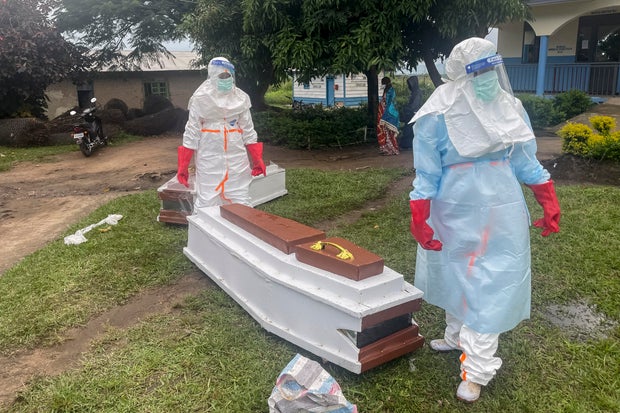
The World Health Organization (WHO) has reported a swift escalation of the Ebola outbreak in the Democratic Republic of Congo. WHO Director-General Tedros Adhanom Ghebreyesus described the situation as “spreading rapidly,” which has led to a “very high” risk at the national level.
Authorities in northeastern Congo have taken preventive measures by banning funeral wakes and limiting gatherings to no more than 50 people. Despite these actions, the UN health agency noted that the threat outside the country remains relatively low. Ghebreyesus stated, “The Ebola outbreak in the Democratic Republic of the Congo is spreading rapidly. We are now revising our risk assessment to very high at the national level.” While the risk is significant within the region, globally the threat is deemed low.
Current reports confirm 82 cases of Ebola within Congo, resulting in seven deaths. However, nearly 750 suspected cases and 177 suspected deaths are occurring, indicating the crisis’s broader impact. Neighboring Uganda’s situation appears stable, with only two confirmed cases and one death linked to the outbreak in Congo.
The provincial government in northeastern Congo has reinforced restrictions, mandating compliance with health guidelines for funerals. Journalists now require permits to report on the outbreak, complicating media efforts. Some community members resist health measures, often due to misinformation or the conflict between medical protocols and local customs.
Incidents of violence have also erupted. An Ebola treatment center in eastern Congo’s Rwampara was set ablaze by locals after authorities refused to release the body of an Ebola victim. This reflects the ongoing struggle between public health directives and traditional practices, such as burial rites.
Efforts to control the outbreak face obstacles in a region that lacks adequate healthcare facilities and where violence is common. Ebola is highly contagious through contact with bodily fluids, and recent health policy mandates that authorities handle burials, causing protests and anger among community members.
Experts underline the urgency of responding to the outbreak. Health personnel and aid organizations urgently need more resources and staff. A vaccine for the virus strain remains unavailable, with estimates suggesting a wait of six to nine months.
Proactive engagement with communities is critical to combating the outbreak. “The priority now is to act quickly and work closely with communities, as the coming days are critical,” emphasized Ariel Kestens from the International Federation of Red Cross and Red Crescent Societies.
Since the first known Ebola death in late April, the virus has gone undetected for weeks, as testing initially targeted a different strain more commonly seen in the country. The WHO has yet to find “patient zero.” The outbreak’s scale indicates an origin some months prior, according to Anaïs Legand, an expert at WHO.
Travel restrictions have been implemented by the U.S., India, and the African Union. The U.S. requires travelers from Congo, Uganda, or South Sudan to undergo screening, while the India-Africa Forum Summit has been postponed due to the health crisis.
Congo’s national soccer team has canceled training and fan events, underscoring the outbreak’s impact on day-to-day activities and global events.
 Early Detection of Atherosclerosis and Heart Disease Prevention
  The Threat of Melting Glaciers: A Call to Action
  Police Discover Ancient Roman Artifacts Off Sardinian Coast
  Church Attendance Linked to Increased Sexual Satisfaction for Married Couples
  Dining with Loved Ones May Benefit Blood Sugar Levels
  Urgent Need for Action in East Africa’s Food Crisis