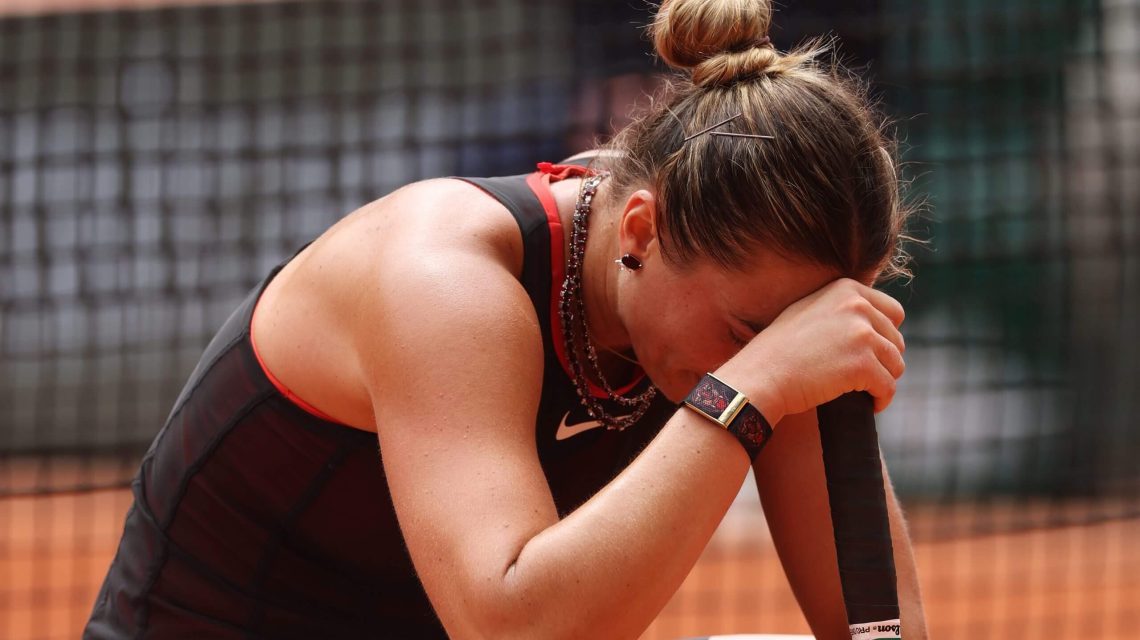
Aryna Sabalenka and her team have developed a routine to handle setbacks in Grand Slam tournaments. After her loss to Diana Shnaider at the French Open, Sabalenka managed to keep her composure and fulfilled her media commitments. Then, alongside her trusted team, she analyzed what went wrong.
Despite being close to a straight-sets win in the quarterfinals, Sabalenka lost her focus and ultimately the match. In the aftermath, she expressed her frustration in a news conference, saying, ‘Right now I just want to quit tennis.’ However, the tight tennis schedule meant there was no time for her to take a break since Wimbledon was only a few weeks away. This pattern is familiar; she faced a similar situation a year ago after collapsing in the French Open final against Coco Gauff.
Jason Stacy, her mental and physical performance coach, remarked that these incidents are less frequent now than earlier in her career. He emphasized that, although these cycles are repetitive, having experienced them helps the team prepare for future challenges. Sabalenka, known for her strong yet sometimes self-destructive gameplay, relies on her team during setbacks.
Long-time experts like Stacy and Anton Dubrov, along with Sabalenka’s physiotherapist Helen Murawska and her fiancé, Georgios Frangulis, were part of the recent debrief. They questioned Sabalenka about her feelings leading up to the match and explored any unnoticed red flags, aiming to learn and improve from the experience. After such events, each team member takes a short break before returning to strategize new methods to support her.
In her first match back, Sabalenka convincingly defeated Teodora Kostović at Wimbledon. This marked a positive step forward. Stacy, who approaches sports psychology with insights from his martial arts background, shared his philosophy: ‘Through loyalty, you gain trust. With trust comes freedom.’ This loyalty encourages athletes to stay true to their discipline.
Sabalenka acknowledged in the foreword of Stacy’s upcoming book ‘The Pressure Code’ that she has learned not to dramatize or overthink situations, instead dealing with struggles openly and moving beyond them.
Following her loss in Paris, Sabalenka revisited her psychologist, whom she had not consulted for three years. She needed an impartial ear to clear her mind before Wimbledon. Despite previous disappointments, she remains focused on her goals.
Sabalenka faced and overcame challenges at various tournaments. For instance, she experienced both victories and defeats against top players like Madison Keys, Mirra Andreeva, Jelena Ostapenko, and Elena Rybakina. Season highs included winning the Indian Wells title and completing the Sunshine Double with a Miami Open victory. Yet, disappointments such as her loss in the Italian Open reflect the unpredictable nature of sports.
Coach Anton Dubrov, with whom Sabalenka has worked for five years, frequently evaluates his role, questioning if a change might benefit her. Despite such introspections, Sabalenka values her team’s stability, emphasizing that they do not panic under pressure.
Max Mirnyi, a consultant who reinforces the idea that perfection isn’t attainable in matches, encourages Sabalenka to adapt to unexpected situations. She faces physical challenges, including hip issues and back pain, which can flare up during competitions. These factors must be carefully managed, particularly on clay and grass surfaces.
Over the years, Sabalenka’s team has maintained consistency, contributing to her resilience. Their collective experience has prepared them to support her through ups and downs, focusing on evolving without unnecessary change.
 Nick Saban’s Comments on ESPN Spark Debate Over College Sports Regulations
  Freddy’s American Adventure: From Soccer to College Football
  Brock Purdy’s Impressive Start in the 2026 NFL Season
  The Value of Retaining Miles McBride for the Knicks
  Penguins Make History with Dominant Season Opener
  Sonny Gray Expresses Frustration After Game Against Yankees