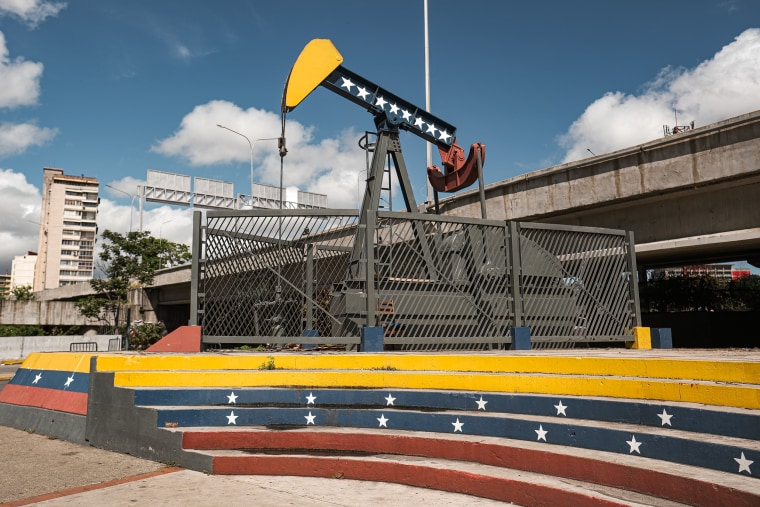
Chevron is expanding its operations in Venezuela following an agreement led by President Donald Trump to develop the nation’s oil reserves. This move includes granting the Pentagon a share in the profits. As the only major U.S. oil company with a substantial presence in Venezuela, Chevron announced it would be increasing its investment in the Orinoco Belt.
The company plans to inject over $7 billion into this initiative over the next five years, aiming to more than double its current production to approximately 600,000 barrels per day. “Chevron’s history in Venezuela spans more than a century, and our expanded position reflects our confidence in the country’s deep resource potential,” stated CEO Mike Wirth.
OPEC’s 2025 Annual Statistical Bulletin indicates that Venezuela has the world’s largest proven reserves, totaling over 303 billion barrels of crude oil. However, despite this abundant resource, the country’s energy infrastructure is severely degraded, and international sanctions further limit its production capabilities.
Venezuela’s daily production is just over 1 million barrels, starkly contrasted with Saudi Arabia’s 10-11 million per day and the United States’ 14 million.
Chevron’s expansion follows a ceremony in Venezuela’s capital, where various energy companies, including Eni, signed agreements with the government’s representatives. U.S. Energy Secretary Chris Wright noted that President Trump’s mission in Venezuela is to foster peace, freedom, opportunity, and prosperity.
This agreement involves collaboration with North American Blue Energy Partners. However, many energy experts remain skeptical, foreseeing that years of neglect have left Venezuela’s oil industry in tatters, necessitating extensive reconstruction.
Additionally, there are legal concerns regarding the authority of Venezuela’s acting president, Delcy Rodríguez, to provide NABEP a 100-year lease on oil fields containing 65 billion barrels of reserves. The deal’s legitimacy is questioned as it bypassed approval from Venezuela’s National Assembly.
Wright countered the criticism, asserting that the deal offers significant benefits for both the U.S. and Venezuela. He emphasized the potential to exploit underground resources for the betterment of both Venezuelan and American energy needs.
Despite Trump’s excitement over U.S. companies entering Venezuela, skepticism remains. R. Vásquez from the Cato Institute wrote, The agreement lacks legitimacy due to its negotiation with a longstanding dictatorship.
There is persistent hesitation among U.S. oil majors regarding investment in Venezuela, mainly due to its history of nationalizing the oil sector. For example, in 1976, Venezuela created Petróleos de Venezuela S.A., and later in 2007, President Hugo Chávez compelled foreign companies into joint ventures, seizing assets from non-compliant firms.
While Trump stated that the new agreement might lower U.S. gasoline prices, experts argue that Venezuela’s outdated infrastructure requires decades of investment. Amy Jaffe, from New York University, indicated, New facilities in Orinoco could take 2 to 4 years to activate.
Amid these developments, U.S. gasoline prices have risen, with the national average for a gallon jumping to $4.12, a significant increase from the previous year, according to AAA.