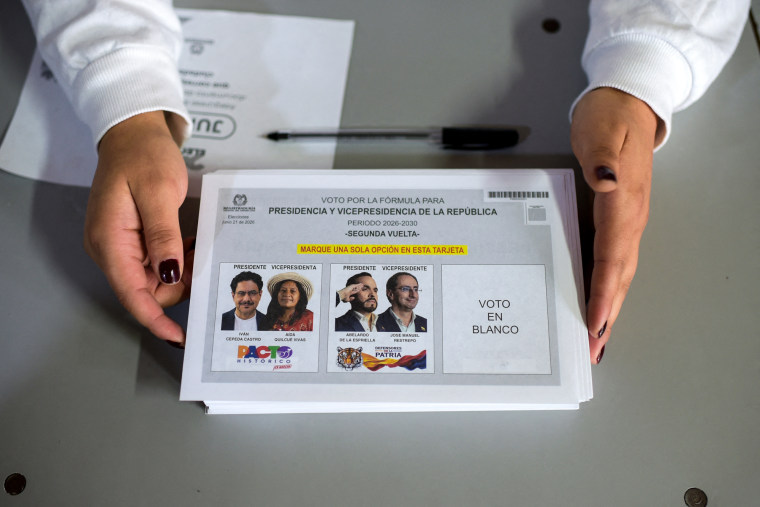
In Colombia, voters face a crucial decision in a presidential runoff marked by stark choices and potential consequences. The contest pits businessman and lawyer Abelardo de la Espriella against Iván Cepeda, who is backed by outgoing President Gustavo Petro’s political movement. Petro is Colombia’s first leader from the left.
Both candidates have reached this stage after surpassing nine others in a vote held on May 31. They each propose strategies to prevent a return to the widespread violence that once plagued the nation. This chaos included car bombs, kidnappings, disappearances, and forced displacements.
De la Espriella advocates for a forceful approach, earning the endorsement of former U.S. President Donald Trump. In contrast, Cepeda aims to continue Petro’s focus on dialogue with illegal armed groups, despite limited success so far.
The election also highlights differing views on Colombia’s health system, public debt, and corruption. A worker prepared electoral materials at a polling station in Bogota as the nation readied itself for this decision.
“Right now, what worries me is the polarization that exists between us: there are two very extreme sides, and the violence is concerning,” said John Manrique, a lawyer from Bogota, walking his dog.
The first round ended with Cepeda receiving 41% of the vote and de la Espriella obtaining 44%, official results show. Petro, without evidence, questioned the results when Cepeda, who had led in polls, did not win outright.
This election takes place a decade after Colombia signed a peace agreement with the FARC guerrillas, aiming to end persistent conflicts. Nevertheless, violence has surged again, driven by factions choosing drug trafficking over ideological battles.
Last year, Colombia saw 14,780 homicides, the highest since at least 2015, largely due to clashes among illegal armed groups. A notable victim of this violence was conservative presidential candidate Miguel Uribe. Extortion cases have also increased dramatically, with 13,417 reported in 2025, doubling the number in 2015.
Over 41 million Colombians are eligible to vote in Sunday’s election. De la Espriella, labeled as “The Tiger,” promises aggressive criminal crackdowns, inspired by El Salvador’s President Nayib Bukele’s tactics of constructing mega-prisons.
Cepeda remains dedicated to Petro’s “total peace” initiative, seeking agreements with guerrilla and criminal factions. After launching in 2022, the approach only recently led to one group, consisting of about 100 members, disarming. Colombia’s illegal armed groups involve more than 27,000 people.
“The left has always been viewed negatively; it has been harsh, and many people have died,” said retired teacher Yamile Guevara, a Cepeda supporter. She argued that more time is required for Petro’s strategies to show results.
The campaign leading up to the runoff has been rife with verbal confrontations and allegations of misconduct, including fraud and intimidation.
Cepeda lodged a complaint with the Colombian Attorney General’s Office and the International Criminal Court, alleging de la Espriella’s ties to paramilitary groups. De la Espriella refutes these claims, as both candidates continue their fight for Colombia’s future.
 The Trump Team’s Challenge to the Military Leadership
  Maryland First State to Restrict Electronic Pricing in Grocery Stores
  British Police Arrest Man Suspected of Terror Plot
  Activists Push for Nationwide Ban on Child Marriage in the U.S.
  Democratic Hopes and Historical Warnings in 2026 Senate Race
  Republicans Face Challenges Amidst Cost of Living Concerns