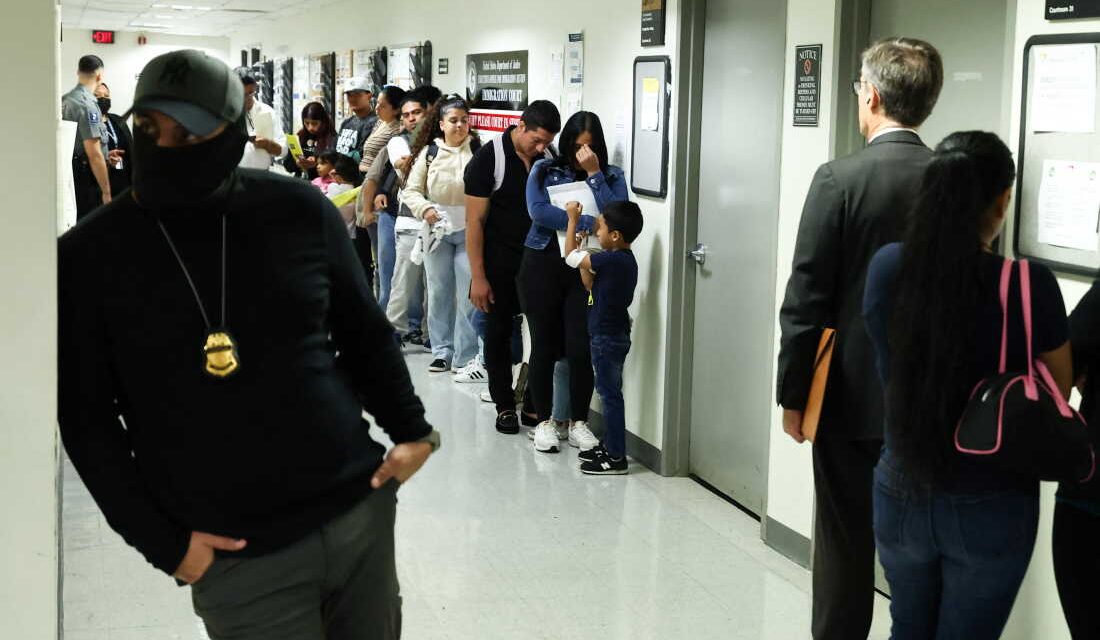
In October 2025, many individuals gathered at the New York Federal Plaza Immigration Court. Immigrants have received sudden notifications about new in-person hearings at previously undisclosed locations. This has been reported by five immigration attorneys who reviewed the notices and shared their observations with NPR.
This last-minute change seems to be part of a broader strategy by the Trump administration. The aim is to reduce immigrants’ due process rights, speeding up arrests and deportations. Over recent weeks, immigrants who were set for hearings in Maryland’s Hyattsville and Baltimore courts, as well as Virginia’s Sterling court, have been rescheduled to venues in Washington, D.C., and Falls Church, Va. Neither location is currently equipped for in-person hearings. The Washington site does not even list an affiliation with the Justice Department; it is occupied by the Federal Emergency Management Agency.
Immigrants have been notified of these location changes only days before their appointed hearings. In some cases, NPR has identified individuals who weren’t notified at all. Kel White, an officer from the D.C. chapter of the American Immigration Lawyers Association, attended such a hearing this week. She noted that appearing at an unusual location, with a judge and prosecutor attending remotely, was unprecedented in her 15 years of practice. White criticized these changes, stating they breach Justice Department regulations, which require at least ten days’ notice.
The attorneys involved have observed that these surprise notices often target immigrants without legal representation. Most immigrants defending their right to stay in the U.S. lack access to a lawyer. Failing to attend a scheduled hearing, even inadvertently, can result in an ‘in-absentia order of removal,’ permitting detainment and deportation.
The Executive Office for Immigration Review (EOIR), a branch of the Justice Department, runs about 60 courts and adjudication centers. EOIR stated that with the addition of new judges, they are making scheduling adjustments, promising timely and lawful case handling. However, they did not clarify the legitimacy of these new hearing locations. The Trump administration has been eager to reduce a backlog of approximately 3.5 million cases, questioning the credibility of many.
White attended a hearing at the Falls Church site, within a government building that houses EOIR headquarters and the Board of Immigration Appeals. The venue is not traditionally used for in-person hearings. White described the setup of the hearing, where a judge and an attorney appeared remotely, and several individuals were deported for not showing up. She highlighted the inequality in requiring immigrants to appear in person while officials engage remotely.
The new Washington location at Federal Center Plaza lacks DOJ courtrooms and EOIR facilities. The General Services Administration has made no comment on DOJ’s space usage. Two anonymous sources informed NPR of a GSA ‘surge’ to secure space for DOJ by December, with no public announcements regarding new sites or conversions.
One immigrant scheduled for a September 2 hearing in Falls Church did not receive a mailed notice. Instead, the app MigraConnect flagged a date change, allowing them to attend. The immigrant expressed gratitude for the app, highlighting the risk of deportation due to lack of notice.
Typically, immigrants are assigned to courts near their listed addresses. Establishing a new court should involve a public announcement, neither of which occurred for these recent adjustments. Instances arose where immigrants had to cross state lines for hearings relocated from their original, closer courts.
Attorney Lucelia Justiniano recounted a case involving a Maryland resident reassigned to Falls Church with an earlier date. Despite contacting the court, they were informed of a new center, active since August 24. The client’s original judge presided remotely from Hyattsville, without explanation.
Attorney James Reyes, with 15 years of experience, faced multiple reschedules for a client now appearing in Falls Church. Doubting the situation, he expected a glitch. Once designated as the client’s lawyer, the case returned to Sterling, with further date unspecified.
Over the past year, the Trump administration has expedited final removal orders in immigration courts. These sudden location shifts are part of broader tactics speeding court proceedings. Nationally, judges schedule ‘mega master calendar’ hearings where over 100 immigrants, many unrepresented, are processed, often resulting in removal if absent. Consequently, in-absentia deportations have reached record levels, while asylum approvals drop. Attorneys highlight these tactics mainly target unrepresented immigrants, complicating notice of new hearings.
Statistics underscore this trend. In Baltimore, in-absentia removals for unrepresented immigrants increased from 54% to 73% by June, according to Mobile Pathways, which tracks immigration court data. Justiniano expressed concern, stating the last-minute notices exemplify obstacles faced by those defending against removal.
 Defense Secretary Emerges as Key Player in the Trump Administration
  Hegseth’s Vision for the Military: Balancing Tradition and Innovation
  Significant Funding Boosts Ken Paxton’s Texas Senate Campaign Amid Tight Race
  U.S. States Extend Gas Tax Waivers Amid Rising Fuel Costs Due to Iran Conflict
  USCIS Raises Immigration Fees
  The Surveillance Threat to U.S. Federal Agents