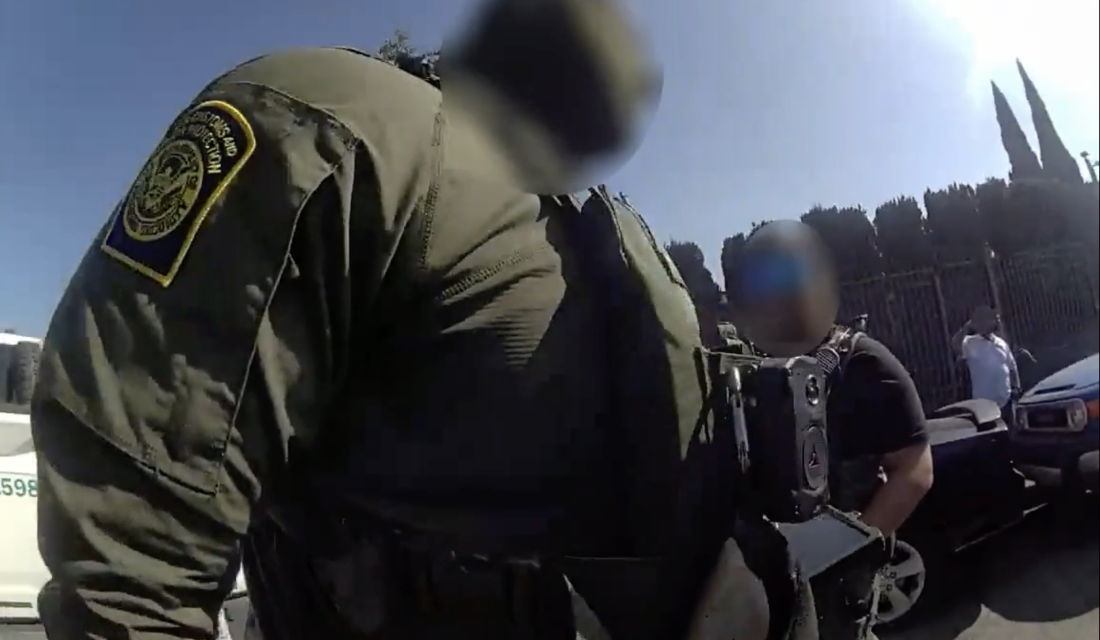
Federal immigration officers in Los Angeles County faced allegations of using racial slurs caught on bodycam footage during a raid last year. This footage, obtained by the ACLU as evidence in a federal lawsuit, reveals troubling behavior by the officers.
The bodycam footage includes an incident where an agent, while leaving the raid scene, used a racial slur to describe a man he saw. He referred to a Latino man using a pejorative term. Another piece of footage features an agent using “tonk,” a derogatory term related to striking a migrant’s head with a flashlight.
The terms “wetback” and “tonk” have been discouraged by Border Patrol supervisors. The ACLU and other civil rights groups are using this footage in a lawsuit accusing ICE and Border Patrol of racial profiling. This lawsuit challenges the legality of targeting individuals based on Latino appearance in executing mass deportation policies under President Trump’s administration.
The Supreme Court has preliminarily supported Trump’s stance, albeit civil rights attorneys continue to compile evidence showing potential legal violations by the agents.
We now know that the only evidence that those agents used to stop an individual was to racially profile and to identify people on the street who appear to look Latino and working class,
said ACLU’s attorney Mayra Joachin.
The Department of Homeland Security denies the allegations of racial profiling. However, in a legal battle initiated last year, the ACLU argues that ICE and Border Patrol officers were targeting individuals based on appearance, job type, and spoken language. A federal judge initially supported these claims, but the Supreme Court overturned this decision.
Justice Brett Kavanaugh acknowledged agents might use “apparent ethnicity” to form suspicions, combined with other factors like job types prevalent among undocumented workers and language spoken. However, he clarified stopping or arresting based on race or ethnicity alone is unacceptable.
In recent months, civil rights attorneys have been gathering evidence to strengthen their case. The Los Angeles federal judge, Maame Ewusi-Mensah Frimpong, ordered the Department of Homeland Security to provide bodycam footage and communication records to assess the agents’ decision-making process.
The Department of Homeland Security insists their operations are precise, targeting known individuals, despite claims against them.
The ACLU contends that the footage and documents contradict DHS claims, citing internal communications where agents used derogatory language, describing people as “tonks” and “wet.” They also reportedly used terms like “stupid” to refer to individuals photographed during these operations.
One particular bodycam video from an operation where US citizens were mistakenly detained captures an agent commenting on a “tonk” who evaded capture. A detainee later became a plaintiff in the lawsuit, accusing agents of racial profiling based on Mexican appearance.
Attorneys have petitioned Judge Frimpong for imposing new restrictions on immigration officers. The ACLU wants written documentation from agents explaining the reasons for suspecting individuals of lacking legal status, arguing failure to do so violates constitutional protections against unreasonable searches and seizures.
According to Joachin, prior knowledge, not appearance, should form the basis for detaining individuals, stressing the need to clearly exclude race as a suspicion factor.
The Department of Homeland Security, responding to NPR inquiries, focused instead on criminal activities involving undocumented immigrants, defending the agents’ priorities without directly addressing the provided footage. Yet, these allegations and the evidence gathered will be pivotal when ACLU attorneys present their case to Judge Frimpong seeking an injunction.