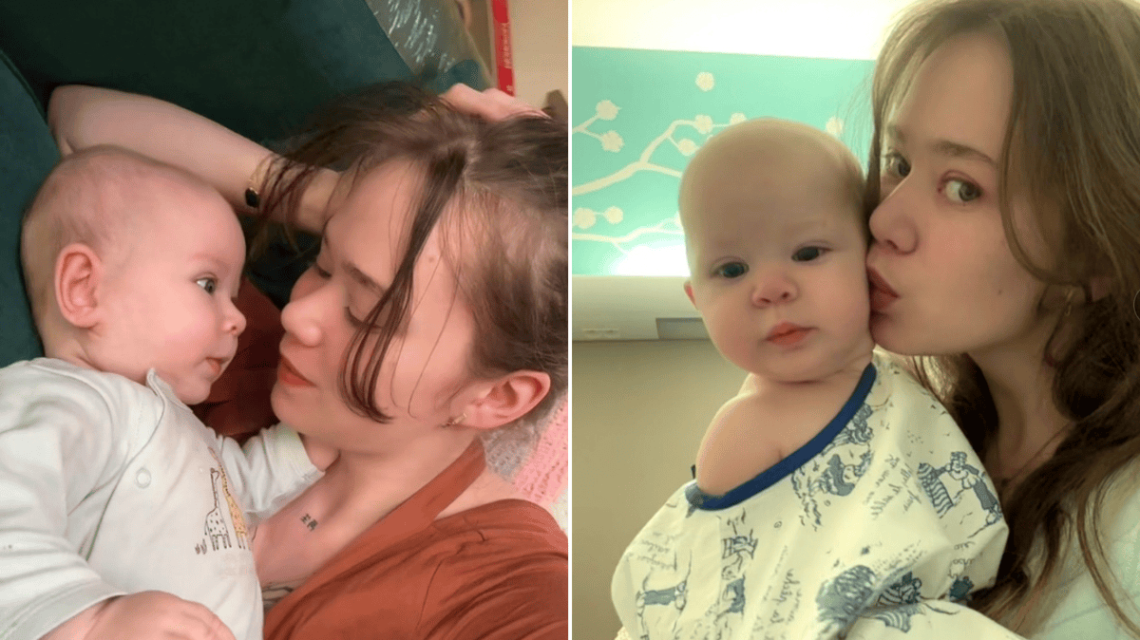
Marcelle Miller experienced profound shock after her three-month-old daughter was diagnosed with a rare congenital condition. Up until that moment, Miller’s pregnancy had been near perfect. She remarked, ‘My pregnancy went really well. I had a slight placental hematoma that resolved with rest, no morning sickness. It was like a dream pregnancy.’
At the age of 22, Miller embraced motherhood while thriving in her career as a realtor in Europe. Her daughter’s birth was a smooth process; after 42 weeks of waiting, 21 hours of labor, and a brief seven minutes of pushing, a happy and healthy baby arrived. Miller described it as ‘everything was perfect.’
However, three months later, Miller noticed something concerning. ‘I started seeing a small cloudy ring in her right eye,’ she explained. Though faint, she couldn’t ignore it and decided to seek a medical evaluation.
After researching online, Miller discovered congenital cataracts, a rare condition where a baby is born with a cloudy lens in one or both eyes. Affecting approximately three to four in every 10,000 births in the U.S., it can lead to vision issues, a white pupil, and eye misalignment. Treatment typically includes surgery during infancy, followed by glasses, contact lenses, or additional therapies to support visual development.
‘I was really hoping it was something else,’ Miller recalled.
Her worst fears were confirmed weeks later when a doctor diagnosed her daughter with bilateral congenital cataracts. ‘My entire life came crashing down. I think I cried for a week straight,’ she said, feeling as if her daughter’s future was uncertain and restricted.
Miller expressed her grief over the imagined future for her daughter. ‘As parents, we all have hopes and dreams for our children. We want them to have it all, to never be limited,’ Miller acknowledged. She had to mourn the life she envisioned, overwhelmed by the unknowns.
Congenital cataracts may stem from genetic mutations, inherited conditions, pregnancy infections, metabolic disorders, or complications in prenatal eye development. Often, doctors can’t pinpoint an exact cause. Ongoing investigations suggest a genetic mutation linked to Miller’s daughter’s father might play a role in her condition.
Miller quickly acted to secure necessary treatment for her daughter. ‘The condition is serious,’ she stated. After diagnosis, her family was referred to a specialist for more targeted care. She noted, ‘Congenital cataracts have specific pathology that appears in various ways and require prompt treatment.’ Since light couldn’t fully pass through her daughter’s eyes, early intervention was essential to prevent impaired visual development.
Her daughter underwent four surgeries, where clouded lenses were replaced with artificial ones. Following surgery, her daughter will need visual aids like glasses or contact lenses. In cases of a unilateral cataract, therapies like eye patching may be used to strengthen the weaker eye.
While Miller’s daughter doesn’t currently wear glasses, she needs contact lenses. ‘Her eyesight is plateauing, but it’s not noticeable if you’re unaware of her condition,’ Miller said.
Miller reflects on how the diagnosis affected her more deeply than her daughter. ‘She was so little during surgery, but seeing her in that state broke something inside me,’ Miller admitted. Despite the likelihood of future surgeries, she remains hopeful that her daughter will lead an unrestricted, normal life.
She encourages other parents in similar situations to take solace in her daughter’s story, believing their children’s futures remain bright. ‘I’ve seen sad, crying parents worried about what’s ahead for their kids. I’ve been there. I know the fear and heartbreak of receiving that diagnosis,’ Miller shared. ‘Our children will have normal lives. It’s us, the parents, who need to adjust our expectations.’
 The Journey from Abandonment to Rediscovery
  Pancreatic Cancer Survivor Shares Journey and Hopes for the Future
  Understanding the Rise of Family Estrangement
  Remembering Mike Ditka: Football Legend and Iconic Coach
  National Protest Rallies Support for Cornell Student’s Assault Case
  Addressing Alzheimer’s: An Urgent Necessity