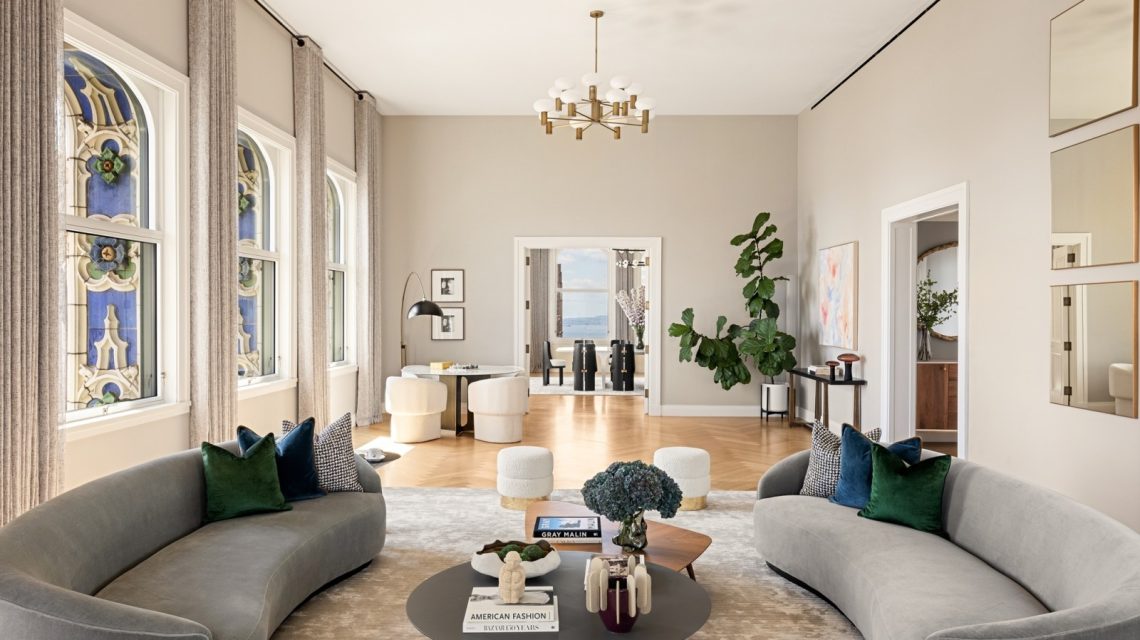
New Yorkers and others can now own a rare piece of history at the top of one of the city’s iconic landmarks, The Woolworth Building. Designed by Cass Gilbert, a renowned architect known for the U.S. Supreme Court Building, the Woolworth Building was completed in 1913. At 792 feet tall, it was the tallest building in the world that year, according to the Skyscraper Museum. Located in Tribeca, Lower Manhattan, this Gothic-style skyscraper includes luxury residences, such as Residence 40 on the 40th floor, now for sale at $18.5 million.
Frank W. Woolworth, founder of the Woolworth Company, had his private office transformed into a sprawling 4-bedroom, full-floor home. Spanning over 6,000 square feet, the residence offers views from 516 feet above City Hall Park. It is the only unit in the building with 15-foot ceilings and original polychromatic terra-cotta window detailing.
What makes Residence 40 truly special is that it’s not just a spectacular apartment, it’s a piece of New York history.
Catherine Juracich from The Corcoran Group, the lead real estate agent for the listing, emphasizes its architectural significance blended with modern luxuries. Michelle Griffith, a broker at Douglas Elliman, echoes this sentiment. She notes that few buildings have more cultural and architectural weight than the Woolworth Building, marking it as one of Gilbert’s crowning achievements.
A Growing Trend in Adaptive Reuse Buildings
The Woolworth Building’s residential sale follows an upward trend in converting historical buildings, notably in New York City. The Flatiron Building, a 1902 skyscraper, is one such example, now being converted into luxury apartments. Recently, plans to transform the Brooklyn’s 1909 Hotel Bossert into Ritz-Carlton Residences were disclosed.
This trend reflects a growing call for adaptive reuse and enhancing existing structures over new constructions. RentCafe data indicates that nearly 25,000 apartments emerged from repurposed buildings in 2024, a 50% increase from the previous year.
Architect Gordon Gill, known for the Jeddah Tower in Saudi Arabia, mentioned that the U.S.’s greatest innovation lies in city programming. Rethinking existing assets is essential for sustainability and avoiding obsolescence. The American Institute of Architects reports that almost half of America’s 125 million buildings are over 50 years old, indicating vast opportunities for transformation. Reusing buildings can eliminate 50 to 75% of new construction carbon emissions.
Rising Demand for Historic Residences
Juracich observes growing interest in homes within historic landmarks, as today’s luxury buyers seek properties with character, history, and a unique story. Structures like the Woolworth Building and Flatiron Building offer unmatched craftsmanship and authenticity that are rare in new constructions.
Older buildings have a connection back to historical detail, materials, and a quality of construction that creates a rich environment and would be difficult or too costly to replicate today.
Architect Eric Robinson from RODE Architects in Boston agrees. Preserving historical elements while adapting for modern living results in homes with warmth and distinct character. RODE is revitalizing a Boston building from the early 1900s, originally a stable and blacksmith shop, into 44 residences.
Location drives the demand as well. Many historical structures are in desirable downtown areas with close access to amenities. In cities like Boston, the challenges of new builds motivate conversions, supported by streamlined permitting and tax incentives.
Michelle Griffith notes that preferable buyers value historic properties for their singularity and provenance, unattainable in new constructions. These conversions merge history and modern luxury, offering buyers a chance to own a piece of a legendary story.
 Coby White Sells Lincoln Park Mansion for $5 Million
  Downtown Skokie Hotel Development Sees New Interest from Murphy Development Group
  The Impact of Baby Boomer Real Estate Transition on U.S. Housing
  Navigating the Challenges and Opportunities of Condo Ownership in California
  Understanding Alaska’s Housing Shortage Amidst Stagnant Population Growth
  Navigating Los Angeles Real Estate on a Budget