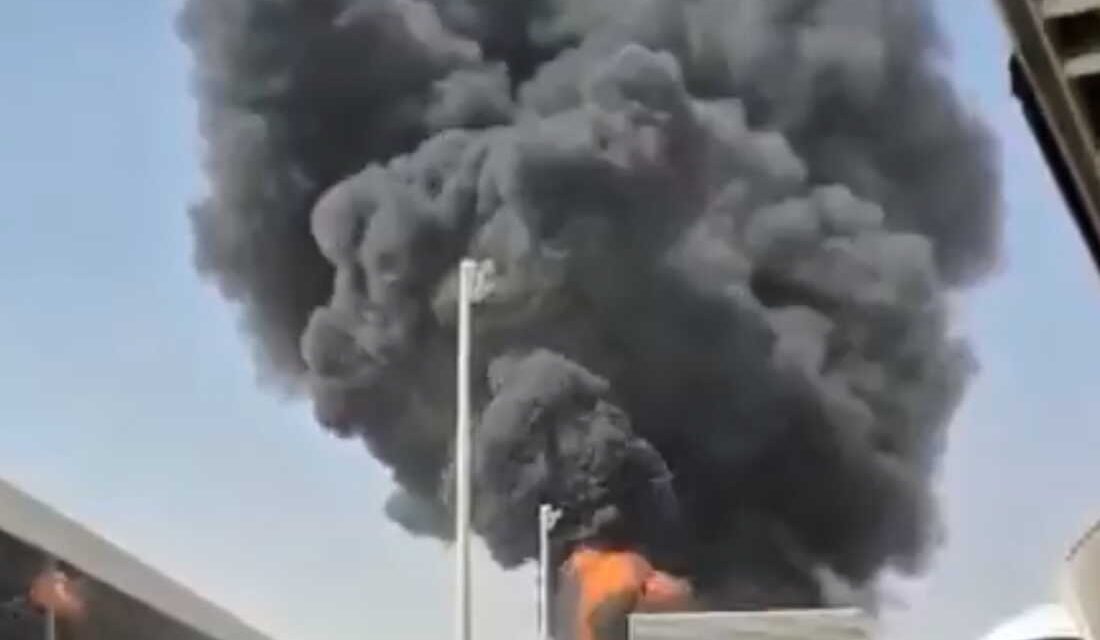
On October 9, 2026, thick black smoke and flames were seen rising from a fire at King Khalid International Airport in Riyadh, Saudi Arabia, as reported by civil aviation authorities. The catastrophic attack resulted in the deaths of 12 individuals and injuries to over 300 more, with several in critical condition.
This incident marks the deadliest attack in a Gulf Arab country since the commencement of the Iran war, exacerbating the ongoing conflict between Yemen’s Iran-backed Houthi rebels and the Saudi-supported government forces.
Among the deceased were four Saudi citizens, as well as nationals from Bangladesh, Palestine, the United States, Egypt, Jordan, Syria, and Sudan. The injured are currently receiving treatment at various medical facilities.
The attack, one of several recent incidents targeting the airport that previously claimed four lives, increases pressure on Saudi Arabia’s allies, including the United States, for military aid. In response, President Donald Trump expressed openness to consider joining Saudi strikes against the Houthis, stating, “We may. We’re going to look at it.”
A regional official disclosed, under anonymity, that a missile struck the airport complex at terminals 3 and 4 catering to domestic flights. In the previous week, attacks on Saudi airports, military facilities, and oil infrastructure have surged following a major military offensive by the Saudi-led coalition against the Houthis.
The Houthi rebels have yet to claim responsibility for the attack. They have alleged that Saudi Arabia targeted Sanaa International Airport in Yemen, often delaying claims of responsibility for attacks.
The chaos at Riyadh’s airport led to its operations being suspended, with authorities blocking entrances and dimming lights around the airport complex. Flights were redirected to other locations, as reported by Flightradar24. Several countries, including the United States, Britain, Germany, Australia, and Canada, have issued warnings for their citizens to avoid the airport.
The Saudi-led coalition later reported the interception of a Houthi-launched ballistic missile in Al-Kharj governorate, southeast of Riyadh, and stated that a projectile landed near King Fahd International Airport in Dammam.
Despite the attacks causing volatility in the region and market instability, Saudi Arabia’s energy ministry continued to promote an international energy conference scheduled to start in Riyadh shortly after the attack.
As the conflict intensifies along Yemen’s Red Sea coast, the Saudi-led coalition is providing robust air support to government forces trying to reclaim territory from the Houthis. The Red Sea corridor is critically strategic, providing an alternative route to the Strait of Hormuz, a site of frequent Iranian attacks on commercial shipping.
The Houthis have previously targeted Saudi shipping, asserting retaliation for a blockade imposed upon them. There are concerns that these attacks may widen in scope, spurred by tensions following the Gaza war, which they had responded to by attacking ships.
Saudi Arabia is reportedly running low on missile interceptors and has sought air defense assistance from France, Britain, Pakistan, and Egypt. This comes in light of dwindling stocks globally, exacerbated by the Iran war.
The diplomatic push for de-escalation continues, with Saudi Arabia’s foreign minister having discussed regional tensions and the need for diplomatic resolutions with Oman.
The risk of flight disruptions grows as the Houthis threaten global airlines, warning against operations in Saudi airspace, labeled as a military operations zone. This warning has led several airlines, including Air India, FlyDubai, Lufthansa, and Pakistan International Airlines, to suspend flights temporarily.
The EU Aviation Safety Agency extended guidance on Saudi airspace in light of the increased missile and drone strike capabilities of the Houthis.
Recent Houthi attacks have already resulted in damage to aircraft at Riyadh airport, evidenced by a Saudi national carrier plane being damaged while parked with no passengers onboard.
Authorities have cautioned the public against filming or sharing information regarding missile and drone attacks, citing legal penalties.
Anna reported from Jerusalem, and additional contributions were made by Victoria Eastwood in Cairo, Collin Binkley in Washington, and Sally Abou AlJoud in Beirut.
 Bill Maher Criticizes Zohran Mamdani’s Response to Oct 7 Anniversary
  Riyadh Airport Hit Amid Rising Conflict and International Response
  Tiger Attack at Yorkshire Wildlife Park Sparks Investigation
  Strike on Riyadh Airport Leaves 12 Dead, 309 Injured
  Gaza’s Painful Recovery Efforts Amidst Devastating Conflict
  Trump Criticizes Nobel Committee Over Peace Prize Decision