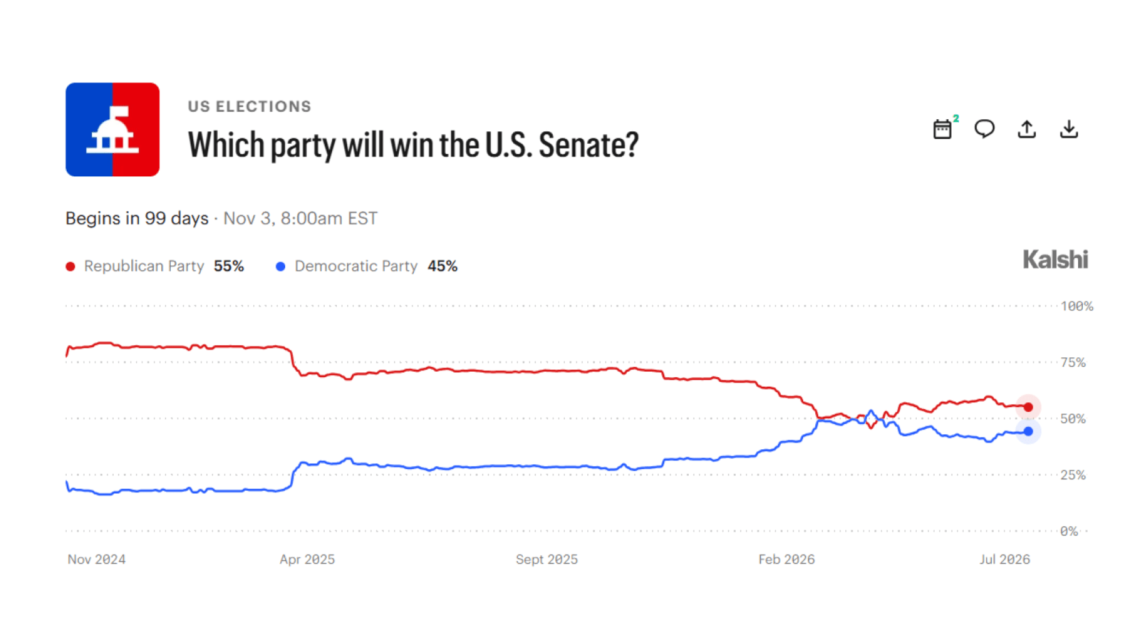
With only 100 days remaining until the 2026 midterm elections, prediction markets provide indications that Democrats have a potential, though not assured, route to regain control of the Senate. Currently, Republicans hold a 55-45 majority, necessitating Democrats to achieve a net gain of four seats to secure outright control. This dynamic arises because Vice President JD Vance would cast a deciding vote in any 50-50 tie favoring Republicans.
Kalshi’s 2026 Senate election guide emphasizes that Democrats must secure 51 seats to claim control based on these numbers.
Key Battleground States
Democrats’ most straightforward path involves focusing on four Republican-held seats: Alaska, Maine, North Carolina, and Ohio. The Cook Political Report categorizes Alaska, Maine, and Ohio as “Toss Ups,” suggesting that both parties have realistic chances of winning. North Carolina is evaluated as Lean Democrat, indicative of a competitive race wherein Democrats possess a slight advantage despite the seat being currently held by the GOP. Additionally, Cook rates Michigan—a Democratic-held open seat—as a Toss Up, indicating potential for Democrats to flip several Republican seats while potentially losing ground there.
Prediction Markets Overview
Prediction markets mirror this uncertainty. Kalshi’s Senate markets currently favor Democrats in Alaska, Maine, and North Carolina, with Ohio remaining uncertain. Similarly, Polymarket’s midterms board presents Democrats as leading in Maine and Alaska, with North Carolina and Ohio Senate races effectively neck-and-neck, each granting Democrats a 50 percent chance of victory. Analyzing Senate control as a whole, Polymarket still projects Republicans with a 56 percent probability of retaining control compared to 44 percent for Democrats.
It is essential to recognize that prediction markets capture investor sentiment and trading activity rather than scientific public opinion polling of registered voters.
State-Specific Analysis
Alaska: In Alaska, Kalshi estimates a 55 percent likelihood for Democrats to win the Senate race, while Republicans are at 45 percent. Polymarket echoes these numbers, granting Democrat Mary Peltola a 57 percent chance in the race. Mixed polling presents a competitive landscape, with a New York Times/Siena University poll conducted from June 15-29 showing Republican Senator Dan Sullivan slightly ahead of Peltola, capturing 47 percent to her 45 percent among likely voters. Conversely, earlier polls by Alaska Survey Research have depicted Peltola leading, including a June 4-7 survey that had her ahead of Sullivan, 49 percent to 44 percent.
Maine: Maine, another Republican-held seat, currently favors Democrats according to prediction markets. Kalshi lists a 64 percent probability for Democrats to win here, while Polymarket concurs with a 67 percent chance for Democrats. The polling landscape indicates competitiveness for Republican Senator Susan Collins, as revealed by a University of New Hampshire Survey Center poll conducted from July 15-20, indicating Democrat Troy Jackson leading Collins 49 percent to 46 percent.
North Carolina: North Carolina emerges as potentially the most promising opportunity for Democrats among the GOP-held battlegrounds. Kalshi places Democrats at a 90.5 percent likelihood of victory here, with Democrat Roy Cooper posed to best Republican Michael Whatley. In contrast, Polymarket rates North Carolina as a Toss Up at 50 percent. Consistent polling has shown Cooper in the lead, with a Public Policy Polling survey from July 9-10 indicating a 48 percent to 44 percent lead over Whatley and a New York Times/Siena University poll from June 15-27 showing Cooper at 50 percent to Whatley’s 43 percent. Cook acknowledges North Carolina as Lean Democrat, which is atypical for a GOP-held seat in the analysis group not listed as a Toss Up.
Ohio: Ohio features the highest level of uncertainty among the four GOP-held targets. Kalshi gives Democrat Sherrod Brown an equal 50 percent chance of triumphing compared to Republican Senator Jon Husted. Polymarket similarly classifies Ohio as a Toss Up with Democrats at 50 percent. Diverse poll results emerge here, with a New York Times/Siena University poll from June 15-28 showing Husted leading Brown 50 percent to 47 percent, while an AARP poll by Fabrizio, Lee & Associates and Impact Research conducted June 14-16 found Brown ahead 48 percent to 45 percent. A Tulchin Research poll further reinforces Brown’s lead at 46 percent to 42 percent in a multicandidate contest.
Ohio has shifted further right in presidential elections, but Brown’s consistent statewide wins offer Democrats an opportunity. It is this mix—Republican leaning state fundamentals juxtaposed with a familiar Democratic contender—that defines why the race is crucial among toss ups both by Cook and market standards.
The Michigan Dilemma
Even if Democrats seize all four Republican-held battlegrounds, Michigan presents a challenge toward cementing their majority. Cook categorizes Michigan, presently Democratic-held, as a Toss Up. Kalshi predicts Democrats retaining the seat with a 70 percent probability, which is reinforced by Polymarket. Recent polls have shown Democrat Abdul El-Sayed leading Republican Mike Rogers by margins of one to five points in various matchups.
Thus, Democrats’ optimal scenario remains precarious. If Democrats capture Alaska, Maine, North Carolina, and Ohio but fail in Michigan, their gains would amount to only three net seats, insufficient for complete control given the existing 53-47 Senate breakdown.
Conclusion
Prediction markets emphasize a Senate map filled with competition yet not definitively Democratic. Kalshi’s analysis reveals Democrats as favored in several crucial races, namely Alaska, Maine, and North Carolina, with Ohio near equal. Polymarket’s assessments reinforce Democratic prominence or stalemate in these pivotal GOP-held domains. Nonetheless, its Senate control forecast still tips slightly towards Republicans.
The reasoning is straightforward: Democrats cannot afford significant missteps. With 100 days remaining, markets hint at a feasible prospect for Democrats securing a Senate majority, albeit demanding near-total success across key Republican-held battlegrounds alongside safeguarding vulnerable seats like Michigan.
 Sen. Cotton Opposes Permanent Daylight Saving Time
  Steve Hilton’s Latino Outreach and Gubernatorial Ambitions
  The Need for Reform in Presidential Nominations
  Controversy Surrounds Performances at Gillette Stadium
  Celebrity Controversies Over Political Activism and Speech
  Trump Pushes for Permanent Daylight Saving Time, Sharing Senator’s Contact Information