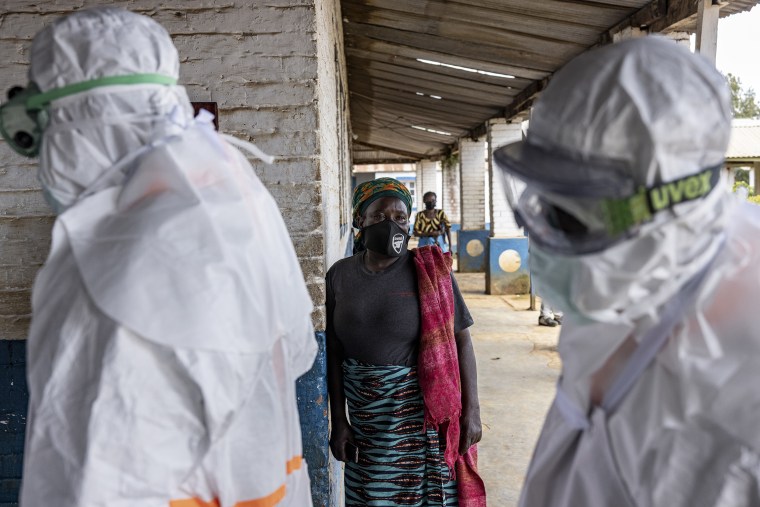
Rose Tchwenko, Congo country director for Mercy Corps, heard about an Ebola case involving a healthcare worker during the outbreak in the Democratic Republic of the Congo. His family attempted to care for him at home, believing his illness was linked to traditional practices or witchcraft. This misunderstanding led to a traditional burial, spreading the virus further. Tchwenko explained that his wife also contracted Ebola while tending to him.
Misconceptions about Ebola persist, complicating efforts to contain the virus. Tchwenko’s organization focuses on community education, battling suspicion toward humanitarian workers and the government. Protests erupted in Rwampara as locals set fire to hospital tents after being denied the body of a relative for burial. Ebola bodies remain infectious for days, and traditional funerals contribute to transmission.
The outbreak has grown significantly, with the World Health Organization reporting 750 cases and 177 deaths. This 17th outbreak in Congo challenges healthcare workers and aid groups, as Ebola attacks organs, the immune system, and blood vessels. Potential consequences include severe inflammation, multi-organ failure, and death.
Ky Luu, president of International Medical Corps, warns this could be the worst outbreak. Detection was delayed due to standard tests failing to identify the rare Bundibugyo virus strain, initially returning negative results. Tests can identify the common Zaire strain, but Bundibugyo requires days for analysis at distant labs.
With Bundibugyo, there’s no vaccine or medication to prevent transmission. Unlike responses to the Zaire strain, which included ring vaccination, containment relies on contact tracing and isolation. Recent available vaccines do not apply to this strain, forcing medical teams to focus on infection control measures.
Alan Gonzalez, operations director for Médecins Sans Frontières, faces challenges in patient isolation due to full facilities. Improvised centers like converted surgical spaces are established to accommodate growing cases. The U.S. State Department pledged $23 million to support response efforts, aiding the construction of new facilities and supplying needed materials.
According to Greg Ramm from Save the Children, there are shortages of disinfectant and protective gear, stemming from decreased humanitarian funding compared to previous years. Reduced resources lead to fewer mobilized community health workers.
The outbreak’s epicenter in a conflict zone further complicates response efforts. Areas controlled by armed groups challenge access, surveillance, and logistics. With around 100 armed factions fighting for control, providing aid to affected areas presents significant obstacles.
 Trump Administration Distributes ACA Refund Checks
  Higher Consumption of Ultra-Processed Foods Linked to Increased Health Risks
  Understanding Inflammation: Myths and Facts
  Dutch Review Board’s Euthanasia Ruling and International Debate
  Israeli PM Commends Heroic Actions in Flight Emergency
  Rabbi and Jewish Leaders Criticize Adam Brody for ‘Genocide’ Comment