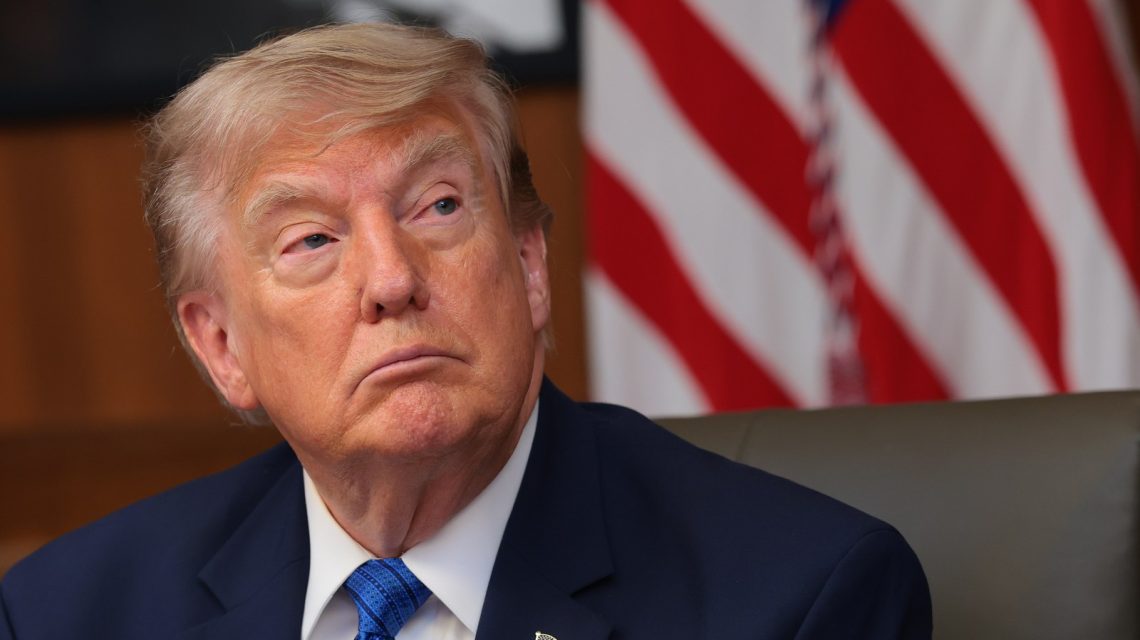
President Donald Trump faces new challenges regarding Americans’ confidence in the economy just 70 days before the 2026 midterm elections. Recent polls indicate increasing voter dissatisfaction with his administration. The Conference Board reported that the Consumer Confidence Index dropped to 89.4 in August from 90.2 in July. Chief Economist Dana M. Peterson noted that consumers feel more pessimistic about future business conditions and the labor market.
Economic Concerns and the Midterms
Economic issues are pivotal in the upcoming midterms, often reflecting a president’s popularity and issue handling. Voter concerns about inflation and cost-of-living have been prevalent. Democrats believe Trump’s falling national approval rating may reduce support for Republicans in key races, giving Democrats a chance to compete in traditionally conservative areas. Negative economic polling poses a risk for Republicans against a potential Democratic surge in November.
White House spokesperson Kush Desai told Newsweek that consumer spending and retail sales data consistently show American consumers are strong, crediting the president’s policies of tax cuts and deregulation. Desai claimed ongoing economic policies and investments promise further progress.
Consumer Confidence Declines
The Consumer Confidence Index experienced a 0.8 point drop amid inflation worries. Consumer comments on factors affecting the economy were slightly more negative, with concerns about prices, war, conflict, and jobs increasing in August.
The Expectations Index also fell, indicating a less optimistic outlook on business conditions, the labor market, and household income. In contrast, the Present Situation Index improved, driven by perceived better employment conditions. More consumers felt jobs were plentiful while fewer felt jobs were scarce.
Expert Opinions
Robert Y. Shapiro, a political science professor at Columbia University, stressed that perceptions of the economy are solidifying for voters. He suggested Trump and Republicans need to change economic realities rather than worsening conditions. Shapiro noted that lowering tariffs could control inflation better than raising them, and keeping immigrant workers is crucial for economic growth. He also mentioned that reopening the Strait of Hormuz, a critical oil passageway, could reduce gasoline prices and mitigate the war’s impact on elections.
Trump’s Approval Ratings
Recent polls highlight a decline in Trump’s approval ratings. A YouGov and The Economist poll found 36% of Americans approve of Trump, while 57% disapprove. The poll, conducted with 1,536 adults from August 21-24, had a margin of error of ±3.5 percentage points. It showed 67% of Americans think the country is on the wrong track.
A Reuters/Ipsos poll showed 65% disapproval of Trump, with 33% approving. It surveyed 1,215 adults with a margin of error of ±3 percentage points. An Echelon Insights poll from August 13-17 found Trump’s approval at 40%, with 59% disapproval, surveying 1,002 likely voters with a margin of error of ±3.4 percentage points. Morning Consult reported 54% disapproval, while 43% approved of Trump.
Trump criticized these polls on Truth Social, labeling them as ‘fake polls’ aimed at demoralizing Republicans. He claimed the actual polls show favorable results for his administration and that national morale is high.
Implications for Midterms
Americans’ economic views are crucial to the upcoming elections. Democrats focus on the economy and affordability, while Trump promotes a robust economy. He recently stated the economy is thriving from Wall Street’s perspective and has emphasized job growth.
The YouGov poll revealed economic issues are top concerns for voters. Twenty-six percent cited inflation as the most important issue, followed by 15% focusing on jobs and the economy. Only 3% rated the economy as excellent, while 21% considered it good, 33% fair, and 40% poor.
Regarding economic management, 39% favored Democrats, while 32% preferred Republicans. Fifteen percent viewed both parties similarly, and 15% were unsure. A majority, 57%, believed the economy is worsening, with only 14% seeing improvement.
Analysts speculate Democrats are likely to regain the House, needing only a few seats due to the Republicans’ narrow 218-212 edge. The Senate poses a bigger challenge, as Democrats need to flip four seats for a majority, facing GOP-held seats in competitive states.
Future Outlook
Consumer confidence and Trump’s approval ratings will be key indicators as the midterms approach. Economic issues could significantly influence voters’ perceptions of Trump and his potential to recover approval ratings.
Contact Newsweek editors on this story: Jason Lemon and Geoffrey Rowland.
 State Department Simplifies Passport Process with Online Applications
 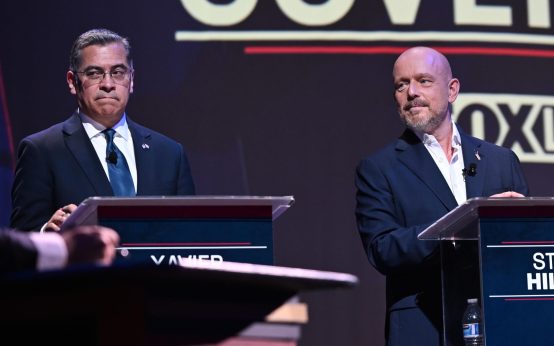 Becerra and Hilton Clash in California Gubernatorial Debate
  California Voters to Decide on $7.5 Billion State Research Fund
 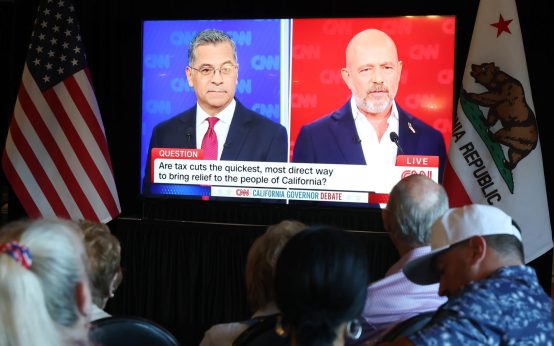 Highlights from the California Gubernatorial Debate: Becerra vs. Hilton
  Becerra vs. Hilton: The Debate and Key Issues in the California Governor Race
  Senate Confirms New Labor Secretary