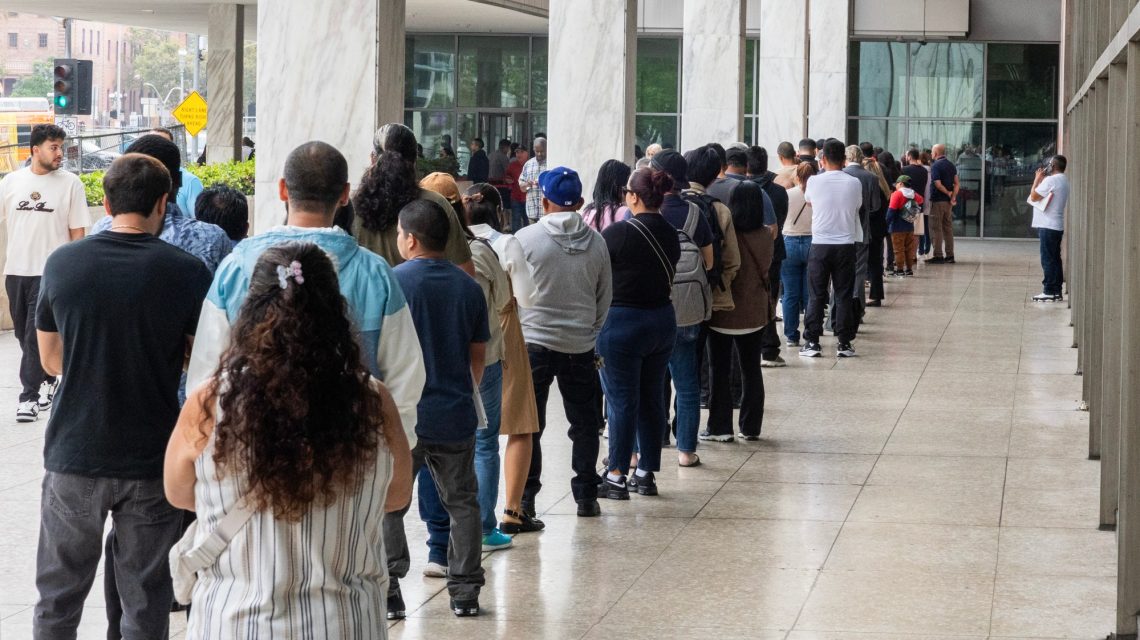
The Los Angeles – N. Los Angeles Street Immigration Court recently became a focal point as people lined up on June 24, 2026. The Department of Homeland Security has implemented new strategies to expedite immigration cases, assigning multiple hearings simultaneously on the same docket.
Unlike previous administrations, the current one has managed to cut down the immigration court backlog. A Justice Department official stated to KPBS San Diego that reducing this backlog remains a top priority. This backlog had consistently grown every year from 2013 to 2024, reaching a peak of 3,716,106 cases. However, the number began to decrease under the Trump administration in 2025, dropping to 3,416,921 cases. Today, the number has further reduced to 3,195,137 cases.
Despite being overwhelmed, the administration continues finding ways to decrease backlog numbers. A significant change in May 2026 involved raising the number of aliens present at master calendar hearings from 20 to up to 150 individuals. Termed as “mega master calendar hearings,” these hearings have increased the number of in absentia removal orders from 35,000 in May to 54,000 in June.
Master calendar hearings focus on scheduling, advising aliens of their rights, and explaining charges, not determining outcomes like deportability or asylum eligibility. Notices for these hearings are sent to the address provided by the alien, who must keep updated contact information with the court.
If an alien does not appear for their scheduled hearing, a removal in absentia order can occur if ICE proves the written notice was properly given and the alien is removable. Advocacy groups criticize the use of mega master hearings for potentially rushing removal proceedings without allowing merits hearings. However, aliens who do not update their address are still subject to absentia proceedings. They cannot appeal these orders but may file a motion to reopen proceedings within 180 days, or any time if they claim non-receipt or detention. Appeals are possible through the Board of Immigration Appeals and federal courts.
Issues for litigation include hearing notice delivery, failure to appear due to exceptional circumstances, and right to counsel. A presumed delivery presumption can be overcome with evidence. Hearings must allow at least ten days for securing counsel, though judges may grant continuances for good cause.
For absentia removal orders, the Department of Homeland Security is required to prove notice and removability with clear evidence, which may be challenged in motions or appeals.
Optimizing immigration court efficiency requires adequate judge training for proper absentia proceedings to ensure fair hearings. Mega master calendar hearings must generate legally sound orders to effectively reduce backlog.
Nolan Rappaport, with experience on the House Judiciary Committee and Board of Immigration Appeals, shares insights on his blog for those interested in further exploring these legal matters.
 Trump’s 2024 Reelection and Evolving Voter Dynamics
  Defense Secretary Emerges as Key Player in the Trump Administration
  Hegseth’s Vision for the Military: Balancing Tradition and Innovation
  Significant Funding Boosts Ken Paxton’s Texas Senate Campaign Amid Tight Race
  U.S. States Extend Gas Tax Waivers Amid Rising Fuel Costs Due to Iran Conflict
  USCIS Raises Immigration Fees