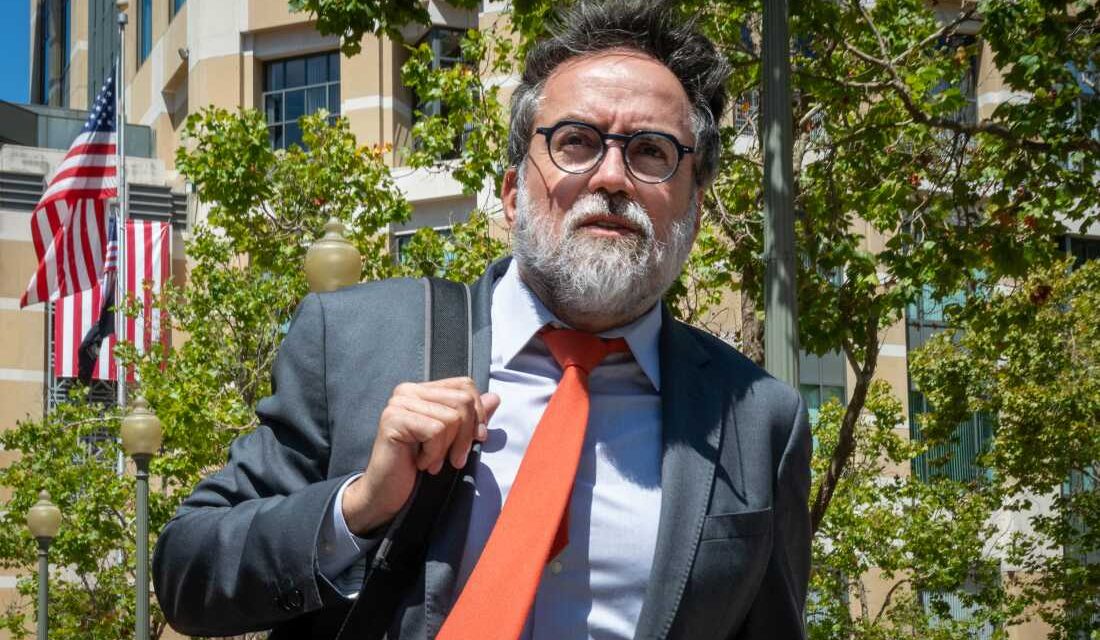
Arturo Béjar, a former Meta engineer, left the Ronald V. Dellums Federal Building & United States Courthouse in Oakland, California, on August 19, 2026. He is a crucial witness in Meta’s ongoing trial regarding social media addiction. Béjar, once an employee turned whistleblower, testified against the company.
Béjar revealed that Meta’s culture deeply focused on user metrics, often sidelining safety. He emphasized that CEO Mark Zuckerberg had the authority to change this but chose not to. “At the end of the day,” Béjar stated, “it was the company culture that Mark had created that made it practically impossible to deliver features addressing wellbeing and safety issues.”
This trial, led by California, Colorado, Kentucky, and New Jersey, accuses Meta of violating consumer and child data protection laws. The states claim Meta misled the public about the risks posed by its platforms. They argue that features like infinite scrolling and the “like” button intentionally hooked young users to extend their use. Meta denies these allegations. During the trial, attorney Paul Schmidt argued that Meta was aware of the risks to teens, actively addressing them, and didn’t deceive the public.
While the state attorneys haven’t indicated if Zuckerberg will testify, Béjar spoke in Oakland’s federal court for a second day. He charged that Zuckerberg wasn’t truthful in denying prioritizing profit over safety. Béjar referenced a 2021 Facebook post by Zuckerberg responding to another whistleblower, Frances Haugen. Zuckerberg had claimed it’s “just not true” that Meta favors profit over safety. Béjar countered, saying, “Based on my experience at Meta, that is not an accurate statement.”
Béjar discussed several internal studies from Meta revealing risks to teens. These studies involved user surveys, including teenagers, about harmful content and its associated negative feelings. Béjar noted that adjusting features to mitigate these risks was challenging. More often, policies focused on increasing usership and revenue over safety. He stated, “Safety was not a meaningful priority.” Béjar’s tenure at Meta lasted from 2009 to 2015, dealing with cyberbullying, and he later returned from 2019 to 2021 as a consultant on Instagram’s wellbeing team, driven by concerns about his daughter’s experience on the platform.
Previously, in 2023, Béjar testified before the Senate, criticizing Meta for promoting harmful content. He granted a detailed interview to The Wall Street Journal, explaining his concerns.
This trial at the U.S. District Court for the Northern District of California examines efforts to hold Meta accountable not for content but for platform features alleged to foster compulsive use, benefiting Meta through advertising revenue.
On cross-examination, Meta lawyer Brian Stekloff questioned Béjar about the challenge of resolving safety risks. Béjar acknowledged working with competent teams but admitted issues remain unsolved. Features like video autoplay, “like” counters, and infinite scroll are “inherently unsafe for teenagers,” he stated. He criticized safety features like Instagram’s “quiet mode” as ineffective, comparing them to having to activate an airbag during each car entry. Béjar highlighted that optional settings don’t ensure widespread user protection.
The trial is expected to continue for six weeks. The Chan Zuckerberg Initiative, founded by Zuckerberg and Dr. Priscilla Chan, financially supports NPR.
 The Evolution of Electronic Shelf Labels in Grocery Stores
  Debate Intensifies Over AI Safety and Regulation
  Venezuelan Man Accused of ATM Hacking Brought to U.S.
  The Historical Fear of Technological Advances and AI
  How Generative AI Affects Critical Thinking Among Professionals
  Virginia Congressional Districts Show Increasing Competitiveness