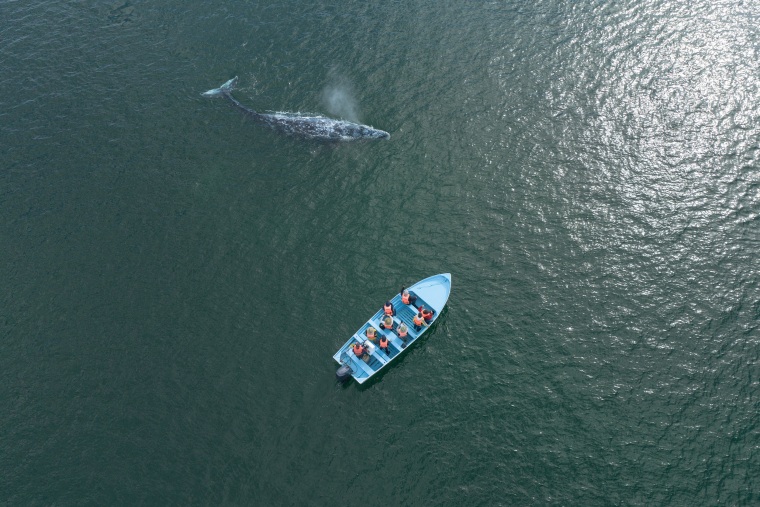
Since March, 21 emaciated gray whales have washed ashore in Washington state, raising alarm among researchers. John Calambokidis, a veteran biologist with the Cascadia Research Collective, worries about these findings. Once hailed as a conservation success, gray whales now show a steep population decline over the last seven years.
Signs of Distress
Many of the beached whales display signs of weakness. Odd behaviors, such as navigational issues, suggest they suffer from poor health. The decline in sea ice due to global warming has far-reaching effects on marine life. It decreases the availability of prey for whales, leading to food shortages.
“We know it’s a food supply issue,” Calambokidis stated. “The Arctic has undergone dramatic changes because of climate change.”
Food Supply Challenges
Environmental shifts in the Arctic impact gray whales significantly. Josh Stewart from Oregon State University emphasizes the changing sea ice conditions. Algae growth, vital for whale food chains, now occurs earlier due to warming, affecting the food availability on the ocean floor.
Such changes make it unlikely for the Arctic to support 25,000 gray whales again. This ice melting timeline boosts other species, reducing necessary nutrients for amphipods, the gray whale’s primary food.
Cyclical Decline or Permanent Change?
Since 2019, whale deaths prompted the National Oceanic and Atmospheric Administration to call it an “unusual mortality event.” Researchers once thought whale populations might experience natural ups and downs, intensified by climate change. However, the expected rebound in 2023 was short-lived.
Whales feed primarily in the Arctic for half a year, then face months of fasting. As the Arctic becomes less reliable for food, whales arriving for spring migration find themselves dangerously thin after a long fast.
Calambokidis notes that some whales appeared in unexpected places, like one found dead in the Wilapa River, searching for sustenance.
Population and Migration Patterns
The gray whale population dropped from 27,430 to around 12,950 according to the latest estimates. This sharp decline challenges researchers, though some groups like the Sounders and the Pacific Feeding Group show resilience by adopting different foraging strategies.
Previously, Eastern North Pacific gray whales were nearly wiped out by whaling but rebounded due to legal protections. Stewart remains hopeful, suggesting that while extinction isn’t imminent, recovery paths remain uncertain.
“We’re significantly lower in abundance than when delisted from the Endangered Species Act, marking new recovery territory,” says Stewart.
 California Voters to Decide on $7.5 Billion State Research Fund
  Senators Reach Bipartisan Agreement on Permitting Reform
  Experts Warn of Critical Period for the Colorado River
  Future Cities: Ambitious Projects Aiming for Innovation and Sustainability
  Supreme Court Case Suncor vs. Boulder: Implications for Accountability in Climate Change
  Hawaii Faces Impact of Record El Niño Through Recent Hurricanes