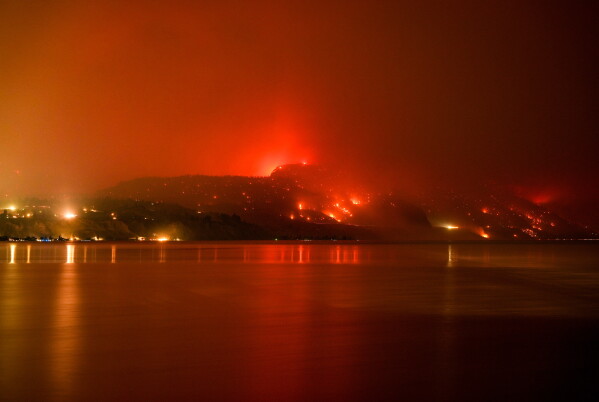
TORONTO (AP) — Canada has put its military on standby to assist in combating devastating wildfires in British Columbia. A woman has died, and approximately 20,000 people have evacuated their homes. Numerous wildfires have been ravaging the province, with nearly half remaining uncontrollable due to hot, windy weather and prolonged drought. Thousands have fled on congested roads, and officials have warned that more communities could be at risk.
Summerland Mayor Warns of Destruction
The mayor of Summerland, a town of about 12,000 people, has warned that the area is too dangerous to access. This community, along with around 8,000 residents from nearby Peachland, was ordered to evacuate on Saturday night. The Bald Range wildfire raced toward Summerland and other areas along Okanagan Lake.
“We need to brace ourselves for that bad news when it’s time to go back,” Mayor Doug Holmes stated. “Everybody will know somebody who has lost a home.”
Military Prepared to Assist
Defense Minister David McGuinty announced that the Canadian Armed Forces are prepared to respond if British Columbia requests their help. The federal government has approved provincial requests for assistance with shelter and accommodations.
The Royal Canadian Mounted Police reported that an 80-year-old woman died while attempting to flee the fire near Summerland. Canadian Prime Minister Mark Carney described her death as heartbreaking and assured continued federal support. The wildfire’s cause is under investigation.
Firefighting Efforts Continue
The British Columbia Wildfire Service indicated the blaze has expanded to about 60 square miles (156 square kilometers). Officials cautioned that clearer skies and direct sunlight might elevate fire activity. Incident commander Hugh Murdoch shared that approximately 99 wildland firefighters, alongside 120 structure protection personnel, are combatting the fire with heavy equipment and helicopters.
A contingent of 100 firefighters from Mexico is expected to join on Tuesday morning. British Columbia Forestry Minister Ravi Parmer mentioned that 19 helicopters are assigned to the wildfire; however, its intensity has hindered containment efforts.
“We could have put a thousand more helicopters and a thousand more people on the ground, and it wouldn’t have made a difference,” Parmer noted.
Visibility has been reduced due to smoke, limiting the use of air tankers and water-skimming aircraft. The wildfire’s rapid growth on Friday, spreading 19 square miles (50 square kilometers) in three hours, has been mainly driven by extremely dry conditions.
Evacuation and Community Impact
Graham Statt, chief administrative officer of Summerland, explained that residents will return in phases, but the timeline remains uncertain. Mayor Holmes stated that residents shouldn’t expect to return soon, emphasizing that the fire must be controlled first.
Kyla Gaudiuso, a resident of Faulder, described receiving a photo of her home engulfed in flames. She referred to the evacuation experience as “pandemonium” and is staying with a friend in Penticton.
Wildfire seasons in Canada have grown increasingly destructive, prompting mass evacuations and repeatedly impacting large areas across Canada and the United States. Summerland, known for its agriculture and vineyards, is in a mountainous region with a history of wildfires.
“People said they’ve never seen a fire move so fast,” Holmes explained.
Comparative Wildfire Challenges in the U.S.
The U.S. is also facing significant wildfire challenges. In California, evacuations have been ordered along the Big Sur coast, with the Timber Fire in Monterey County expanding rapidly. A fire in Reno, Nevada, called the Bug Fire, forced 5,500 evacuations, driven by hot, dry, and windy conditions.
Firefighters in Spokane, Washington, have improved containment lines around destructive fires, allowing for some residents’ return. Washington Governor Bob Ferguson emphasized the importance of rebuilding affected communities.
“It’s our job to rebuild that community,” Ferguson stated.
Oregon reports its worst year on record for land burned by wildfires, with 3,671 square miles (9,508 square kilometers) scorched. This surpasses the state’s previous record set in 2024, according to Northwest Interagency Coordination Center spokesperson Jean Nelson-Dean.
 Israeli Prime Minister Calls for Comprehensive Security Review of Civil Flights
  U.S. Marine Arrested in Okinawa for Alleged Murder and Robbery
  North Korea’s Missile Test and Its Implications
  Israel and Ireland Soccer Teams Display Tension in Nations League Match
  Fox News Report on FlyDubai In-Flight Incident
  Brazilians Vote in Crucial Presidential Election