Hungary’s Response to Threatened Nuclear Operations
Prime Minister Péter Magyar stated, “The Danube has given us days, not months,” in response to dropping river levels that jeopardize the plant providing about one-third of Hungary’s power.
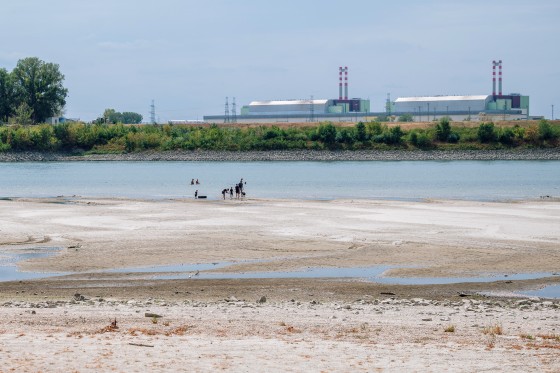
On August 9, 2026, individuals sought relief in the low waters of the Danube near Paks, Hungary, where the Paks Nuclear Power Plant stood visible in the distance. This scenario highlights the urgency of the situation. Due to diminishing water levels in the Danube, efforts must commence promptly to protect Hungary’s sole nuclear facility, preventing a halt in its operations for the first time in decades.
Plans to Elevate River Levels
Persistent droughts and severe heat waves have severely reduced the Danube’s water supply, leading to unprecedented low water levels and putting the Paks plant at risk of a shutdown for the first time in its 44-year existence. Constructed during the Soviet era, Paks relies on the Danube’s water to cool its reactors and currently functions at barely 10% of its total 2,000-megawatt capacity, threatening Hungary’s electricity supply.
Construction to Boost Water Levels
Magyar, in a Facebook video on Wednesday, announced the construction of a bed sill to increase water levels. Scheduled to begin Thursday, the project involves building a concrete or stone structure to slow water flow and raise upstream levels near the plant.
Starting Wednesday evening, authorities will deliver 145,000 cubic meters of rock for the structure. This measure might boost the Danube’s depth by up to one meter (3 feet).
Additionally, two large barges may be sunk to further elevate river levels near the plant’s cooling systems. Officials plan to decide on this measure by Friday.
Preventing Future Shutdowns
Magyar emphasized the importance of rapid intervention to prevent a complete shutdown, calling the construction a “long-term” solution to ensure sustained adequate water levels. Following recent increases, water levels are anticipated to decline again, risking a Paks shutdown without external action.
Comparative Measures and Economic Impact
Romania faced a similar dilemma last week, sinking four barges laden with rock to divert water to the Cernavoda nuclear plant, which had already halted one reactor.
Magyar mentioned that maintaining the Paks plant at its current reduced capacity costs Hungary’s economy about 50 billion forints ($158 million) monthly. The new interventions, however, are expected to cost approximately 6 billion forints ($19 million).
 Senators Reach Bipartisan Agreement on Permitting Reform
  Experts Warn of Critical Period for the Colorado River
  Future Cities: Ambitious Projects Aiming for Innovation and Sustainability
  Supreme Court Case Suncor vs. Boulder: Implications for Accountability in Climate Change
  Hawaii Faces Impact of Record El Niño Through Recent Hurricanes
  Efforts to Save the Endangered American Red Wolf