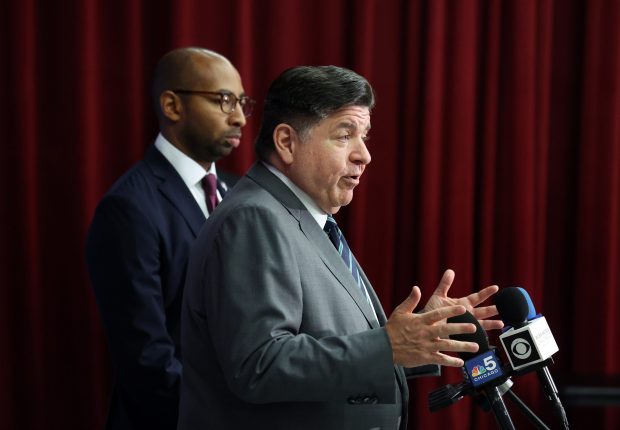
Governor JB Pritzker accepted the endorsement of Illinois’ suburban teachers union, expressing doubts about a push for increased funding for Chicago Public Schools (CPS). He argued the state’s resources must be shared statewide, not focused solely on Chicago. Pritzker, addressing the $150 million funding request for CPS, emphasized the need to balance this against broader educational funding needs. “The state doesn’t have spare funds. We must find where the dollars are,” he remarked.
The call for additional CPS funding highlights divisions as the General Assembly’s veto session approaches in November and December. Pritzker, seeking his third term, spoke after the Illinois Education Association’s backing. This union supports educators mainly outside Chicago. Meanwhile, CPS, under pressure from the Chicago Teachers Union, approved a $10 billion budget including $150 million in unallocated state funding. Questions arise about this budget’s feasibility, given the state’s existing fiscal plans.
Any CPS funding boost would necessitate a corresponding increase for all Illinois schools, noted Pritzker. “Allocating $150 million implies multiplying it for schools statewide,” he advised, adding concerns over where such funding would be sourced without compromising other budget priorities. He admitted, “We are not yet funding our schools correctly.”
IEA President Karl Goeke, following the endorsement, dismissed assumptions of political rifts with unions like the Illinois Federation of Teachers. He clarified the IEA’s endorsement process as distinct and highlighted a strong working relationship with other unions. On the CPS funding issue, Goeke refrained from commenting due to limited information.
Changes to the state budget require a supermajority in the Illinois House and Senate. Lawmakers, notably some Democrats, express skepticism about CPS’s budget proposals. State Rep. Daniel Didech criticized CPS’s “unbalanced budget” for relying imprudently on the state to rectify a self-made fiscal gap, cautioning against a “moral hazard” where entities could follow suit.
Pritzker critiqued the CPS proposal, highlighting the lack of current revenue for the described funding. The Chicago Teachers Union argues the budget acts as a leverage tool to compel state lawmakers into providing overdue state funds, ensuring job positions lost to layoffs are restored and classroom funding shielded.
Efforts for more CPS funding coincide with Illinois House Speaker Emanuel “Chris” Welch’s attempts to maintain his position following separate controversies. Welch supports more statewide educational funding, although financial sources remain uncertain.
Pritzker underscored the need for clarity from Speaker Welch on new revenue plans, reiterating no engagement with the CTU on endorsements. His Republican opponent, Darren Bailey, advocates private school options.
The Chicago Board of Education backs lobbying for state funds, pointing to underfunding issues based on the state’s evidence-based model for educational allocations. While there’s agreement on CPS’s need for funds, consensus on funding routes is lacking.
Some Democratic representatives argue expansive funding dialogues should encompass statewide needs. State Rep. Rita Mayfield, representing low-income school districts, wants more funds for her areas, indicating preparations for the upcoming veto session. Rep. Bob Morgan also supports a statewide focus, reflecting broader geographical priorities in past veto sessions.
State Rep. Will Davis, leading the House Appropriations Committee for K-12 education, noted the need to prioritize statewide schools eligible for evidence-based funding. He remarked on educating new Chicago school board members about state governance dynamics, urging them to recognize the impracticality of single-district funding adjustments during veto sessions.
 Sen. Cotton Opposes Permanent Daylight Saving Time
  Democratic Governors Face Pressure on Federal School Choice Program
  Steve Hilton’s Latino Outreach and Gubernatorial Ambitions
  Navigating School Year Challenges and ‘The Talk’ on Safety
  The Need for Reform in Presidential Nominations
  Controversy Surrounds Performances at Gillette Stadium