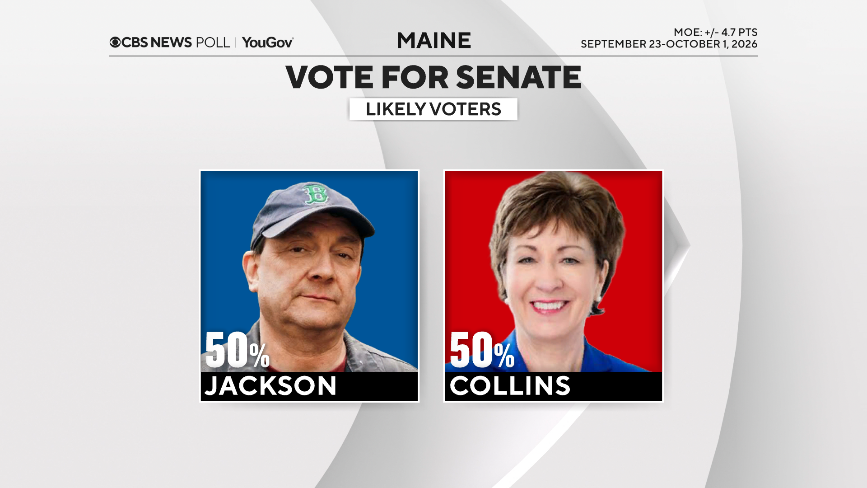
As autumn’s chill descends on Maine, the state’s Senate race remains a focal point, resisting overarching national political trends favoring Democrats. Incumbent Republican Susan Collins maintains a tight contest against Democrat Troy Jackson, reflecting the state’s Democratic-leaning voter base.
Collins succeeds in capturing a broad spectrum of voters in Maine, including a significant portion of state Democrats. Her strength lies in the perception that state matters outweigh national issues for many voters. Additionally, voters believe Collins has a better track record of securing federal funds for Maine. This advantage poses a challenge for Jackson, who contends with Collins’ ability to attract one in five voters critical of former President Trump—a higher rate than most Republican candidates manage nationwide.
Jackson’s support hinges on the view that Collins aligns too closely with Trump. His backers are also motivated by opposition to tariffs and the desire to see Democrats control the Senate. Furthermore, those prioritizing political change over seasoned experience form part of his base. Notably, 10% of voters remain open to changing their preferences, introducing an element of unpredictability in the race’s outcome.
Despite the financial impacts attributed to Trump’s policies, Collins attracts nearly one in five voters who feel otherwise disadvantaged by these policies. However, Collins’ long-standing service in the Senate remains a double-edged sword in a year characterized by anti-incumbent sentiment.
Jackson, on the other hand, contends with intraparty sentiments as about 40% of Democrats, along with the majority of independents, express a preference for an alternative Democratic nominee. His alignment with the gubernatorial candidate Hannah Pingree also demonstrates discrepancies; Pingree fares better, aligning closely with the state’s partisan tendencies.
The dynamics of ticket-splitting have Pingree claiming some voters who otherwise support Collins, illustrating the complexities within voter decision-making. This analysis relies on data collected by a CBS News/YouGov survey conducted from September 23 to October 1, 2026, with a representative sample of 1,114 registered Maine voters. The survey included weight adjustments based on demographics and the 2024 presidential vote, presenting a margin of error of ± 4.7 points for registered voters.
 Sen. Cotton Opposes Permanent Daylight Saving Time
  Steve Hilton’s Latino Outreach and Gubernatorial Ambitions
  The Need for Reform in Presidential Nominations
  Controversy Surrounds Performances at Gillette Stadium
  Celebrity Controversies Over Political Activism and Speech
  Trump Pushes for Permanent Daylight Saving Time, Sharing Senator’s Contact Information