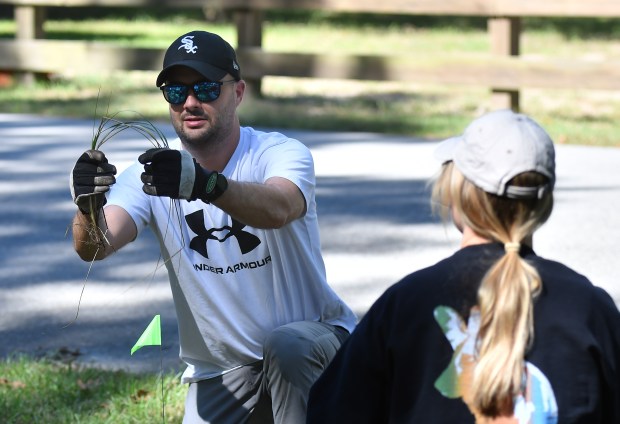
Marram grass, previously growing in a parking lot, found a more suitable home at Indiana Dunes State Park on a recent Saturday. During this event, participants not only learned how to plant marram grass but also understood why it’s crucial for the park’s ecosystem.
Volunteers in Action
Ben Kalinowski from Highland prepared to plant marram grass, with his wife Amanda observing, during the National Public Lands Day event at the Indiana Dunes State Park campground in Chesterton, Indiana. Volunteers and staff successfully planted about 100 grasses. This event emphasized the plant’s importance to the dunes.
Natural Resource Technician Jessica Deerwester explained the significance of marram grass, known scientifically as Ammophila breviligulata, meaning “sand friend.” She detailed how its roots stabilize the sand, growing both downward and outward, effectively locking the sand in place. Marram grass is a pioneer species vital to initiating plant succession. It can spread six to ten feet annually and is highly drought-resistant, curling its leaves in dry weather to conserve moisture.
As a pioneer species, marram grass sets the stage for other plant species, facilitating ecological succession.
Planting Strategy
Deerwester placed 78 flags in a grassy area at the park’s entrance to guide planting efforts. After those spots were planted, additional holes were dug throughout the island. With proper growth, marram grass may cover the area in a few years. She advised volunteers on planting depth and how to fold leaves to anchor the plants against the wind.
Volunteers used buckets of tools and marram grass, transported from a parking lot by Deerwester. She later filled these buckets with water to nourish the newly planted grass. Planting generally occurs in early spring or fall, avoiding peak growth season. Once established, marram grass will reduce maintenance needs while beautifying the campground entrance. It also supports wildlife, like the quick-moving racerunner lizard.
Volunteer Vida Bartasius from Burns Harbor expressed her long-standing love for the dunes, having visited for 65 years. Ben and Amanda Kalinowski, fellow volunteers, shared similar sentiments, having grown up in the area. They previously participated in beach cleanups and native plantings.
Family Participation
Dustin Moffitt from Plainfield, along with his family, also joined in. They are on a mission to visit all of Indiana’s state parks, using this opportunity to participate in interpretative programs. Moffitt noted that digging in the soft, sandy soil was relatively easy compared to other challenges, like hiking the 3 Dunes Challenge.
Such events highlight the collaborative efforts of volunteers and park staff in preserving and enhancing the natural landscape of Indiana Dunes State Park.
 Senators Reach Bipartisan Agreement on Permitting Reform
  Experts Warn of Critical Period for the Colorado River
  Future Cities: Ambitious Projects Aiming for Innovation and Sustainability
  Supreme Court Case Suncor vs. Boulder: Implications for Accountability in Climate Change
  Hawaii Faces Impact of Record El Niño Through Recent Hurricanes
  Efforts to Save the Endangered American Red Wolf