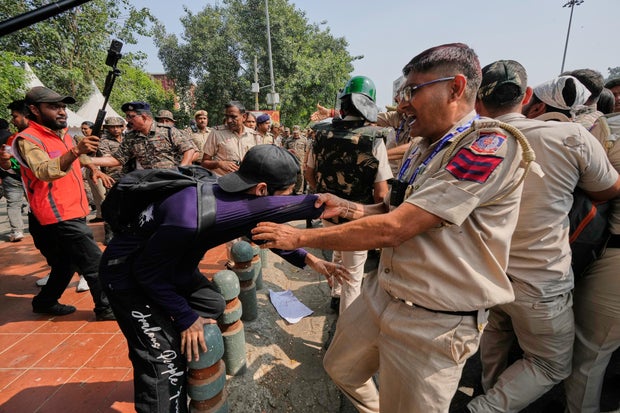
Indian authorities initiated a large-scale security crackdown in New Delhi on Saturday, detaining thousands of protesters. The “Cockroach” movement, driven by young people, aimed to amplify a national campaign opposing a controversial voter list revision. This revision has heightened discontent towards Prime Minister Narendra Modi’s Hindu nationalist government and election authorities.
Police intervened to disperse the protest before it began, intercepting participants heading to Jantar Mantar, the designated protest site in India’s capital. Many demonstrators were chased away or detained. Some were forcibly put into police vehicles and taken to temporary detention centers. Key leaders of the “Cockroach” movement, opposition lawmakers, and student activists were detained, significantly hindering the protest from starting.
The crackdown extended beyond the protest location, with police stopping vehicles at checkpoints entering the capital to find demonstrators. Jantar Mantar was blocked off, while anti-riot vehicles with tear gas launchers stationed on key routes further complicated protest efforts. Restrictions on mobile internet and access to parts of the city added to the challenges for protesters.
Police said they denied permission for the protest due to a late request. Sambit Patra, spokesperson for Modi’s party, dismissed the demonstrators as anarchic elements. “Their flop show has been completely demolished,” said Patra.
Extensive Crackdown
The crackdown’s magnitude reflected the authorities’ determination to impede a rapidly growing protest campaign engaging thousands. The “Cockroach” movement’s protests have attracted opposition support and increased scrutiny of Modi. Demonstrations earlier in the year resulted in the resignation of Modi’s education minister following exam paper leak protests.
Movement leaders Abhijeet Dipke, Saurav Das, and Ashutosh Ranka, who were expected to lead the protest, were detained upon arriving at the Delhi airport from Mumbai. The “Cockroach Janta Party” shared footage of police detaining them. The movement stated, The pre-planned interception by Delhi Police aims to cripple the leadership of today’s peaceful demonstrations before they even reach the protest site.
Authorities used loudspeakers at the protest site to announce bans on gatherings of five or more people, enforcing sweeping security measures rarely seen in the capital. Some journalists also faced restrictions, with police briefly detaining some.
Despite these measures, some protesters managed to breach police lines, chanting slogans against Modi and election authorities before getting detained.
We are a democracy, yet peaceful protests are being crushed by force. Shouldn’t we fight for our rights?
said Tanya Negi, a student who traveled from Mumbai. Why is Modi afraid of India’s young people?
Opposition Criticism
The response signified a significant show of force in a city where the government has frequently sought to restrict public dissent. Under Modi’s leadership, the use of arrests and restrictions on gatherings has raised questions about protest rights in the world’s most populous democracy.
Opposition leaders accused the government of stifling dissent, with lawmaker John Brittas questioning the presence of democracy amid the capital’s siege. Brittas was later detained by police.
The protests focus on the Election Commission’s Special Intensive Revision, which the opposition claims has disenfranchised millions of voters. Protesters demand the resignation of Chief Election Commissioner Gyanesh Kumar, arguing against changes that have removed over 130 million names from voter lists.
The Election Commission and the government deny voter manipulation claims, asserting the revision targets duplicate and ineligible entries.
For the “Cockroach” movement, the voter list issue provides a platform to expand their campaign. Initially an online initiative in May, the movement gained momentum through protests and hunger strikes over exam paper leaks, leading to the education minister’s resignation in July.
While the protests challenge Modi in his third term, the political impact remains uncertain. National elections are slated for 2029, but upcoming state elections in Uttar Pradesh and Gujarat will serve as indicators of Modi’s party’s influence.
 Police Investigate Fatal Shooting in South Georgia
  Hurricane Isaias and Other Storm Updates
  Mubin Shaikh’s Journey from Radicalization to Counterterrorism Specialist
  Concerns Over Russia’s Biological Weapons Program
  Russian Strikes in Ukraine Amid U.S.-Russia Diesel Deal
  Cartels Face New Challenges as Political Alliances Shift