America stands at a crucial point where the potential for a technological golden age is within reach. The next election cycles could significantly influence the path taken toward these advancements. At a White House event in September, Elon Musk, alongside President Donald Trump, envisioned a future where artificial intelligence (AI) and advanced robotics lead to an “age of abundance.” Musk believes these technologies could offer average Americans medical care surpassing the best currently available to the wealthiest.
Trump’s Vision for American Tech
The Trump administration has positioned American leadership in AI as a key economic strategy. Efforts have centered on eliminating regulatory obstacles, building data centers, and expanding the energy infrastructure needed for the AI boom. Treasury Secretary Scott Bessent envisions AI and automation revitalizing American manufacturing. In 2025, Bessent suggested that “smart factories” could address labor costs, making U.S. manufacturing competitive internationally. This future involves advanced robotics enhancing domestic manufacturing and AI spearheading major medical breakthroughs, promising economic prosperity.
Challenges from the Far Left
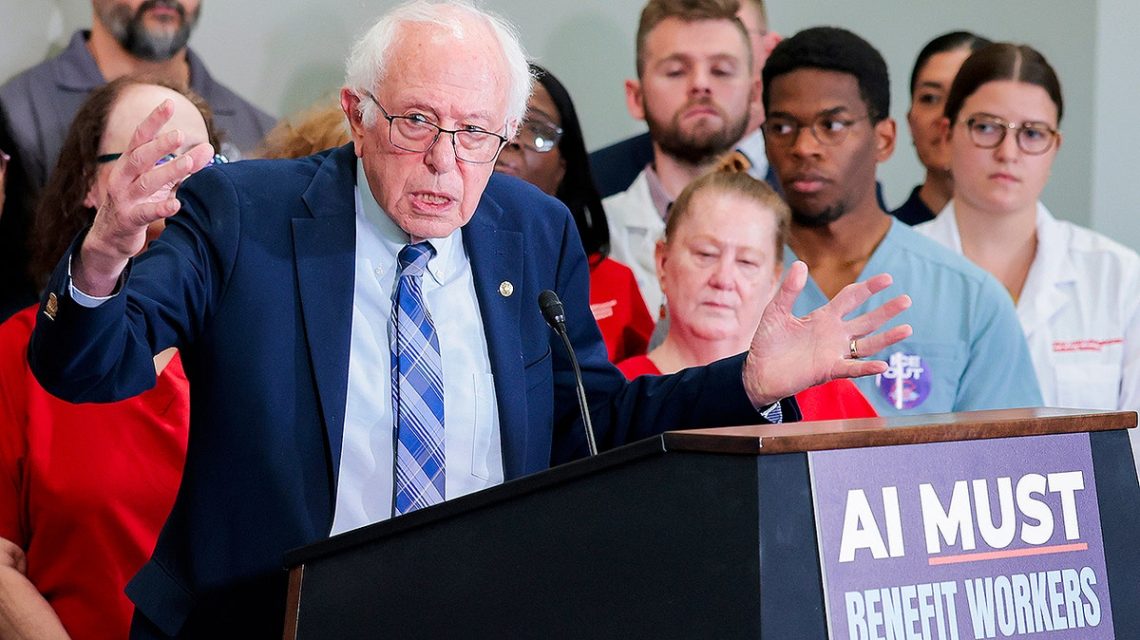
While the Trump administration plans for a technological golden era, figures like Vermont Independent Sen. Bernie Sanders propose a different route. Sanders and New York Democrat Rep. Alexandria Ocasio-Cortez have called for a moratorium on new data center construction until proper regulations are in place. They argue that unchecked development poses risks. Sanders’ proposals, such as the American AI Sovereign Wealth Fund Act, aim for substantial government control over the AI industry, suggesting nationalization of 50% of AI stakes. Furthermore, Sanders has pushed for legislation that would ban the development of artificial superintelligence and establish a federal AI agency with powers to halt research deemed too advanced.
The Cost of Inaction
Discussion around the AI revolution often highlights valid concerns like job displacement, privacy issues, algorithmic manipulation, and misuse of AI. These challenges deserve consideration. Yet, focusing on suppressing technological progress could overlook the immense benefits, such as AI-assisted drug discovery enhancing treatments for conditions like cancer and Alzheimer’s, AI-driven robotics revolutionizing manufacturing and agriculture, and innovations aiding the disabled and elderly.
Global Competition
A critical aspect of these discussions involves America’s position in global AI leadership. China, similarly committed to AI development, is closing the gap with American advancements. The 2026 Stanford University AI Index reveals a diminishing performance difference between the two nations. Proposals from the far left to stall AI research provide China with the chance to advance further in the AI race, threatening America’s global economic and geopolitical standing.
The AI revolution promises unprecedented prosperity, but realizing its potential hinges on a willingness to embrace progress rather than fear it. Donald Kendal, director of the Emerging Issues Center at The Heartland Institute, underscores the importance of seizing this opportunity rather than ceding it to geopolitical rivals.
 Controversy Surrounds Autonomous Vehicle Legislation in D.C.
 Elon Musk Plans to Distribute SpaceX Shares to American Children
 Apple Customers Eligible for Settlement Due to Siri Feature Delays
 TikTok Leadership Criticized Over Child Safety Concerns
 Theranos Whistleblower Tyler Shultz Speaks Out on Documentary Depiction of Elizabeth Holmes
 Former OpenAI Engineer Arrested for Installing Listening Device