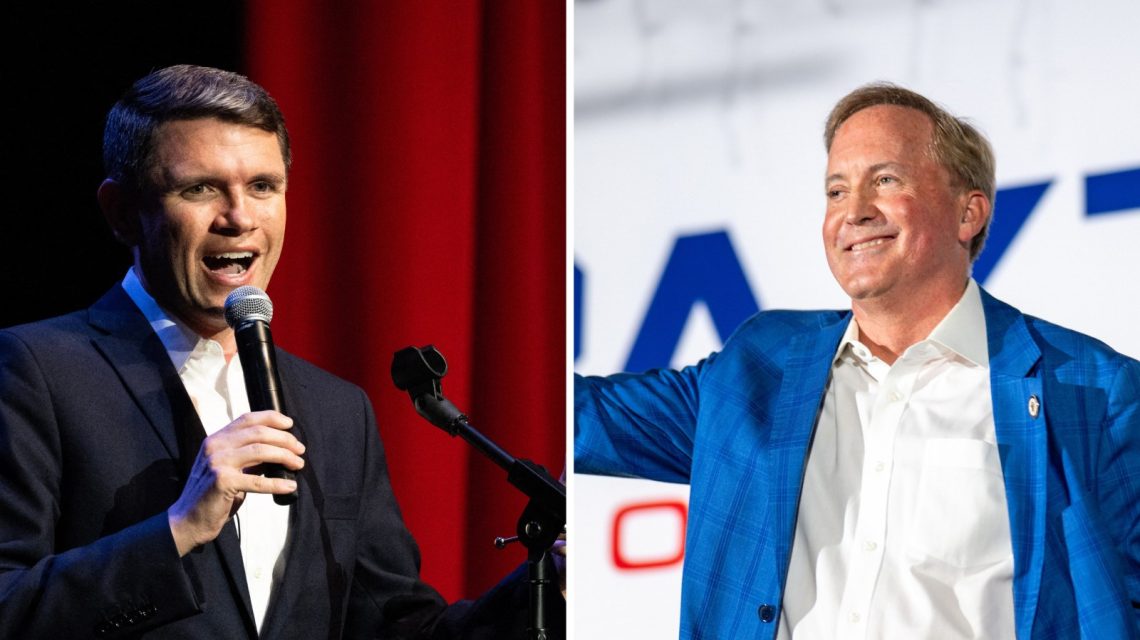
Representative James Talarico, a Texas Democratic Senate candidate, criticized his opponent, Republican Attorney General Ken Paxton, accusing him of using artificial intelligence to devise a plan for managing data centers if elected in November.
Data centers have become a contentious issue leading up to the midterm elections, with Americans expressing concerns about their construction and impact on local resources, including water and power supplies. Candidates from both parties have taken positions against these facilities, despite President Donald Trump’s ongoing support for their expansion.
On Monday, Paxton shared his data center plan online, quickly drawing accusations of AI involvement. Talarico’s campaign stated that Paxton ignored voter concerns. Talarico highlighted Paxton’s financial ties to the data center industry, claiming he took nearly half a million dollars from them, supported tax incentives for data centers, and failed to address community concerns as Attorney General. “Texans can’t afford a senator influenced by big data center companies,” Talarico said. “Texans can’t afford Ken Paxton’s corruption.” Newsweek sought comment from Paxton’s campaign.
What Is in Paxton’s AI Plan?
Paxton introduced his “Texas First Data Center Plan,” emphasizing protecting the state’s grid, communities, and children while competing with Communist China in AI development. The plan includes federal legislation to ban Chinese technology in U.S. data center infrastructure and proposes criminal liability for operators whose AI systems compromise children’s safety. Additionally, Paxton supports a deregulatory approach at the federal level by co-sponsoring the DATA Act, intending to reduce regulatory barriers, expand power generation, and prevent rising electricity costs in Texas.
At the state level, Paxton promises to support Governor Greg Abbott’s efforts to enhance oversight of new data center projects. His proposals include limiting data centers in rural areas, mandating noise reduction, and improving coordination during grid stress. Paxton’s plan also seeks to repeal specific tax exemptions for data centers, require them to finance necessary infrastructure, contribute to Texas’s grid capacity, and implement closed-loop water cooling.
Midterms Issue
The release of Paxton’s plan comes as data centers become a growing national issue, drawing objections over energy consumption, water usage, and local impact. Critics argue that large data centers put more strain on electric grids, consume vast amounts of water, and transform rural communities. Supporters contend they provide jobs and technological advancement. In response, Governor Abbott has pushed for stricter project oversight and audits.
Paxton’s plan addresses infrastructure costs, overturns tax incentives, and restricts development near rural neighborhoods, tackling concerns driving opposition campaigns. Yet, he also supports streamlining regulations and expanding energy infrastructure for continued industry growth.
Critics, including Talarico’s allies, highlight that some Republicans who now support oversight had once favored tax incentives helping data center expansion. The political battle focuses on accountability over their rapid growth and protecting communities from the ramifications.
November Battle
Texas is a crucial battleground in the midterms, with Democrats targeting the state as Talarico outperforms Paxton in several polls. Although Texas hasn’t elected a statewide Democrat since 1994, Talarico’s campaign gains momentum as Paxton navigates a challenging primary battle. The state is key to Democrats’ hopes of claiming the upper chamber majority. The Cook Political Report and Fox News categorize it as a “tossup,” while The Sabato Crystal Ball suggests it “leans Republican.” Trump has secured Texas in three elections.
 Trump’s 2024 Reelection and Evolving Voter Dynamics
  Defense Secretary Emerges as Key Player in the Trump Administration
  Hegseth’s Vision for the Military: Balancing Tradition and Innovation
  Significant Funding Boosts Ken Paxton’s Texas Senate Campaign Amid Tight Race
  U.S. States Extend Gas Tax Waivers Amid Rising Fuel Costs Due to Iran Conflict
  USCIS Raises Immigration Fees