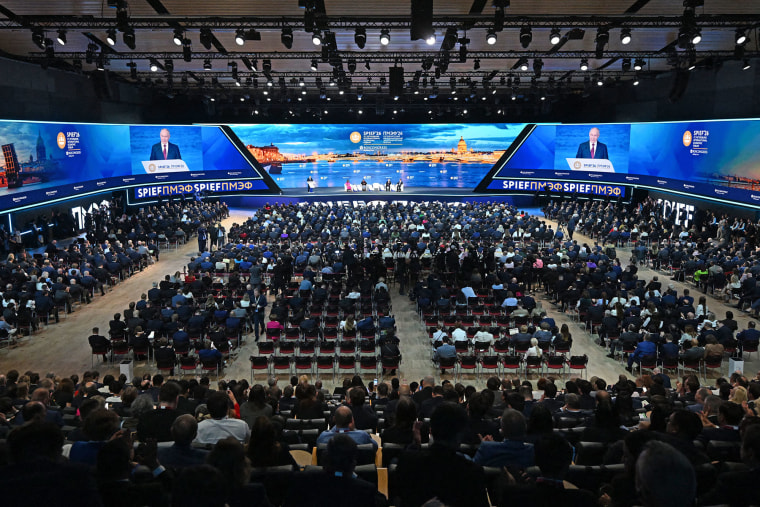
In St. Petersburg, President Vladimir Putin addressed a familiar gathering at the International Economic Forum. The audience comprised government officials, business leaders, and supporters. Optimism was once high after an August summit with President Donald Trump, but that has shifted to a stalemate regarding the conflict in Ukraine.
The recent bipartisan legislation passed by the U.S. House aims to provide new assistance to Ukraine and impose sanctions on Moscow. Concurrently, the U.S.-Israeli conflict with Iran has raised inflation and exacerbated fuel shortages in Russia, worsening the effects of existing sanctions.
While once a symbol of economic optimism, this year’s forum in Putin’s hometown featured drones, manufactured in Russia and prominently displayed. Meanwhile, Ukrainian drone attacks have unsettled residents of the historic city.
Putin rejected a request from Ukrainian President Volodymyr Zelenskyy for a face-to-face meeting, stating there was “no point.” According to him, expert negotiations should precede any high-level meetings. He questioned Zelenskyy’s legitimacy in negotiations due to the postponed Ukrainian presidential election.
“First, let experts work, work something out, and then we can meet to sign things,” Putin said, according to a translation provided by the forum’s organizers.
Deputy Prime Minister Alexander Novak expressed Moscow’s willingness to improve ties with the United States, commenting, “Russia never turned its back to the United States.” According to him, the willingness for a new relationship is there.
Security measures at the forum were stringent, with PCR tests required for attendees. Putin was closely guarded. Russian Foreign Ministry spokeswoman Maria Zakharova noted that Iran has impacted U.S. priorities, diverting attention from Ukraine.
Photos of teenagers reportedly killed in a Ukrainian attack were displayed by Zakharova during a press briefing, highlighting the ongoing animosity between Moscow and Kyiv. Ukraine maintains they targeted a military unit, not civilians.
Efforts to negotiate a resolution remain hindered, despite Zelenskyy’s open letter urging Putin to end the conflict.
“You, too, will have to fight much harder for your own existence— not Russia’s, but your own,” Zelenskyy warned.
Kremlin envoy Kirill Dmitriev claimed that negotiations with U.S. envoy Steve Witkoff and Trump’s son-in-law Jared Kushner were progressing. He suggested a potential deal where Ukraine would relinquish the Donbas in return for security assurances. Ukrainian adviser Dmytro Lytvyn dismissed this, reiterating Ukraine’s stance that it will not cede territory.
Russian businesses face challenges, with billionaire oligarch Vladimir Yevtushenkov conceding the detrimental impact of sanctions but noting some adaptation after enduring restrictions. “We are close to the moment when the war ends and economic growth begins again,” he stated.
High-level delegations from Saudi Arabia, Iran, and China replaced the European or American presence at the forum. Culture discussions included participation from Steven Seagal and architect Rodney Mims Cook Jr., with Cook advocating for “peace” through cultural exchanges.
Despite challenges, Putin maintains a positive public outlook, pointing to low unemployment and advancements in AI. He acknowledged potential increases in the country’s deficit but noted that “inflation has slowed down significantly, and it keeps going down.”
 The Trump Team’s Challenge to the Military Leadership
  Maryland First State to Restrict Electronic Pricing in Grocery Stores
  British Police Arrest Man Suspected of Terror Plot
  Activists Push for Nationwide Ban on Child Marriage in the U.S.
  Democratic Hopes and Historical Warnings in 2026 Senate Race
  Republicans Face Challenges Amidst Cost of Living Concerns