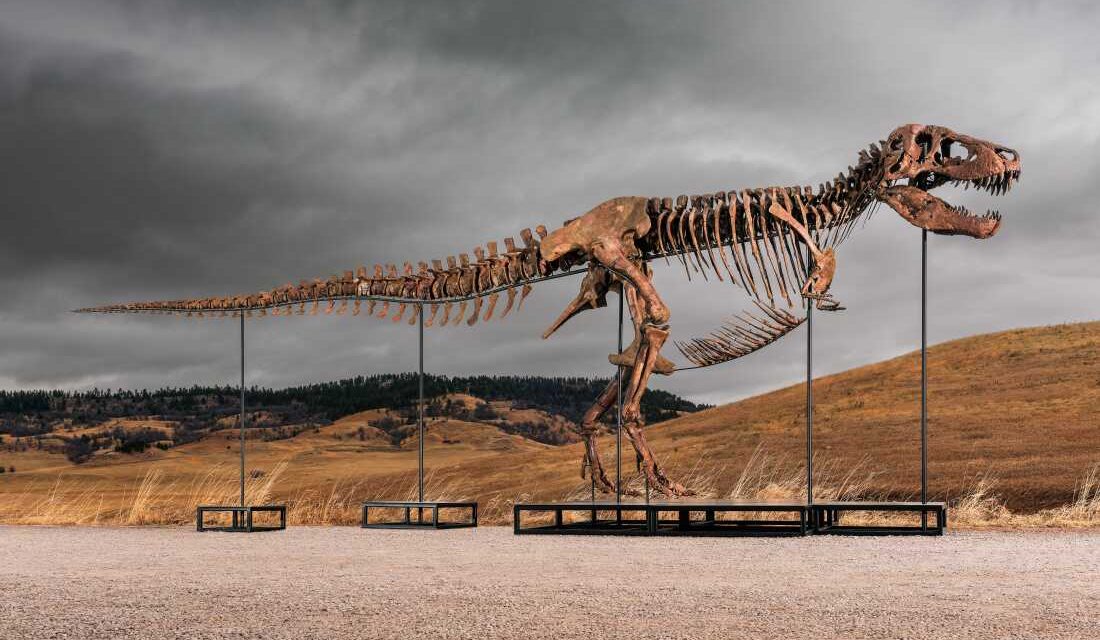
The auction house Sotheby’s has announced the record sale of a Tyrannosaurus rex fossil, known as “Gus,” for an unprecedented $50.1 million. The sale, conducted in New York, sees “Gus” becoming the most expensive set of dinosaur bones ever to be auctioned, surpassing a previous price record set by a stegosaurus at $45 million in 2024. This record was held before by a Tyrannosaurus rex called “Stan,” which sold for nearly $32 million in 2020.
Details of the Specimen
“Gus,” standing 12 ½ feet tall and measuring 38 feet in length, is approximately 61% complete. The specimen features an “exceptionally preserved” skull with powerful teeth and two well-represented feet. Notably, there are rare bones like the furcula, or wishbone. Discovered on a ranch in South Dakota in 2021, the fossil was named in memory of property owner Gary Licking, who passed away during its excavation, restoration, and mounting.
The Auction Process
The auction unfolded with bidders engaging energetically. The winning bid came through an anonymous participant by phone, outbidding six others. Initially estimated to garner between $20 to $30 million, high anticipation surrounded this sale. Auctioneer Phyllis Kao urged buyers to “try a bigger bite,” highlighting the competitive nature of this event.
Scientific Community’s Perspective
The Society of Vertebrate Paleontology, comprised of scientists and scholars, advocates for fossils like “Gus” to be exhibited in public institutions. They stress that such specimens should be accessible for scientific research and educational purposes. The society hopes the new owner will donate “Gus” to a museum, ensuring its contributions to science continue.
Precedents exist for such actions. “Apex,” a previously sold stegosaurus, is exhibited at the American Museum of Natural History. Similarly, “Sue” the T. rex holds a prominent position at the Field Museum in Chicago. “Stan” is displayed in Abu Dhabi, prominently featured in a prehistoric combat setting.
The Tyrannosaurus Rex Legacy
The Tyrannosaurus rex, meaning “King of the Tyrant Lizards,” dominated the late Cretaceous period. Recognizable by its powerful jaws and distinctive small arms, it continues to captivate public imagination. The species has been immortalized in popular culture, appearing in children’s shows and the “Jurassic Park” film series. During its reign, the region now known as western North America provided a rich habitat with high sea levels and fertile floodplains, supporting diverse prey like the triceratops.
 Climate-Resistant Rock Glaciers: Hidden Water Resources
  California Voters to Decide on $7.5 Billion State Research Fund
  Ancient Pottery Unearthed During Roadworks in Tbilisi
  U.S. Space Academy Announcement
  The Need for New Strategies in Oregon’s Wildfire Management
  Plastic Pollution in the Great Lakes: A Growing Concern