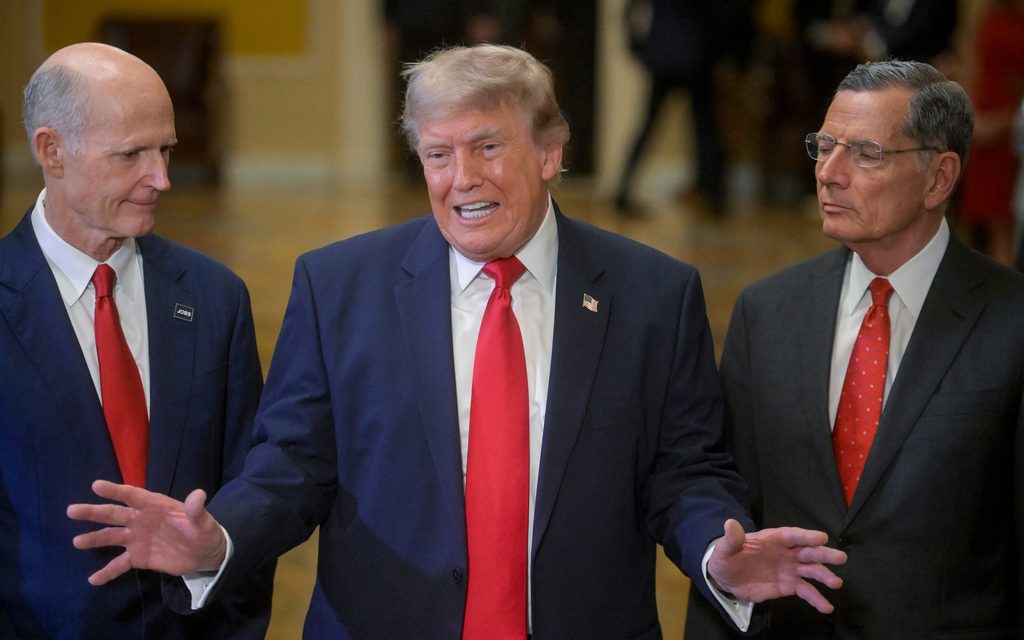
Last week, the Senate exhibited conflicting actions regarding the conflict with Iran by voting both for and against ending the war. President Donald Trump attended a closed-door meeting with Senate Republicans where he voiced frustration with four GOP senators who supported a resolution to limit US military activities in Iran. The resolution passed 50-48.
The president questioned why senators would back the war powers resolution. In response, Senator Bill Cassidy of Louisiana, recently defeated in his primary by a Trump-endorsed opponent, challenged Trump, highlighting unfulfilled objectives and the extended military mission. This led to a heated exchange between the two.
The administration claims the resolution is unconstitutional, citing the 1983 Supreme Court decision in Immigration and Naturalization Service v. Chadha, which invalidated a legislative veto on constitutional grounds. The Court’s decision prompted revisions of several laws to require presidential approval for finalizing resolutions. However, Congress did not amend the 1973 War Powers Resolution, leading to ongoing legal debates over its applicability.
Following the intense discussions, Senator Tim Kaine of Virginia proposed his own joint resolution needing executive endorsement. This motion failed 47-50 as Cassidy opposed and Senator Rand Paul voted ‘present’.
The Senate contended with Trump’s push for an immediate vote on the SAVE America Act, promising support for a bipartisan housing bill if passed. Without sufficient backing, the Senate adjourned early for a recess. Additionally, plans for the confirmation of Jay Clayton as director of national intelligence were disrupted when the president withheld his appearance until Clayton’s district court successor was confirmed.
Trump’s strategy of leveraging legislation and nominations has frustrated congressional leaders accustomed to organized scheduling. Such interference drew parallels to the control exerted in the 1941 movie “The Man Who Came to Dinner,” with Trump dictating terms not only for legislative priorities but also procedural order.
“A tough gut Congress has found these tactics challenging to handle,” observes Don Wolfensberger, a congressional veteran and author of works on legislative dynamics.
 Maryland First State to Restrict Electronic Pricing in Grocery Stores
  Activists Push for Nationwide Ban on Child Marriage in the U.S.
  Democratic Hopes and Historical Warnings in 2026 Senate Race
  Republicans Face Challenges Amidst Cost of Living Concerns
  A Different Kind of Fall for Congress This Year
  Cornel West and Sean Hannity Discuss Differences on Podcast