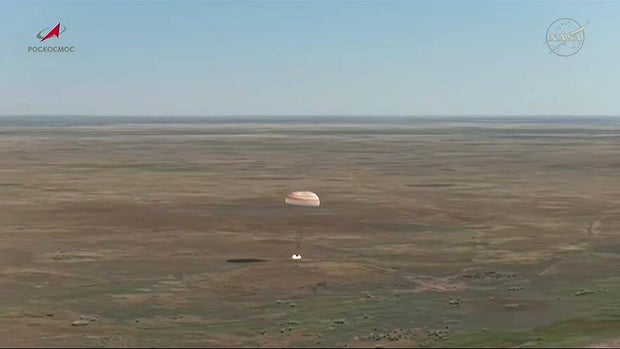
On July 26, 2026, at 7:35 AM EDT, two Russian cosmonauts and a NASA astronaut completed a 241-day mission aboard the International Space Station (ISS) by landing safely in Kazakhstan. The crew, consisting of commander Sergey Kud-Sverchkov, flight engineer Sergey Mikaev, and NASA’s Chris Williams, returned to Earth in a Soyuz MS-28/74S spacecraft.
Departure and Landing
The spacecraft undocked from the ISS at 3:03 a.m. EDT, leaving from the Russian Rassvet module. Two and a half hours later, the Soyuz’s braking rockets fired for nearly five minutes, initiating its descent to Kazakhstan. The crew module’s parachute ensured a controlled descent and landed near Dzhezkazgan at 6:27 a.m. EDT (3:27 p.m. local time).
Mission duration: 241 days, 3,856 orbits, covering 102 million miles since launch on November 27, 2025.
Following their landing, recovery teams promptly assisted the crew as they re-acclimated to Earth’s gravity. All crew members enjoyed initial medical checks, fresh fruit, and made phone calls to family. Kud-Sverchkov expressed his gratitude for the smooth landing and received a welcome home matryoshka doll from recovery crews.
Post-Landing Plans
After removing their pressure suits, the team traveled by helicopter to Karaganda, about 285 miles away. Williams headed back to the Johnson Space Center in Houston via a NASA jet, while Kud-Sverchkov and Mikaev returned to Star City near Moscow.
Throughout the mission, Williams completed two spacewalks and credited his crewmates for their teamwork. He described Kud-Sverchkov and Mikaev as intellectually curious, noting their valuable discussions and shared experiences.
Remaining aboard the ISS is NASA Crew 12, led by Jessica Meir, along with Jack Hathaway, European Space Agency astronaut Sophie Adenot, and cosmonaut Andrey Fedyaev. Additionally, newly arrived Soyuz MS-29/75S crew members Pyotr Dubrov, Anna Kikina, and Anil Menon replaced the departing team.
Chris Williams’ Journey
Before his NASA selection in 2021, Williams had diverse experiences as a firefighter, emergency medical technician, and astrophysicist. He shared that his fascination with space began in childhood and developed into a lifelong passion.
While on the ISS, Williams reflected on the unique perspective of observing Earth from space and imagined experiencing similarly profound moments if he were to visit the moon.
 SpaceX Successfully Launches Starship Flight 14 into Orbit
  Pentagon Confirms US Possession of Space Weapons Amid Rising Tensions
  Countering Fear: A Pilot’s Approach to Calm Nervous Flyers
  Challenges in Establishing a Unique Identity for the United States Space Force
  NASA Launches Major Space Telescope for Cosmic Exploration
  NASA’s Roman Space Telescope Embarks on Mission to Unravel Cosmic Mysteries