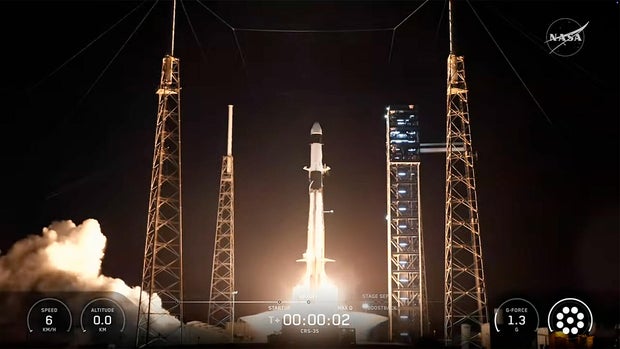
On Tuesday, a SpaceX Falcon 9 rocket successfully launched an unpiloted Dragon cargo ship, heading towards the International Space Station (ISS) for a delivery scheduled early Thursday. The spacecraft carries over 6,300 pounds of supplies, including research materials, spare parts, and necessary items for the crew.
An essential part of the cargo includes two roll-out solar array blankets, which are the final sets in an ongoing upgrade project. This upgrade aims to address the deterioration of the ISS’s original solar wings. Since June 2021, six IROSA blankets have been installed during spacewalks. The new seventh and eighth arrays will be installed later this month and early November.
The Falcon 9 booster activated its engines at 6:33 a.m. EDT, producing 1.7 million pounds of thrust to lift off from Cape Canaveral Space Force Station. After two-and-a-half minutes, the first stage separated, returning to Cape Canaveral, while the second stage continued into orbit. Observers, including those at Kennedy Space Center, were treated to a view of the ISS in orbit 260 miles above.
The first stage successfully landed back near its launch site at 6:41 a.m., and shortly after, the second stage engine shut down, releasing the Cargo Dragon to proceed independently towards the ISS.
The launch yielded a remarkable visual known as the “jellyfish effect,” with the Falcon 9’s exhaust plume being illuminated by sunlight.
The Cargo Dragon is equipped with more than 6,300 pounds of supplies, encompassing 844 pounds for the crew, 1,307 pounds of scientific equipment, 417 pounds of spacewalk gear, and 880 pounds of vehicle hardware. Included are fresh foods such as oranges, apples, grapefruit, tomatoes, blueberries, baby carrots, and mini sweet peppers. These supplies also feature a pizza kit, cookies, candies, and special holiday items.
The IROSA solar arrays, weighing 2,635 pounds on Earth, are housed in the Dragon’s unpressurized trunk section. Each array generates 20 kilowatts of power, enhancing the ISS’s power output to optimal levels. Dana Weigel, director of low-Earth orbit operations, explained that these arrays are installed over older ones and will work in tandem. They feature more efficient solar cells, boasting a higher energy density, which leads to improved power generation.
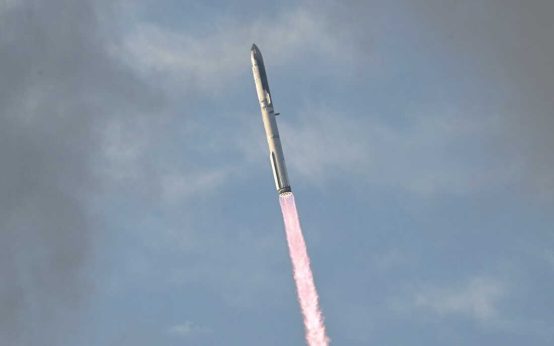 SpaceX Successfully Launches Starship Flight 14 into Orbit
  Pentagon Confirms US Possession of Space Weapons Amid Rising Tensions
  Countering Fear: A Pilot’s Approach to Calm Nervous Flyers
  Challenges in Establishing a Unique Identity for the United States Space Force
  NASA Launches Major Space Telescope for Cosmic Exploration
  NASA’s Roman Space Telescope Embarks on Mission to Unravel Cosmic Mysteries