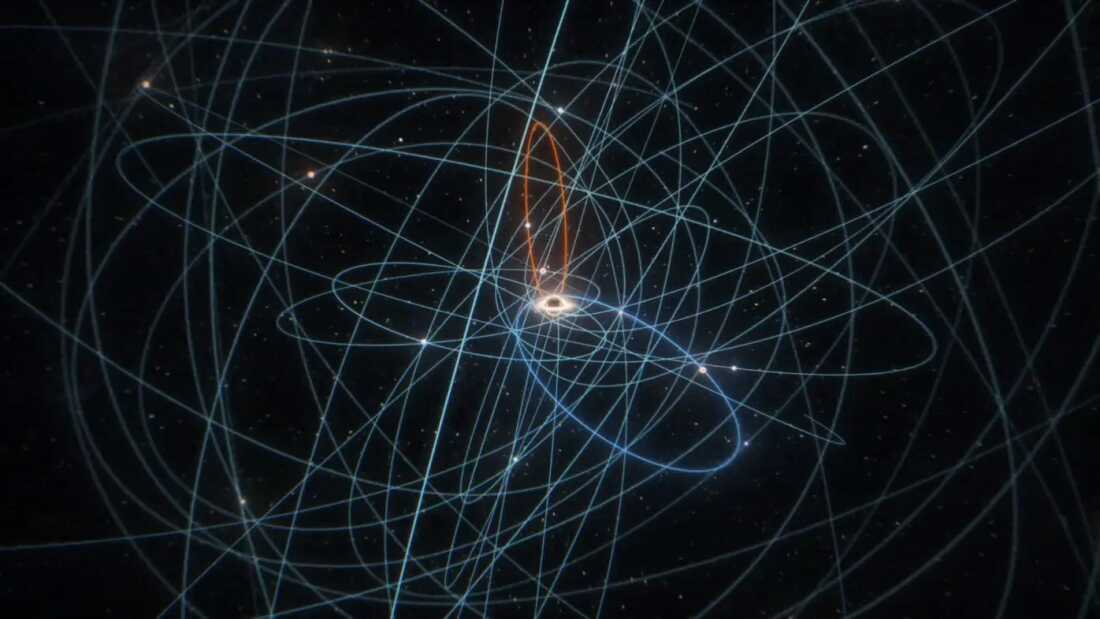
The image captures the orbital paths of stars around the massive black hole at the center of the Milky Way. Among these, star S301 approaches the black hole closely, traveling over 15,000 miles per second at its nearest point.
In 2002, scientists determined the mass of a massive entity central to our galaxy. This object is four million times the mass of the Sun and is almost certainly a supermassive black hole. Stefan Gillessen, an astronomer at the Max Planck Institute for Extraterrestrial Physics, likens it to the depiction in the film ‘Interstellar.’ It consists of a dark shadow with a halo of light, hard to view directly, as black holes emit no light.
In research published in ‘Nature,’ Gillessen discusses a record-breaking star orbiting the Milky Way’s central black hole, Sagittarius A*. The star’s speed is noteworthy, but its proximity to the black hole is more significant. This proximity allows scientists to use the star to study gravity’s effects on space and time.
The Black Hole Next Door
Black holes, despite their gravitational power, remain mysterious. Researchers like Gillessen want to learn how they function and influence their surroundings. The Milky Way’s center is an ideal study location due to its accessibility.
Using the European Southern Observatory’s telescopes in Chile, Gillessen and his team gathered infrared light to see through cosmic obstructions and examine the galaxy’s core. Felix Mang, a Ph.D. student, identified a faint star moving rapidly in their data, later confirmed as S301.
The Fastest Star
Mang tracked S301’s movement, noting its elongated elliptical orbit, with the black hole at one end. At its closest, the star reaches impressive speeds over 15,000 miles per second, nearly 8% of the speed of light. This speed makes it the fastest star observed in the galaxy.
Understanding S301’s orbit helps researchers measure the black hole’s gravitational potential and visualize the effects of gravity on space and time.
Exciting Discoveries Ahead
This discovery sets the stage for unprecedented black hole measurements in the coming decade, says astrophysicist Erin Kara of MIT. Analyzing S301 could offer insights into the spin of Sagittarius A*, a feat not previously achieved for a quiescent black hole. Such measurements can provide clues to the black hole’s origin and the formation of our galaxy.
Kara values black holes for their exotic nature and fundamental roles in galaxy formation. The scenario imagined by Gillessen, where an alien on a planet orbiting S301 witnesses the black hole every nine years, highlights the cosmic wonder of these celestial behemoths.
 The Threat of Melting Glaciers: A Call to Action
  Climate-Resistant Rock Glaciers: Hidden Water Resources
  California Voters to Decide on $7.5 Billion State Research Fund
  SpaceX Successfully Launches Starship Flight 14 into Orbit
  Ancient Pottery Unearthed During Roadworks in Tbilisi
  U.S. Space Academy Announcement