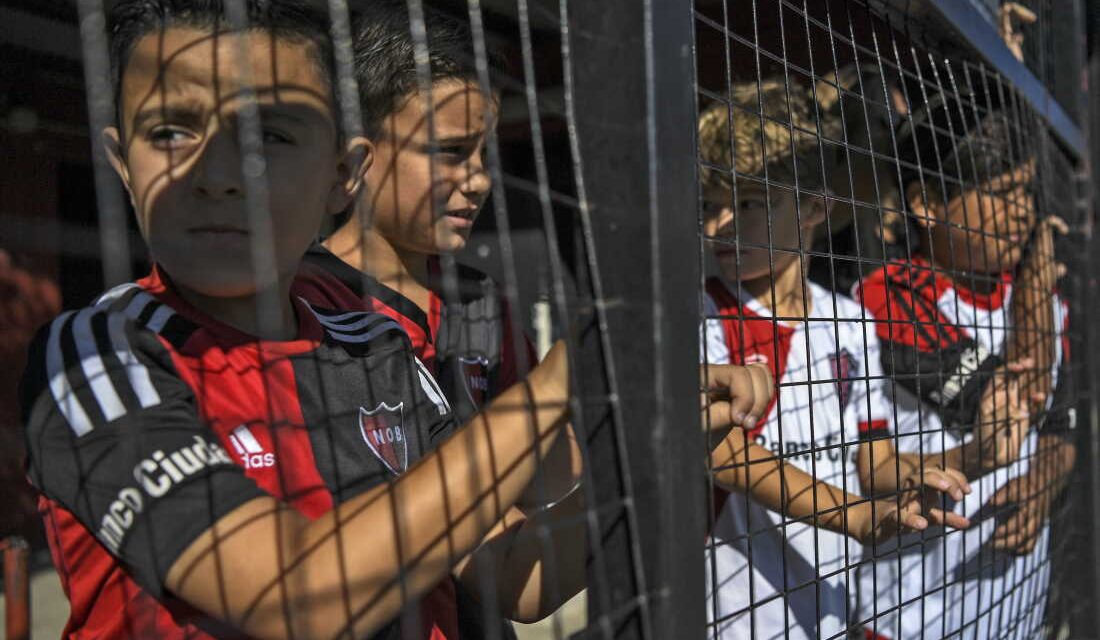
Children eagerly await their turn to play football at the minor leagues of Newell’s Old Boys club in Rosario, Argentina, where Lionel Messi once honed his skills. Situated in Argentina’s third-largest city, Newell’s Old Boys stands out as a popular soccer club, known for its successful youth academy. Approximately 700 children, aged 4 to 12, train weekly at its central city facility decorated with black and red murals, celebrating famous alumni like Messi.
Newell’s academy, known as ‘baby football,’ offers scholarships to its most promising young talents, allowing them to train for free. Those without scholarships pay a modest fee of about $25 monthly for bi-weekly sessions led by coaches, many of whom are former professionals. Weekends are reserved for competitive matches against other local teams.
Carlos Gil, a fencing contractor, takes his eight-year-old son to practice, emphasizing the importance of good coaching and skill development. He expressed surprise upon comparing training costs in Argentina with the steep prices in the United States, ranging between $1,000 and $3,000 annually. Gil highlighted how such costs could impede access to soccer and potentially threaten Argentina’s status as a soccer powerhouse, given that its top players often hail from modest backgrounds.
‘Our best players tend to come from low-income backgrounds,’ Gil noted. ‘Where would they train?’
With recent World Cup enthusiasm, discussions have emerged in the U.S. about making youth soccer more affordable. Critics argue that the prevalent pay-to-play model may hinder U.S. men’s soccer from reaching its full potential. In contrast, Argentina exemplifies a model that balances affordability with the production of world-class players, prompting some coaches to suggest that the U.S. could learn from Argentina’s soccer structure.
Newell’s Old Boys, the club where Messi played from ages 6 to 13, is among the numerous Argentine clubs subsidizing young player training without relying on tuition fees or corporate donations. The club’s professional team, competing in Argentina’s top division, generates revenue through ticket sales and broadcasting rights. Additionally, substantial funds come from transferring young talents to other clubs globally.
Gustavo Tognarelli, head of youth development at Newell’s, stated, ‘The kids that we are training today are what sustains this institution.’
In the U.S., youth clubs lack access to transfer payments, contrasting sharply with practices in Europe and South America. Here, youth clubs receive portions of transfer fees for players they coached from ages 12 to 23. Rory O’Neill, a youth coach in Pennsylvania, noted that U.S. clubs depend heavily on parental payments due to limited revenue streams. He advocated for transitioning the U.S. soccer system to an open ecosystem where poor-performing teams face relegation to lower divisions, while successful teams rise to higher leagues, thereby incentivizing investment in youth academies.
O’Neill explained, ‘If you train a player and they move to a bigger club, you get nothing for that.’
An open system, similar to Argentina’s, could potentially motivate small investors across the U.S. to invest in clubs, attracting more financial backing into soccer. Filippo Silva, a coach and business owner from Orlando, concurred, emphasizing the merit-based approach’s ability to foster investment opportunities.
‘In Argentina, where soccer operates with promotion and relegation, thousands of clubs have the potential to reach the top division,’ Silva remarked.
Newell’s invests in roughly 400 players aged 12 to 18, who train six times per week, funded by player transfers and solidarity payments. Some younger players, such as Dastan Gil, practice twice a week with scholarships. For Carlos Gil, despite challenges like traveling from his small town 120 miles away, Newell’s affordable setup lightens the burden. He concluded, ‘In Argentina, we might not have so much money, but in some areas, we have a better quality of life.’
 The True Value of Youth Sports
  Controversy Surrounding Virginia Tech vs. Pittsburgh Game
  Controversy Unfolds as Broadcaster is Let Go Over Old Tweets
  Rethinking Youth Sports: Balancing Opportunity and Health
  Chicago White Sox: The Underdog Story Captivating Baseball Fans
  Suspected Plague Death in Siberia Sparks Health Measures