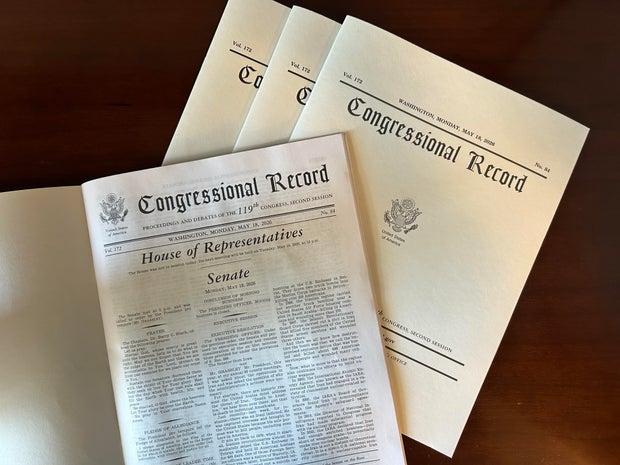
Every night while Congress is in session, a dedicated group of workers in a large red-brick building near the Capitol creates a key record of legislative history. This structure houses the Government Publishing Office (GPO), responsible for producing the Congressional Record. The Record has been the complete daily account of Congressional proceedings since 1873, capturing both speeches and routine business with precision and care.
History of the Congressional Record
Before the first publication of the Congressional Record in 1873, details about Congress’s internal workings were scarce. Newspapers provided inconsistent and sometimes biased coverage of floor proceedings. Daniel Holt, an associate Senate historian, explained there was a clear demand for accurate records, but no formal structure to provide them. This necessity led to the production of the Congressional Record by the GPO on March 5, 1873.
Lyndon B. Johnson, then Senate Majority Leader, highlighted its importance in 1956, stating that it documents debates, resolutions, bills, and legislative actions critical to the Senate and House’s purpose.
The Record, printed on significant days on 11 x 8.5 inch paper, varies in length based on congressional activity. It provides a substantially verbatim account of Capitol Hill proceedings, including sections like the “Daily Digest” and “extensions of remarks.” The latter allows members to add speeches or tributes not spoken on the floor, which has occasionally sparked controversy.
Creation Process
The creation of the Congressional Record starts in the Capitol itself, where a team logs every spoken word. Floor reporters using stenotype machines capture speeches at high speeds. These notes are then converted into polished documents by editors, known as scopists. This process takes significantly longer than the original speech, requiring meticulous editing.
After editing, material is sent to the GPO, where it undergoes final corrections. The building, established in 1903 and once the world’s largest printing plant, houses a team of 70 who ensure the Record is ready before the next congressional session. Paper copies, essential for resolving discrepancies, win out over digital files whenever inconsistencies arise.
Each day, proofreaders in the GPO mark up documents with formatting notes. Though the process is from another era, it remains efficient, running primarily in the early morning hours. Finally, specialized printers produce the paper copies, ready for Capitol Hill delivery.
Modern Challenges and Adaptations
In the past, the GPO printed up to 50,000 copies daily; now, it’s about 1,500, mostly for libraries and institutions. The agency balances between its traditional paper-focused operations and modern digital capabilities through govinfo.gov, converting documents into digital files accessible online.
GPO Director Hugh Halpern acknowledges the need for gradual modernization while maintaining quality. Investments are being made to improve publishing systems and adapt to advancing technology, including exploring AI for proofreading tasks. However, the precision of human proofreaders remains unmatched by current technology.
Despite an evolving technological landscape, the pursuit of a new generation of the Congressional Record is ongoing. Halpern emphasizes that while they’re still on this journey, their focus remains firm on serving both Congress and the public efficiently.
 The Trump Team’s Challenge to the Military Leadership
  Maryland First State to Restrict Electronic Pricing in Grocery Stores
  Activists Push for Nationwide Ban on Child Marriage in the U.S.
  Democratic Hopes and Historical Warnings in 2026 Senate Race
  Republicans Face Challenges Amidst Cost of Living Concerns
  A Different Kind of Fall for Congress This Year