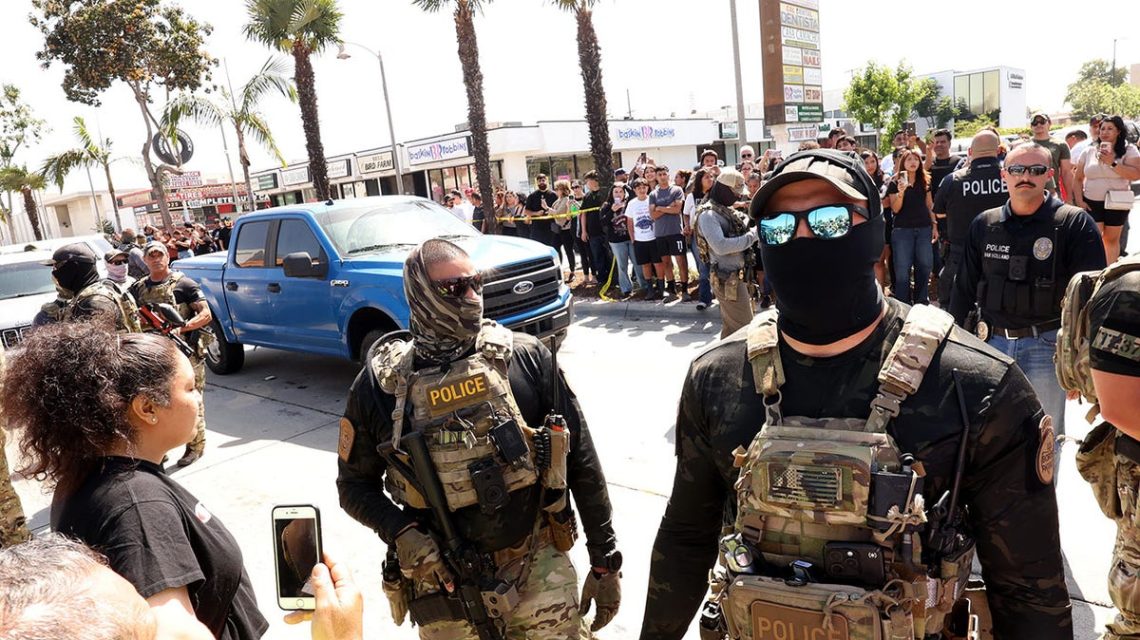
The Trump administration achieved a legal victory at an appeals court known for its liberal leanings. This court temporarily halted a part of a California law. The law required plainclothes federal law enforcement to display badges and identification during operations. The 9th Circuit Court of Appeals stated that the Trump administration would likely prevail in its lawsuit against California. The court found that the identification requirement in the No Vigilantes Act breached the Constitution’s supremacy clause. This clause prioritizes federal law over state law when conflicts arise.
The court’s order counters past conflicts this appeals court had with the Trump administration. Previously, the court blocked the administration on several key immigration policies. These included stopping efforts to reduce federal funding for sanctuary cities in 2018, limiting asylum eligibility, and refusing to reinstate a travel ban targeting mainly Muslim countries in 2017.
“Section 10 explicitly overrides the federal government’s power to determine whether, how, and when to publicly identify its officers,”
This decision represents a setback for California’s Democratic Governor Gavin Newsom. Newsom, a probable 2028 presidential candidate, has been a strong critic of Trump’s immigration policies. His administration enacted a series of protective laws for immigrant communities. The laws aim to curtail federal immigration enforcement and offer increased oversight on federal agents.
The Trump administration sued California over certain aspects of the No Vigilantes Act and the No Secret Police Act. These included measures that restricted law enforcement officers’ apparel. In November 2025, Judge Christina Snyder initially blocked the mask restriction for federal officers but allowed the identification requirement to remain. The administration appealed this decision. The 9th Circuit initially blocked the identification requirement in February and later issued an injunction pending appeal in April.
California contended that the identification rule did not infringe on the federal government’s regulatory power, asserting that a state law breaches this only when it applies “substantial burdens on federal operations.” However, the appeals court disagreed, ruling California lacked authority to regulate federal officers directly.
The burden of the regulation on federal operations, whether substantial or otherwise, is irrelevant,
the court wrote.
This ruling drew support from Trump administration officials. Brett Shumate, assistant attorney general for the Justice Department’s Civil Division, emphasized that California cannot regulate federal law enforcement.
“The Ninth Circuit agrees that California cannot regulate federal law enforcement,” Shumate stated.
Associate Attorney General Stanley Woodward Jr. reiterated the court’s stance. “Today, the Ninth Circuit again affirms what common sense makes clear: California cannot regulate how Federal law enforcement officers carry out their jobs authorized by Congress. Today’s decision is a huge WIN for protecting the safety of our Nation’s law enforcement officers and ensuring @POTUS ‘s promise to enforce our Nation’s immigration laws.”
Fox News Digital sought comments from Newsom’s office. The outcome carries implications for state-federal law enforcement relations and regulatory powers.
 Former U.S. Ambassador to Greece Accused of Ethical Violations
  Challenges Facing Modern Polling
  The Impact of Recent Supreme Court Decisions on Democratic Politics
  Brit Hume Challenges Trump’s Media Ban and Its Effectiveness
  Republican Senate Hopes Rise in Minnesota
  Cartel Drone Use Increases Along the US-Mexico Border