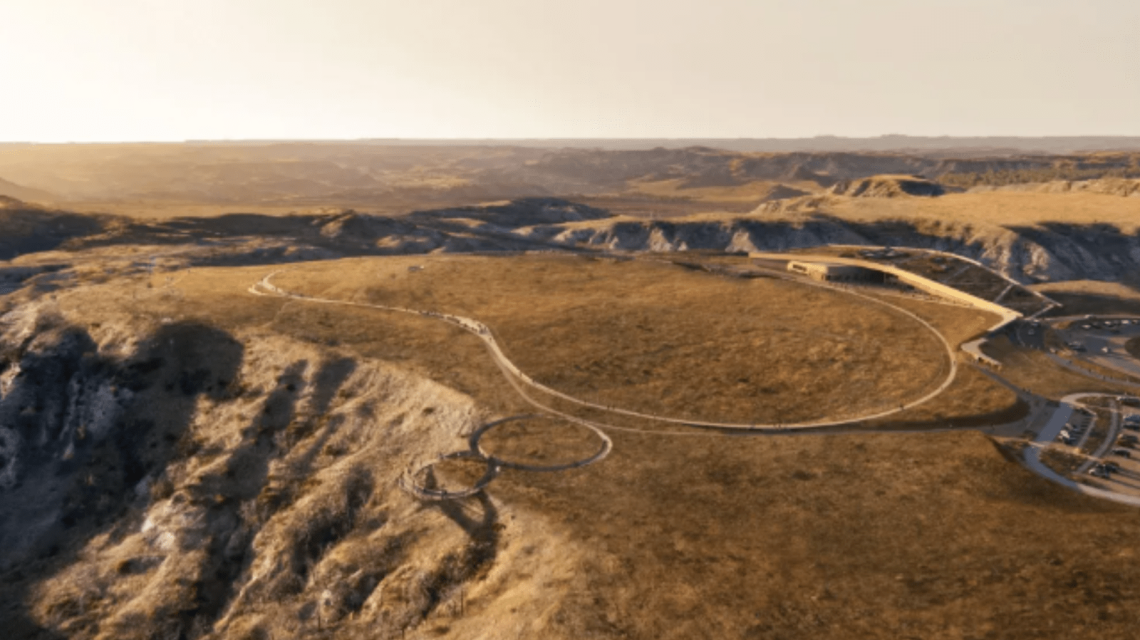
President Donald Trump will travel to North Dakota next week to attend the dedication of the Theodore Roosevelt Presidential Library. This takes place a few days before the library officially opens to the public as part of the United States’ 250th anniversary celebrations. According to organizers of Freedom 250, which coordinates events for the nation’s semiquincentennial celebration, Trump will visit the library in Medora on July 1. The library, honoring the nation’s 26th president, will open to the public on July 4.
Freedom 250 released a statement highlighting Trump’s participation in the dedication ceremony: “By participating in the dedication of the Theodore Roosevelt Presidential Library, President Trump will celebrate a leader whose life and accomplishments continue to inspire Americans to dream big, act boldly, and leave the nation stronger for future generations.” While Trump is expected at next Wednesday’s event, he did not attend the recent opening of the Obama Presidential Center in Chicago. Valerie Jarrett, CEO of the Obama Foundation, mentioned that Trump was not invited but could request a tour if interested. Newsweek has reached out to the White House for comments.
Inside the Theodore Roosevelt Presidential Library
Located in the North Dakota Badlands, the expansive museum and research center offers insights into Roosevelt’s life and legacy. Notably, Roosevelt attributed his time in the Badlands with shaping his character during personal hardships. Edward O’Keefe, CEO of the library, noted that Medora was chosen over Roosevelt’s native New York due to the significant influence the area had on his leadership and principles.
O’Keefe, who authored a book on Roosevelt’s personal life, shared with CBS News that Roosevelt moved to the Badlands after losing his mother and wife on the same day in 1884. “At the funeral of his wife and mother—it was a double funeral—he was so desolate and so depressed, that they were concerned for his own safety,” O’Keefe explained. He emphasized, “He was a broken man, in a broken land, and nature was his healer.”
This library is one of North Dakota’s major cultural projects, with construction costs estimated around $450 million. Private donations primarily funded the facility, with financial backing from state lawmakers, including a credit line from the state-owned Bank of North Dakota, to support construction funding commitments.
The building was designed by Snøhetta, a Norwegian architecture firm, to integrate with the surrounding prairie and Badlands. Additionally, it is promoted as the first carbon-neutral presidential library and overlooks the Little Missouri River near Theodore Roosevelt National Park.
Unlike conventional presidential libraries, Roosevelt’s library offers much of its experience outside. Visitors traverse an elevated boardwalk over the Badlands to reach the museum, which is partially embedded in the prairie. There, visitors can interact with an AI archive and engage with a digital version of Roosevelt.
Why Is Theodore Roosevelt Gettings a Presidential Library Now?
Presidential libraries preserve presidential papers, artifacts, and records for the public. Roosevelt, who died in 1919, did not have a dedicated presidential library since the system was established after his death. The concept originated in the 2010s when North Dakota business leaders, historians, and Roosevelt’s descendants campaigned to build a permanent institution.
Who Was Theodore Roosevelt?
Theodore Roosevelt, serving from 1901 to 1909, remains one of the most significant figures in U.S. political history. He expanded the presidency’s power, took on corporate monopolies through antitrust measures, and positioned the U.S. as a more active global presence.
Roosevelt is celebrated for his conservation efforts, having safeguarded approximately 230 million acres under federal protection during his presidency. This laid the groundwork for modern conservation efforts, contributing national forests, wildlife refuges, monuments, and parks according to the National Park Service.
He still holds the record as the youngest person to assume the presidency, taking office at 42 following President William McKinley’s assassination in 1901. Roosevelt later secured a full presidential term on his own.
 Defense Secretary Emerges as Key Player in the Trump Administration
  Hegseth’s Vision for the Military: Balancing Tradition and Innovation
  Significant Funding Boosts Ken Paxton’s Texas Senate Campaign Amid Tight Race
  U.S. States Extend Gas Tax Waivers Amid Rising Fuel Costs Due to Iran Conflict
  USCIS Raises Immigration Fees
  The Surveillance Threat to U.S. Federal Agents