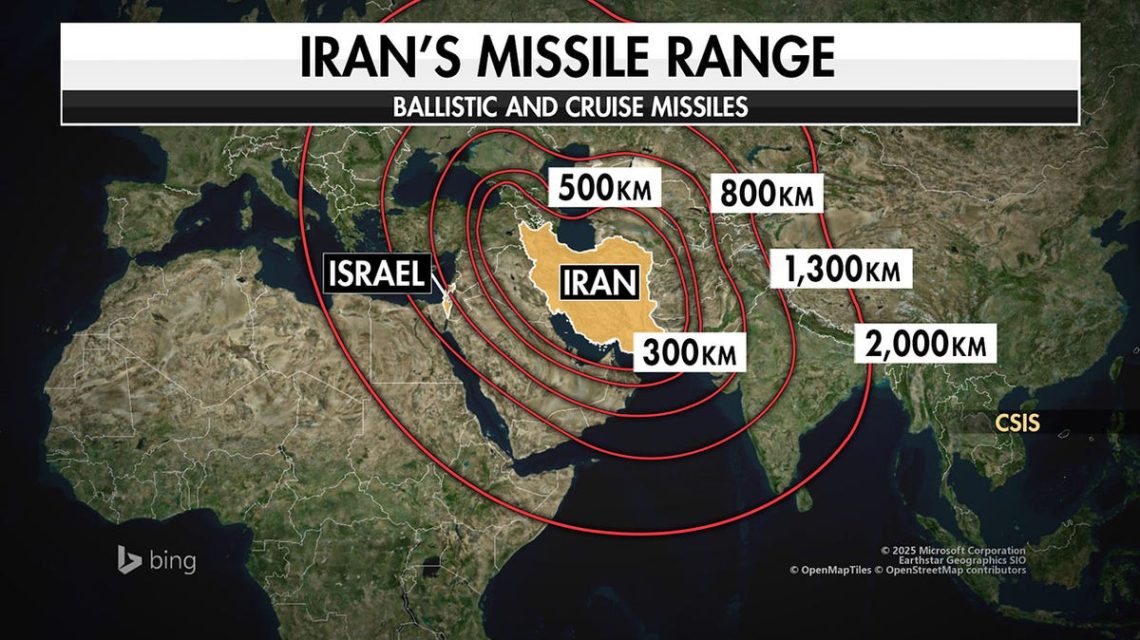
Senior officials in the Trump administration argued for months that Iran’s ballistic missile arsenal posed a significant threat. They said it shielded Tehran’s nuclear plans, motivating the U.S. to launch Operation Epic Fury. But President Trump has changed the narrative.
During the G7 international forum in Évian-les-Bains, France, Trump questioned the fairness of restricting Iran’s missile capabilities. “If other countries have them, it’s unfair for them not to have some,” Trump commented. He compared the situation to Saudi Arabia and Qatar, suggesting it might be acceptable if Iran maintained missiles relatively proportional. “Missiles aren’t the problem. They harm small areas, but they don’t destroy the planet,” he remarked.
The Gulf nations will address the nonnuclear issues; we’ll discuss ballistic missiles and their terrorist proxies. We don’t want those issues to happen,Trump added.
A map highlights the range of missiles fired from Iran, showing the areas within reach. Israeli officials have reportedly warned about potential solo military action against Tehran due to its missile capabilities.
The administration had previously stressed that Iran must not hide behind a massive missile stockpile. On March 3, Secretary of State Marco Rubio said, “Iran can never have a nuclear weapon, and we will not allow them to shield themselves with their missile inventory.” He emphasized that Iran was building conventional weapons as cover for their nuclear program.
Operation Epic Fury had a central objective of degrading Iran’s missile capabilities. Trump and other officials, like War Secretary Pete Hegseth and Press Secretary Karoline Leavitt, stressed the mission focused on eliminating Iran’s missile power. “Our objectives are clear: first, destroy Iran’s missile capabilities,” Trump said at the White House.
Throughout the operation, Rubio argued the destruction of Iran’s missile force was crucial to limit their conventional military power. “The President laid out our objectives clearly: destroy their air force, their navy, diminish missile capabilities, and eliminate factories,” said Rubio on March 30.
Trump’s remarks also raised questions about the administration’s stance on Iran’s nuclear program, portraying the approach as more flexible. He discussed Iran’s right to nuclear power for electricity purposes at the G7, weighing common sense in the discussion.
The memorandum of understanding with Iran leaves unresolved the dispute over enrichment capabilities. A framework agreement will see the U.S. and Iran negotiate Iran’s enriched uranium stockpile fate. Although Iran’s willingness to dilute its stockpile is a noted concession, the ultimate permission regarding enrichment capability remains unclear.
The administration, previously firm against allowing Iran nuclear enrichment, seems to have softened its stance. Special envoy Steve Witkoff had stressed not allowing Iran “even 1%” enrichment capability.
The State Department spokesperson referenced Trump’s recent remarks, stating, “We are going to let the President’s comments stand.” Meanwhile, the Pentagon was not immediately available for comment.
 The Surveillance Threat to U.S. Federal Agents
  Trump Administration Distributes ACA Refund Checks
  Trump Administration’s Approach to Illegal Alien Deportations
  New Jersey Voter Fraud Prompts Renewed Push for SAVE Act
  Concerns Over Changes to Voter-Registration Form for Americans Abroad
  Trump’s 2024 Campaign Targets Young Men Through Cryptocurrency