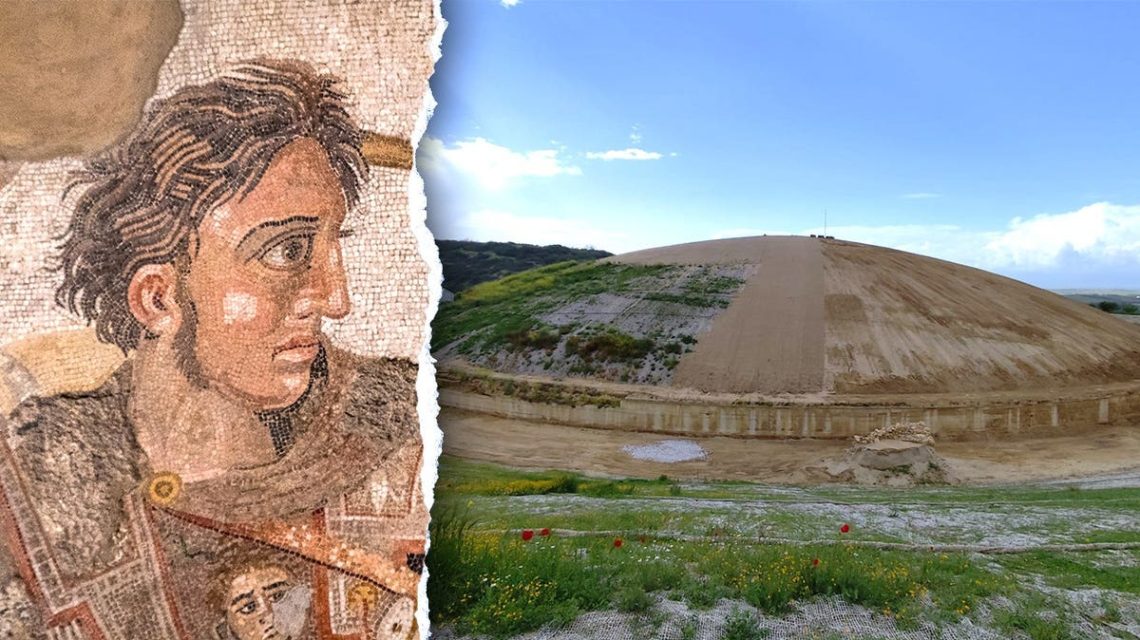
Greek officials have revealed the interior of a large ancient tomb in Amphipolis, possibly connected to Alexander the Great, as archaeological work continues. The announcement was made by Greece’s Ministry of Culture on May 11.
The excavation is centered on the Kasta Tomb, located in the ancient city of Amphipolis in northern Greece, northeast of Thessaloniki. The restoration has unveiled the full enclosure of the site, showing the monumental scale of the tomb.
The enclosure, dating back to the 4th century B.C., measures approximately 1,630 feet in circumference, surrounding a burial mound more than 20 acres wide. This information was shared by Cover Media.
The ministry released images showcasing marble-lined corridors and detailed architectural features, indicating construction for a Macedonian elite. Officials have removed previous metal supports to reveal the tomb’s interior. Future plans include reinstalling the Macedonian marble door and restoring the sphinx sculptures that once guarded the entrance.
Lina Mendoni, the Greek Minister of Culture, highlighted the monument’s significance, stating that the restoration work has emphasized its historical importance and value.
Amphipolis is connected to significant figures of the Macedonian kingdom, including generals Nearchus, Hephaestion, and Laomedon, who lived in the city. The Ministry of Culture’s website notes that after Alexander’s death, the city remained loyal to his mother, Olympias, and surrendered to Cassander, a successor of Alexander, on her orders. Cassander later imprisoned and killed Alexander’s wife Roxana and his son, Alexander IV.
Alexander the Great, who ruled from 356 B.C. until his death in 323 B.C., created an empire across Europe, Asia, and Africa. He defeated the Persian Empire before dying at the age of 32 under unclear circumstances.
The Kasta Tomb is believed to have been constructed for someone closely related to Alexander, possibly his mother, a wife, or an associate. National Geographic reported this theory in 2014.
In recent developments, authorities aim to restore parts of the sphinx sculptures that guarded the tomb’s entrance. This project is one of several archaeological efforts linked to Alexander the Great.
Earlier in 2026, Fox News Digital highlighted the discovery of a lost city founded by Alexander, named Alexandria on the Tigris, near the Persian Gulf in southern Iraq.
 British Police Arrest Man Suspected of Terror Plot
  Activists Push for Nationwide Ban on Child Marriage in the U.S.
  Investigation into Alleged Incident at Cornell University
  Rising Drone Threats Highlight Vulnerabilities in Moldova’s Airspace Defense
  Bolivia Faces Security Test Amid Unrest
  Incident on FlyDubai Flight Raises Security Concerns