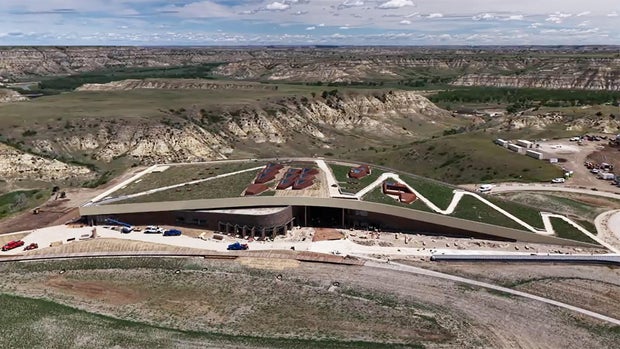
Theodore Roosevelt stands as one of America’s most beloved presidents, often ranking among the top five favorites. This July 4th, his legacy will be honored with the opening of the Theodore Roosevelt Presidential Library. However, the location may surprise many. Instead of being situated in his native New York, this library emerges from the North Dakota Badlands.
Spanning 96,000 square feet, the library is a subtle tribute to Roosevelt’s enduring influence, akin to his likeness on Mt. Rushmore. Architect Craig Dykers emphasized the transformative power of nature, stating, “Nature is transformative here. It transformed Theodore Roosevelt, and it will transform new visitors to this library.” The library’s design features a gently sloping roof that mimics the surrounding buttes, covered in native grasses, offering a scenic view of the adjacent Theodore Roosevelt National Park.
Dykers asserts, “We wanted something that just felt primitive… this form emerging from the Earth, it felt like it just arrived from the Earth.” The library’s interior will rely on natural illumination from skylights and walls composed of compressed earth. This design merges seamlessly with nature.
“The light has gone out of my life,” Roosevelt wrote in his diary following the deaths of his mother and wife.
Roosevelt’s journey to the Badlands began with personal tragedy. On Valentine’s Day 1884, both his mother and wife died in the same house. Devastated, Roosevelt sought solace in the Dakota Territory, reshaping himself from a “broken man” to a figure of resilience.
Edward O’Keefe, CEO of the library and author of “The Loves of Theodore Roosevelt: The Women Who Created a President,” sheds light on Roosevelt’s transformation. Despite his privileged background, Roosevelt embraced the rugged lifestyle of the Dakota cowboys, redefining his life goals and ambitions.
The library aims to capture this raw experience. O’Keefe explains, “Library and museum are the two worst descriptions of what the TR Library actually is… It’s a call to adventure.” Leveraging artificial intelligence, visitors can interact with a virtual avatar of Roosevelt, engaging in immersive experiences rarely seen in other presidential libraries.
Furthermore, it stands apart by incorporating elements like hitching posts for horses, nature walks, and campfire storytelling sessions. Visitors can explore Roosevelt’s cabin and reflect on his heritage.
While the library provides entertainment, it also prompts candid reflections on Roosevelt’s legacy. Theodore Roosevelt V asserts, “There’s plenty of things named after him, plenty of statues… we get to face those issues head-on.” This includes Roosevelt’s controversial views on indigenous peoples. The library engaged with local tribes to ensure representation and context.
The institution also houses a statue previously displayed at the American Museum of Natural History, stirring discussions on racial representation. O’Keefe emphasizes preserving Roosevelt’s life and legacy while addressing these themes.
Ultimately, the library conveys the importance of courage and resilience in the face of adversity. “The strong man stumbles,” as Roosevelt noted, but those who rise and challenge themselves define progress. The library encourages visitors, especially the youth, to initiate change actively.
For more information, visit the Theodore Roosevelt Presidential Library in Medora, ND, opening this July 4th. Explore Theodore Roosevelt National Park and discover the profound impact Roosevelt’s experiences in the Badlands had on his life.
 Troy Swanson: Award-Winning Librarian Transforming Academic Libraries
  Lisdoonvarna Matchmaking Festival: A Unique Tradition
  Midwest Underground Railroad Network Gains National Recognition
  Art Collective Critiques Administration with Mall Installation
  American Hagwon: A Tale of Family and the Korean Diaspora
 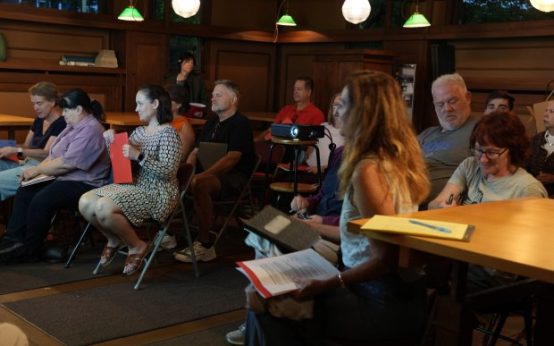 Volunteer Enthusiasm Shines at Frank Lloyd Wright Home and Studio