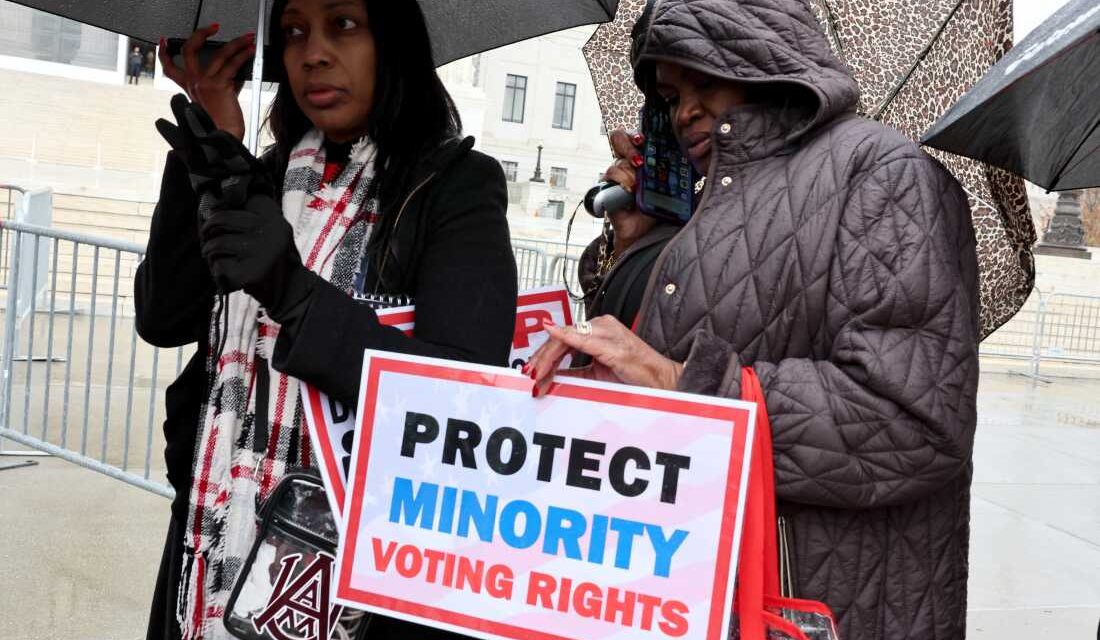
In 2025, demonstrators rallied outside the U.S. Supreme Court, holding signs that read ‘PROTECT MINORITY VOTING RIGHTS.’ The court’s recent decision has aroused significant concern over voting rights protection. The choice not to review a lower court ruling presents a challenge to the Voting Rights Act. The ruling stems from an Arkansas lawsuit that impacts several Midwestern states.
The Supreme Court’s refusal leaves the appeals panel’s decision intact. This decision affects Arkansas, Iowa, Minnesota, Missouri, Nebraska, North Dakota, and South Dakota. The crux of the ruling denies private individuals and groups the ability to enforce Section 208 of the Voting Rights Act. This section traditionally allows voters with disabilities or literacy difficulties to receive assistance from a person of their choice.
Earlier in the year, the Supreme Court’s conservative majority weakened the Voting Rights Act’s Section 2. This triggered widespread redistricting across the nation. In May, the court opted not to explore the ‘private right of action’ further. This pertains to cases from Black and Native American voters in Mississippi and North Dakota.
Historically, private lawsuits have played a significant role in enforcing the Voting Rights Act. However, Justice Neil Gorsuch’s opinion in 2021 raised doubts about the private right of action. Following this, Republican officials have argued that only the U.S. attorney general can bring these lawsuits. Such a stance may limit voting rights litigations due to the Justice Department’s resource constraints and changing priorities.
The Arkansas United group initiated the case dismissed by the Supreme Court. They sought to support voters with limited English proficiency using Spanish-language interpreters. Their challenge targeted an Arkansas law that limits assistance to a maximum of six voters, not poll workers. A 2022 federal ruling suggested this law violated Section 208. Nonetheless, state officials appealed, leading to the 8th Circuit ruling against private group lawsuits.
The 8th Circuit is the only federal appeals court defying years of precedent regarding private rights of action under Sections 2 and 208. This development affects how voting rights lawsuits can be pursued in these states.
 The Trump Team’s Challenge to the Military Leadership
  Maryland First State to Restrict Electronic Pricing in Grocery Stores
  Activists Push for Nationwide Ban on Child Marriage in the U.S.
  Democratic Hopes and Historical Warnings in 2026 Senate Race
  Republicans Face Challenges Amidst Cost of Living Concerns
  A Different Kind of Fall for Congress This Year