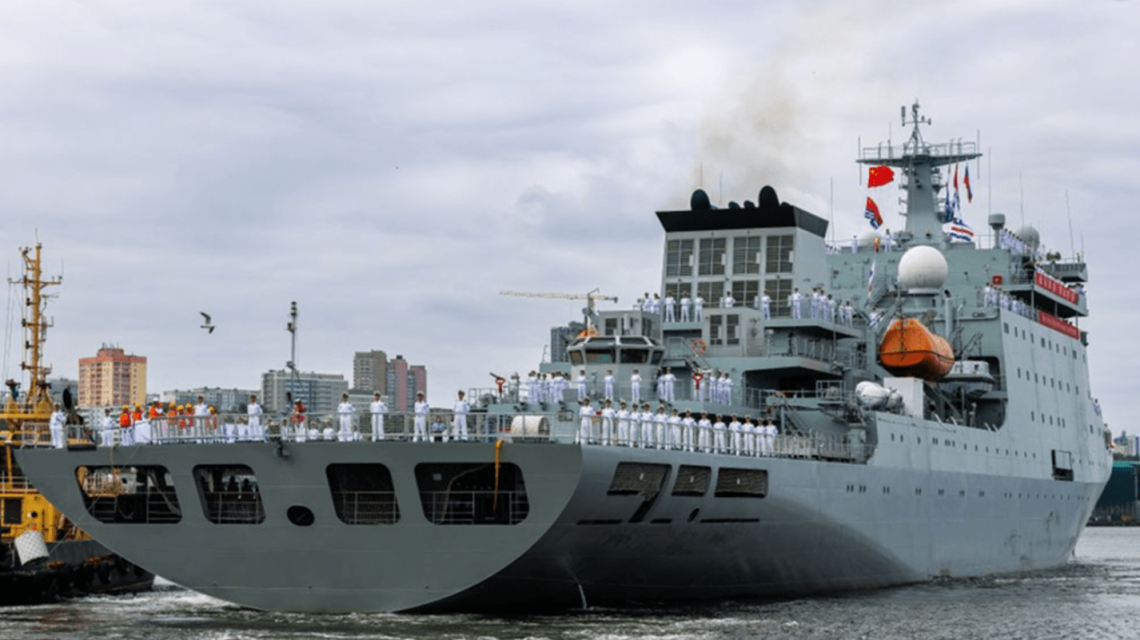
A Chinese naval flotilla arrived in Russia’s port city of Vladivostok, enhancing military relations between Beijing and Moscow amidst growing tensions with the United States and its allies in the western Pacific. The People’s Liberation Army Navy’s Task Force 83, consisting of the training ship Qi Jiguang and the amphibious dock landing ship Kunlunshan, docked in Vladivostok—home to Russia’s Pacific Fleet—upon the invitation of the Russian Navy. Photographs shared by Chinese state media, Xinhua, show spectators waving flags along the waterfront to welcome the vessels.
While maintaining a neutral public stance on Russia’s conflict with Ukraine, China has bolstered Russia’s economically strained position through increased bilateral trade. This includes dual-use exports and rising purchases of discounted Russian oil and gas. The United States and its European allies often depict China as a “decisive enabler” of Russian President Vladimir Putin’s ongoing military actions.
In a show of strengthened ties, Putin and Chinese leader Xi Jinping renewed their strategic partnership during Putin’s recent visit to Beijing. Both leaders pledged to enhance cooperation in defense, energy, and technology sectors. China’s Defense Ministry emphasized both nations’ commitment to expanding practical cooperation following a statement issued before the Chinese ships arrived in Vladivostok.
Naval Cooperation
The current deployment is labeled a “long-distance sea internship,” allowing Chinese sailors to interact with Russian naval officers. China and Russia have systematically intensified their security collaborations through joint air and naval exercises. A notable development occurred in 2025 when, despite a dip in joint drills to six from a high of 14 in 2024, the nations executed their inaugural joint submarine exercise, as stated by the Center for Strategic and International Studies.
The Congressional Research Service highlights Russia’s navy as central to its aspirations for global power. The extensive Russia-PRC naval exercises underscore a familiarity and trust between their naval forces, possibly exceeding ground military cooperation.
U.S. and Allied Concerns
The U.S. Coast Guard has raised alarms about heightened Chinese and Russian patrols near Alaskan territories. Their coordinated military activities evoke concerns in Japan and South Korea, key U.S. allies in Northeast Asia. In December, joint Chinese-Russian bomber patrols over the Sea of Japan and international waters prompted Japan’s Air Self-Defense Force to deploy fighter jets. Japanese Defense Minister Shinjiro Koizumi warned that such maneuvers represent a show of force and pose a significant concern for Japan’s national security.
While lacking a formal military alliance, Beijing and Moscow remain united in opposing U.S. military dominance. Their efforts aim to advocate for a multipolar international order, challenging the established global power structures.
 British Police Arrest Man Suspected of Terror Plot
  Activists Push for Nationwide Ban on Child Marriage in the U.S.
  Investigation into Alleged Incident at Cornell University
  Rising Drone Threats Highlight Vulnerabilities in Moldova’s Airspace Defense
  Bolivia Faces Security Test Amid Unrest
  Incident on FlyDubai Flight Raises Security Concerns