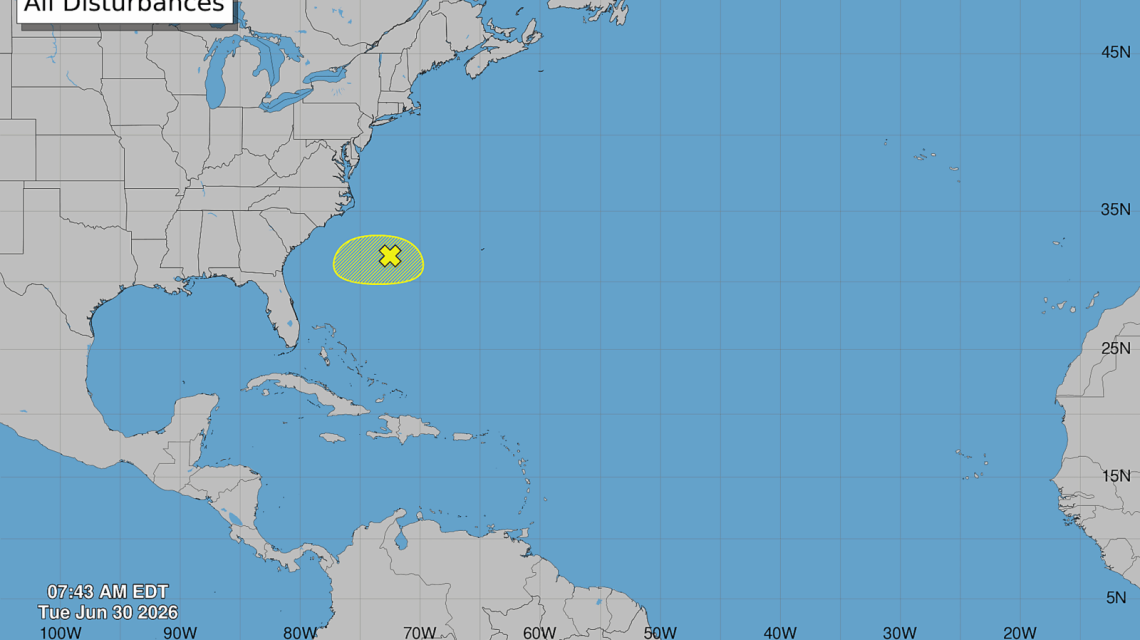
A low-pressure system off the southeastern U.S. coast might become Tropical Storm Bertha as it heads towards Florida. Forecasters are observing a narrow opportunity for it to develop into a tropical storm. The National Hurricane Center (NHC) reports that the disturbance offshore remains poorly organized, with just a 10 percent chance of developing in the next two days.
Environmental conditions are becoming less conducive for significant strengthening as the system nears Florida. Despite this, if it adequately forms and gains a name, it will be Bertha, the second named storm of the 2026 Atlantic hurricane season. The NHC noted on Tuesday that the disturbance is moving south and should shift west later in the week.
AccuWeather’s Lead Hurricane Expert, Alex DaSilva, suggested potential development on Wednesday or Thursday, making this period crucial in deciding if it advances to a tropical depression or storm before hitting Florida.
If named, Bertha would be the second storm of a season that NOAA predicts to be relatively quiet. The NOAA’s forecast includes eight to 14 named storms, with three to six becoming hurricanes and one to three major hurricanes. They remind us that even a quieter season can bring destructive storms.
NOAA estimates a 55 percent chance of a below-normal hurricane season due to expected El Niño conditions. El Niño increases wind shear over the Atlantic, which makes forming tropical systems more challenging. Hurricanes require a calm, vertically stable atmosphere to grow, but upper-level winds from El Niño can disrupt and weaken storms.
DaSilva noted that wind shear might not be too strong, though dry air from a cold front can hinder development. He explained that a heat dome affecting the Midwest and East Coast could push dry air into the system, preventing it from developing further.
The disturbance is expected to move near the Gulf Stream in coming days. Any tropical depression would likely form there, DaSilva stated. Though it requires monitoring, the primary concern is increased rip currents along Florida’s eastern coast to the Carolinas.
“We need to watch it. Storms can gain energy off the East Coast and become a tropical depression,” DaSilva mentioned, while AccuWeather does not dismiss the possibility of development.
If a tropical depression emerges, it could form by July 1 or 2 when the system reaches warmer Gulf Stream waters. However, the disturbance is associated with limited moisture, so the main threat remains rip currents. As many head to beaches during a heatwave, DaSilva warns of ocean safety due to elevated rip current dangers.
Additionally, the NHC is tracking another disturbance in the Pacific Ocean with an 80 percent chance of developing within the next 48 hours.
 Rare Bison Skull Discovery in Alberta Raises Questions About Its History
  Atlantic Disturbance May Become Third Named Storm of 2026
  Canada’s Battle Against Wildfires Intensifies with Military Standby
  NOAA Withdraws Direct Support from 2026 Arctic Report Card
  Mayor Johnson Orders Stricter Data Center Regulations in Chicago
  NOAA Withdraws Support from Arctic Report Card