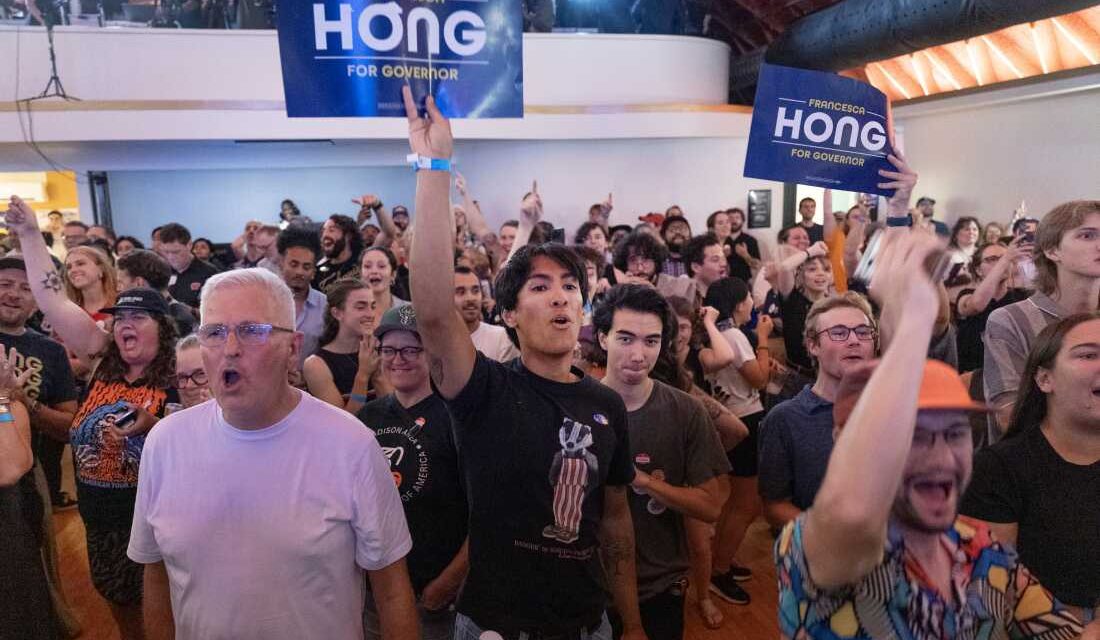
Supporters of Francesca Hong, a Democratic candidate in Wisconsin, gathered in Madison on election night. Although Hong narrowly lost the primary, she sparked interest as a self-described democratic socialist. Swing voters may not quickly dismiss socialist candidates.
Focus groups held in Nevada revealed insights into voter attitudes. Among 12 participants, 10 expressed no automatic bias against politicians with left-wing views. These voters, who supported differing presidential candidates from 2020 to 2024, included a mix of independents, Republicans, and Democrats.
I don’t just take one thing and label or judge,said Jasmine, a 33-year-old independent voter.
Another participant, Melody, a 37-year-old independent, echoed her sentiment, saying she seeks solutions for equality in basic needs before forming opinions.
On the same night as Hong’s primary, the Democratic Party’s direction was a topic of discussion. Some wonder if democratic socialist wins could alienate centrist voters. A Pew Research Center survey found mixed views about democratic socialist leaders among Democrats and a neutral stance in the broader American populace.
Focus groups offer snapshots of voter opinions. These sessions, facilitated by Engagious and Nelson Recruiting, partnered with NPR as part of the Swing Voter Project. Rich Thau, Engagious’s president, noted the overall openness toward democratic socialism.
I was struck by the receptivity,Thau remarked.
Participants also discussed differences between conventional Democrats and democratic socialists. Marianne, a 57-year-old independent, perceived traditional Democrats as centrist with corporate ties, while socialist Democrats focused on community.
Despite varying understandings of socialism, voters like Justin, a 39-year-old independent, sensed socialist Democrats catered more to public interests than business ones.
Even voters skeptical of socialism acknowledged some merits. Freddy, a 34-year-old independent, criticized socialists for radical positions but noted their aggressive policies to balance wealth.
Economic concerns fuel shifting political openness. 10 of 12 voters expressed heightened economic anxiety since Trump took office. Rising debts and costs contributed to their anxieties.
I feel anxious that nothing has really changed,stated Katrina, 53, reflecting widespread economic unease.
Thau connects this anxiety with openness to new political ideas. Financial struggles drive acceptance of different economic systems. Marianne and others described increasing personal debts largely due to rising costs, which strain household finances.
Participants distinguished socialism from communism. Despite favorable views of the former, they expressed aversion to communism.
Communism, it’s very ingrained as negative,Justin concluded.
Political rhetoric continues to blur lines between socialism and communism. Terms like ‘communist’ are frequently used in political discourse to challenge opponents.
 Investigation into Thomas Crooks’ Assassination Attempt
  Supreme Court Allows Trump Administration to Continue Third-Country Deportation Policy
  Trump Rallies Support in GOP Strongholds as Midterm Elections Approach
  Brazil’s Next Election: Familiar Faces and High Stakes
  Iowa Steel Plant: Incentives and Political Maneuvering
  Strategies for Democrats Leading Up to Election Day