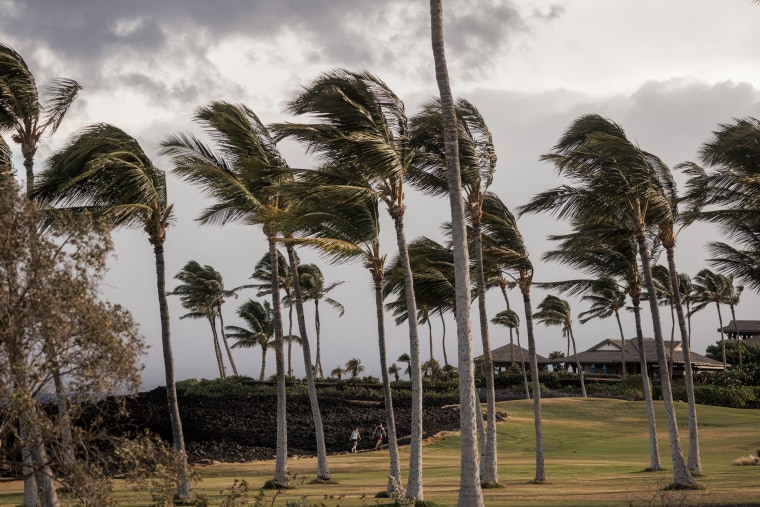
Hurricane Lala has decreased in strength to a tropical storm as it veered past Hawaii. Despite not striking the land, severe conditions continued to challenge the Big Island. Nearly three feet (1 meter) of rainfall on elevated windward slopes threatened to turn rivers into violent currents and raised the risk of mudslides.
Tropical storm conditions advanced westward from Maui to Oahu and Kauai. The National Hurricane Center alerted that wind speeds on mountain tops and along slopes often exceed the surface wind speeds used for storm classification by up to 30%.
Massive waves battered the Big Island’s shores as Lala slowly moved past, bringing gusty winds that bent palm trees and filled waterways with fast-moving rain runoff.
“More than 130,000 households lost power on Sunday morning across Hawaii’s three largest islands,” stated poweroutage.us. At least three hospitals were reported to be relying on generator power, according to Governor Josh Green.
In the South Point area, a fatal car accident occurred, and 19 roofs were damaged, the governor reported. The storm impacted numerous roads, with crews already responding to over 30 locations.
Rescue Efforts Underway
A multi-agency search-and-rescue effort was initiated, comprising Civil Defense, the National Guard, and the Coast Guard, after flash floods appeared to have swept several residences off foundations in the coastal towns of Na’alehu and Wai’ohinu on the island’s southern edge, Hawaii County Mayor Kimo Alameda reported.
“The situation is complicated by rushing water, debris, and boulders blocking roads, and it’s happening at night,” Alameda noted.
Future Concerns
Tropical storm warnings were issued for Maui, Molokai, Lanai, Kahoolawe, Oahu, Kauai, and Niihau as the storm continued westward, posing potential flooding and further threats, such as wildfires ignited by strong winds.
As of early Sunday, Lala was positioned about 105 miles (170 kilometers) west-northwest of Kailua-Kona and approximately 100 miles (160 kilometers) south of Honolulu, with tropical-storm-force winds reaching around 175 miles (280 km) from the center.
Lala’s maximum winds were logged at 70 mph (110 kph), moving northwest at 15 mph (24 kph). Forecasters predicted it could regain hurricane strength once clear of the island chain.
Mauna Kea volcano’s higher altitudes might receive up to 35 inches (89 centimeters) of rain, enough to destabilize slopes where some of the 210,000 islanders reside in makeshift housing.
Preparing for Impact
In anticipation of the hurricane, shelters were set up, events canceled, and ranchers were advised to leave cattle in open areas rather than in potentially dangerous structures. Many residents still handle the damage from recent floods in March and remained cautious.
Bobby Camara, 75, from near Hilo, intended to “stay put and hope for electricity continuity” at a care home. Gas stations were bustling as individuals acquired fuel for chainsaws and automobiles.
“People here learn to be self-reliant,” Camara explained.
Mike Caputo, located near the east coast in Keaau, had his power generator ready and a full water tank holding 10,000 gallons (37.8 kiloliters). His anxiety focused on flash flooding and falling trees, especially the large yet weak albizia trees.
Christine Matsuda, residing in Waimea, described powerful gusts rattling her house and unexpected leaks appearing amid the conditions.
The hurricane center projected 8 to 12 inches (20.3 to 30.5 centimeters) of rain on Maui and lower Big Island areas, with 4 to 6 inches (10.2 to 15.2 centimeters) anticipated over the remaining islands.
 Mayor Mamdani Responds to Netanyahu’s United Nations Speech
  British Prosecutors Charge Man with Terrorism Over Politician’s Murder
  Backlash Against Trump’s White House Photos
  State Department Accuses Senate Democrats of ‘Grandstanding’ Over Venezuela Oil Deal
  EU Plans Deportation of Rejected Asylum Seekers
  British Police Arrest Man Suspected of Terror Plot