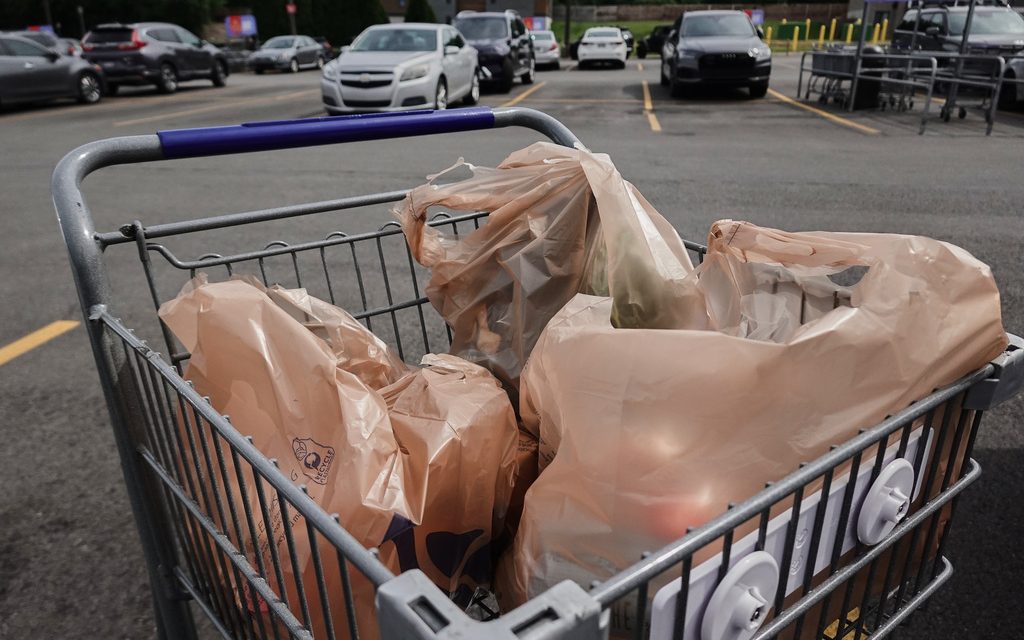
Plastic bags with groceries sit in a cart in Cincinnati on Monday, May 18, 2026. If you notice the classic “chasing arrows” symbol on your next takeout container, you might assume it will be recycled as long as you place it in the correct bin. However, this assumption could be misleading.
The symbol, created by a California college student for the first Earth Day in 1970, originally indicated that a product was recyclable. In the late 1980s, the Society of the Plastics Industry — now the Plastics Industry Association — adopted the chasing arrows icon to classify plastic types, regardless of their recyclability.
The reality is stark: less than 9% of plastics in the U.S. undergo recycling. Despite generating the most plastic waste globally, most plastics end up in landfills, are exported, or poorly managed, harming the ocean. Scientists estimate that a truckload of plastics enters the ocean every minute worldwide. On beaches, unrecyclable plastics predominate. Even a small amount ingested can be deadly to marine life; just less than a sugar cube’s worth of plastic can kill half of Atlantic puffins.
The gap between consumer perception of the chasing arrows symbol and reality highlights regulatory failures. Americans, and their waterways and coastlines, deserve improvement.
Recently, a new bill was introduced to tackle this issue. The Truth in Labeling Act aims to clarify recycling labels for consumers, mitigate greenwashing, and reduce contamination in U.S. recycling streams. This legislative effort marks significant progress in America’s plastics policies.
Proposed by Sen. Jeff Merkley (D-Ore.) and Rep. Lou Correa (D-Calif.), the Truth in Labeling Act establishes clear federal guidelines for labeling products as “recyclable,” “compostable,” or “reusable.” To label a product as recyclable, companies must prove that typical consumers can recycle the product and that there is a market for the recycled material. The bill prohibits counting harmful chemical recycling methods as legitimate recycling.
The Truth in Labeling Act also restricts the use of the chasing arrows symbol on non-recyclable items, preventing consumers from being misled about the recyclability of products.
Two other bills attempted to address recycling label clarity: the PACK Act and the Recycled Materials Attribution Act. However, these bills have relaxed standards, further enabling greenwashing. For example, the Recycled Materials Attribution Act allows plastics transformed into fuels via harmful chemical processes to receive recycling credit. This could mean a plastic item might be labeled as “100% recycled content” even if made chiefly from new plastic.
The PACK Act, marketed as reducing consumer confusion, leaves determining recyclability to third-party certifiers, some established by the very industry that created the confusion. Like the Recycled Materials Attribution Act, it also inhibits state-level actions for transparency.
To end ocean plastic pollution, reducing plastic production is critical. This reduction necessitates an effective recycling system that Americans can easily comprehend. The Truth in Labeling Act aims to provide the necessary reform for recycling clarity and efficacy.
Anja Brandon, Ph.D., is the director of plastics policy at Ocean Conservancy.
 Supreme Court’s New Term Tackles Climate Liability and Key Legal Battles
  Tick Crisis on Martha’s Vineyard: A Growing Health Threat
  Colorado’s Emissions Regulation and Its Broader Implications
  The Threat of Melting Glaciers: A Call to Action
  Collapse of Hawai’i’s Hōlei Sea Arch Amidst Storms
  Los Angeles Faces Uncommon Heatwave in October