On Saturday, Iceland held a vote on whether to restart membership discussions with the European Union. The nation is sharply divided, with debates centering on the cost of living, security, sovereignty, and control over fishing waters. A recent Gallup poll indicated a slight majority against reopening talks, marking a change from earlier surveys that showed a slight lead for supporters.
Campaign Insights
Advocates for revisiting EU talks argue that joining the bloc could alleviate high interest rates and enhance security amidst global uncertainties, including tensions from the Ukraine conflict and concerns about U.S. foreign policy strategies. Critics, however, fear EU membership would jeopardize sovereignty and control over crucial fishing territories.
“Today is our encounter with history,” remarked Iceland’s former President Ólafur Ragnar Grímsson, a vocal opponent of EU membership, on social media.
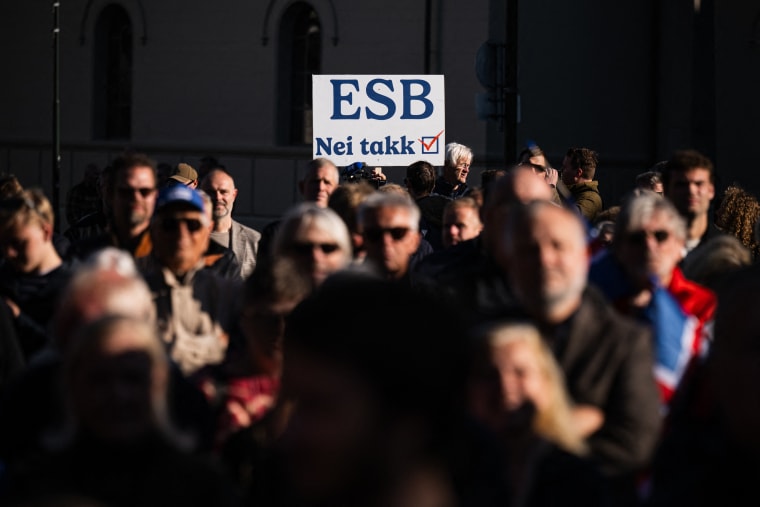
An image captured a supporter of the ‘No’ campaign holding a placard during a rally in Reykjavik on August 27, as part of the campaign efforts.
Potential Outcomes and Historical Context
If voters approve reopening membership discussions, it would initiate conversations with Brussels. Iceland would eventually conduct a second referendum to decide on joining the EU. Iceland first pursued EU membership in 2009 due to a severe financial crisis but halted negotiations in 2013 as a result of a Eurosceptic government.
Renewed Momentum Amid Global Changes
Recent geopolitical disruptions have reenergized the debate within Iceland. Foreign Minister Thorgerdur Katrin Gunnarsdottir, a supporter of resuming talks, emphasized that current global challenges require small nations to reconsider their alliances and strategies.
Domestic Concerns Highlighted
Within Iceland, discussions have emphasized economic issues like interest rates, fishing rights, and the cost of living rather than security. The country struggles with high inflation and steep mortgage rates. Proponents of EU talks suggest membership and possibly adopting the euro might provide some economic relief. Iceland’s central bank rate stands at 8%, contrasting sharply with the European Central Bank’s 2.25%. Vilhjalmur Hilmarsson, chief economist at Viska, stated that while EU membership wouldn’t fix all structural issues, it could stimulate economic health.
Guðrún Hafsteinsdóttir, leading the ‘No’ campaign, argued that economic challenges cannot be resolved by Brussels and must be addressed by Icelandic policymakers.
Fishing Rights Concerns
Under EU regulations, fishing quotas are determined by historical patterns, which might allow Iceland to maintain control over its waters. However, skeptics doubt these assurances. Hafsteinsdóttir expressed skepticism about the permanence of promised flexibility.
A foreign ministry memo suggests that if talks restart, negotiations could commence by the end of 2026 and last 18 to 24 months. However, Iceland plans a general election by November 2028, adding to the political complexity of any negotiations.
Polling stations across Iceland, home to approximately 400,000 residents, are scheduled to close at 6 p.m. ET.
 The Threat of Melting Glaciers: A Call to Action
  Police Discover Ancient Roman Artifacts Off Sardinian Coast
  Urgent Need for Action in East Africa’s Food Crisis
  Suspected Plague Death in Siberia Sparks Health Measures
  G7 Nations Agree to Release 100 Million Barrels of Oil Amid Fuel Price Surge
  Co-Pilot Attempts Hijack on Flight to Tel Aviv