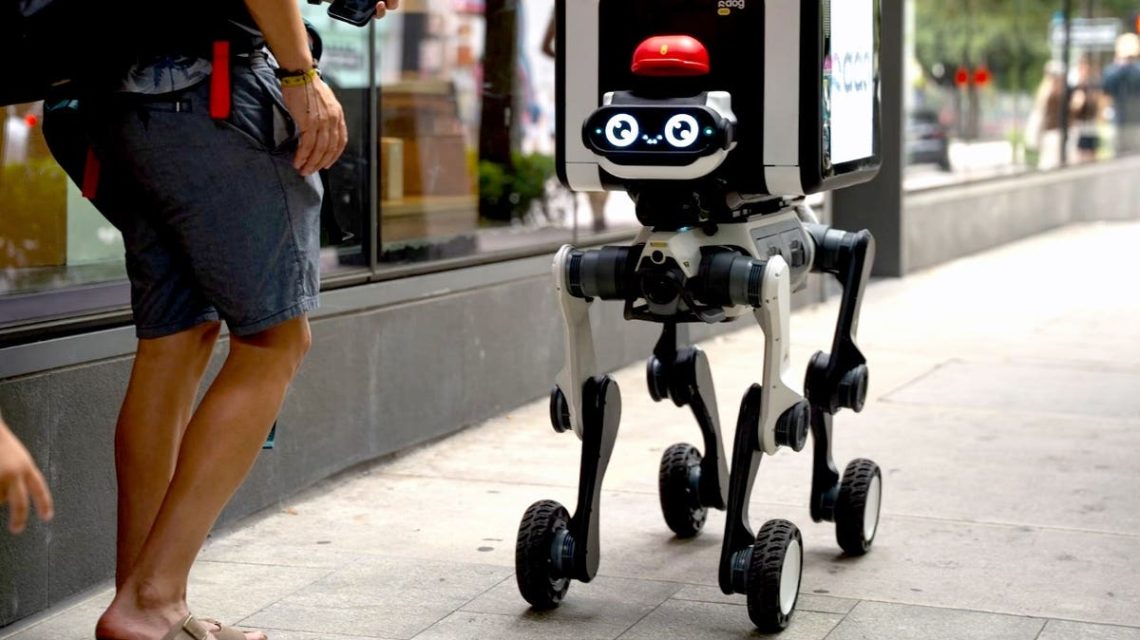
Robot dogs have been making headlines, especially those that patrol with police and navigate challenging terrains. One common question often arises about these machines: How do they handle stairs? Robot.com’s new innovation, the four-legged R-dog, might offer an answer. Built to carry packages where wheeled robots falter, it also features screens for advertising, transforming deliveries into moving billboards.
Understanding the R-dog Concept
Unveiled on August 11 by the San Francisco-based Robot.com, the R-dog aims to address the challenge of delivering packages to doorsteps. Wheeled delivery robots excel on flat surfaces but struggle at curbs and stairs. The R-dog combines wheels with articulated legs to traverse these final hurdles.
Each leg ends in a wheel, allowing efficient movement on smooth terrain. For obstacles such as stairs or curbs, the flexible legs offer a solution. The robot’s body is primarily a cargo compartment capable of transporting food orders and standard packages. Its design mimics a dog, complete with a tail, making it more personable in public spaces.
The Challenge of Stairs for Delivery Robots
Getting a delivery robot from the street to the door can be more challenging than a cross-town trip. Traditional delivery robots perform best on predictable surfaces like sidewalks but falter at stairs or awkward entrances. Robot.com designed R-dog to conquer these obstacles, thus expanding autonomous delivery options in complex environments such as campuses or neighborhoods.
R-dog’s Unique Delivery System
The R-dog carries multiple items, including stacked orders. Upon reaching a destination, it uses an automated drop-off system. Packages slide out from the back, allowing the robot to continue its route without human intervention. However, Robot.com hasn’t detailed how it selects the correct package from multiple items, a crucial point to address before public deployment.
Integration of Advertising
More than just a delivery tool, R-dog functions as a mobile advertising platform. It has video screens integrated into its side through R-ads, Robot.com’s advertising network. These screens allow for remote management of ad campaigns, turning each trip into a dual revenue opportunity through delivery and advertising.
The engaging design and advertising potential could capture public attention, encouraging interactions and social media shares. Robot.com indicates it provides analytics on campaign performance, though specifics on data collection remain unclear.
AI and Navigation
For navigating dynamic environments, R-dog partners with FieldAI. Their models enable adaptation without prior mapping, helping R-dog adjust to unexpected conditions. Additionally, Robot.com’s REMI platform manages the fleet, allowing integration of the new design without developing a separate system. This approach builds on Robot.com’s existing expertise.
Robot.com’s Proven Experience
Founded in 2017, Robot.com already operates over 500 robots globally in markets including the U.S., Canada, and MENA regions. With models like R-kiwi and R-cargo, the company leverages its existing experience in both consumer and industrial applications.
Anticipation for R-dog’s Launch
Robot.com targets a 2027 launch, focusing initially on college campuses, ideal for short deliveries and diverse terrain. While pricing is unannounced, the company prioritizes commercial pilots over consumer sales.
Businesses can register for early access to these initiatives. The integration of advertising with delivery operations represents a potential shift in the economics of robot deployment.
Looking Ahead
R-dog’s ability to deliver packages close to the doorstep could make autonomous delivery viable in more contexts. However, privacy concerns highlight the need for clear policies on data collected during public interactions. The success of Robot.com’s strategy hinges not only on technological feasibility but also on societal acceptance and ethical considerations.
 Challenges in Managing Advanced AI Models
  The Risky Foundations of AI’s Economic Impact
  Meta’s Muse AI Assistant Sparks Cybersecurity Concerns
  Keurig Dr Pepper Launches Compostable Coffee Pods to Reduce Waste
  Minneapolis Council Member Faces Criticism Over Autonomous Vehicle Concerns
  Washington’s Reaction to Trump’s AI Self-Regulation Accord and Technology Updates from The Hill