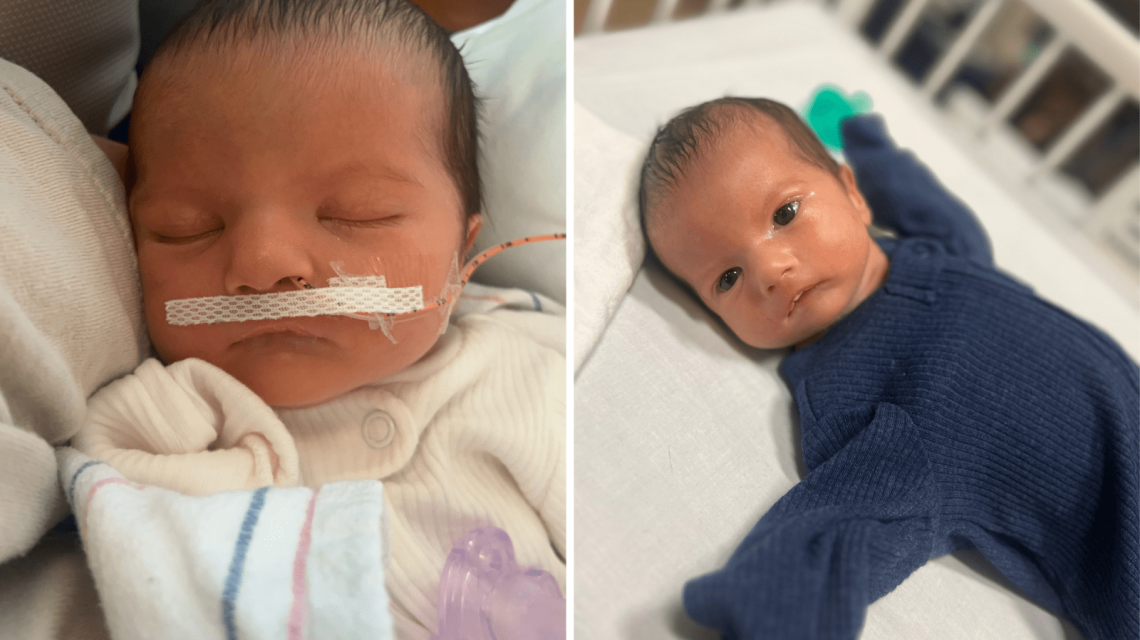
A mother from Indiana, Jeannie Hochstetler, has shared her experience about her toddler son who lives with a rare condition that results in a permanent “mask-like face.” This condition prevents him from forming facial expressions.
Hochstetler, 28, welcomed her first child, Riley, on January 29, 2025, following a textbook pregnancy. She noted that the only unusual sign was her smaller-than-expected stomach, which she assumed meant she would have a small baby—a common occurrence.
After Riley was born without crying, doctors quickly took him to provide respiratory support. „I remember the doctor examining him intensively. Looking back, I realize he suspected something was wrong but could not pinpoint it,” Hochstetler recalled.
Riley was transferred to the NICU, where further evaluations revealed some distinctive features, including small, webbed hands and an absent right pectoral muscle. Doctors could not open his mouth sufficiently for feeding, requiring a CPAP and an NG tube. Despite these measures, his condition remained unidentified.
Poland-Moebius Syndrome Diagnosis
After weeks in the NICU, a doctor speculated Riley might have Poland-Moebius Syndrome. This rare congenital condition results in facial paralysis and undeveloped chest muscles. Faced with this complex syndrome, Riley was moved to a larger NICU.
Hochstetler described the emotional weight of seeing Riley transported to another hospital. He was officially diagnosed with Poland-Moebius Syndrome at three weeks old. Moebius Syndrome affects about one in 50,000 births, causing underdevelopment of facial nerves, leading to difficulties in expressions, eye movements, speech, and swallowing.
Associated with Poland Syndrome, those affected may have missing or underdeveloped chest muscles. For Hochstetler, learning of her son’s condition was overwhelming, filled with uncertainty.
She expressed: „Knowing Riley may never smile was heart-wrenching. I felt grief as this wasn’t the parenthood I envisioned for my baby.” Each case of Moebius varies, with Riley unable to blink, facing feeding challenges and delayed milestones.
With no cure, managing symptoms is essential. Riley, lacking his seventh cranial nerve, has facial movement and eye restrictions. Despite these, he adapts and conveys emotions differently.
Adaptations and Achievements
Riley uses a G-tube for feeding, but Hochstetler hopes to transition to oral feedings as his swallowing ability strengthens. At 13 months, Riley underwent surgeries for crossed eyes and problematic eyelashes. He has mild hearing loss in his left ear.
Despite challenges, Riley has a contagious laugh and uses his voice when displeased. Hochstetler adeptly deciphers his body language, understanding his feelings.
Riley’s condition is non-progressive, meaning it won’t deteriorate. With therapy, some improvements are already visible. Hochstetler commended his adaptability, noting that he devises ways to achieve tasks uniquely.
Awareness and Positivity
Documenting their journey on social media, Hochstetler hopes to increase awareness of Moebius Syndrome. Riley’s resilience and positivity have taught her a lot about strength, showing love can manifest in varied forms.
Reflecting on their journey, Hochstetler affirmed: „Riley is my greatest blessing, and I am grateful to be his mom, witnessing his happiness despite his challenges.”
If you have health concerns and seek expert advice, share your thoughts with Newsweek at [email protected], and your story might be featured.
 Understanding Inflammation: Myths and Facts
  Calm Parenting: Strategies to Manage Stress
  Trump’s Executive Order to Combat Mosquitoes and Ticks in D.C.
  Overcoming Weight Loss Challenges: Brain Health and GLP-1 Medications
  Supporting Children’s Mental Health at Home: Practical Steps for Parents
  Tragedy and Immigration: The Impact on a Family