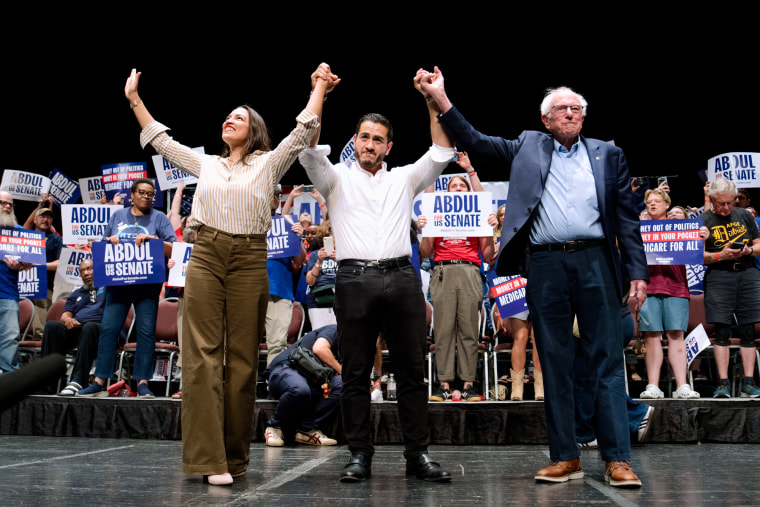
Abdul El-Sayed secured victory in Michigan’s contentious Democratic Senate primary, defeating Rep. Haley Stevens in a close contest. NBC News projects this result as a significant advancement for the progressive left in the Midwest this midterm cycle.
El-Sayed faced nearly $65 million in external funding aimed against him and an establishment support for Stevens, who was endorsed by popular Governor Gretchen Whitmer in a last-minute attempt to curtail El-Sayed’s rising influence.
As a former public health official, El-Sayed will contend in the November elections against former Rep. Mike Rogers, who won the Republican nomination without challenge. This race is anticipated to be highly competitive and may influence Senate control. The victor will replace Sen. Gary Peters, who chose not to run for a third term and had backed Stevens in the primary.
Republicans hold 53 Senate seats. Democrats aim to convert four Republican seats to take the majority, while defending seats in battleground states like Georgia and Michigan. Former President Donald Trump’s early endorsement helped Rogers secure the GOP primary. Republicans consider El-Sayed an easier opponent than Stevens, even producing a digital ad highlighting El-Sayed’s progressive stance and endorsement from Sen. Bernie Sanders.
Sanders and Rep. Alexandria Ocasio-Cortez supported El-Sayed in key Michigan campaigns. His initiative emphasized “Medicare for All,” criticized political funding, and targeted Stevens’ support for aid to Israel. This Democratic primary was a measure of whether a populist movement successful in blue states like New York and Colorado could thrive in Michigan’s diverse political landscape.
El-Sayed has accused Israel of committing genocide in Gaza, a stance resonant in Michigan due to its significant Muslim and Arab American communities. He also criticized Stevens for accepting corporate PAC money and benefiting from substantial financial support affiliated with the American Israel Public Affairs Committee (AIPAC).
Stevens and her allies spent significantly more on advertising than El-Sayed, with funds totaling about nine times higher, according to the ad-tracking firm AdImpact.
“If you need a $60 million crutch, you probably can’t be elected on your own terms,” El-Sayed remarked during a recent debate in Detroit.
Stevens, aligned with the Democratic establishment, received backing from figures like Whitmer, Peters, and Senate Minority Leader Chuck Schumer. El-Sayed gathered support from national left-wing figures and secured an endorsement from the United Auto Workers, a significant presence in the state due to its automotive industry.
An increasingly contentious primary concluded with state Sen. Mallory McMorrow’s exit last month. McMorrow endorsed El-Sayed, emphasizing party unity going forward. She noted the primary’s harsh nature but stressed its contrasts with the upcoming November race.
El-Sayed’s campaign benefited from notable enthusiasm, while Stevens leveraged ads and endorsements to project herself as the candidate keeping Michigan interests at the forefront.
Stevens criticized El-Sayed for focusing heavily on national issues rather than Michigan-specific matters. Her arguments were reinforced by Whitmer’s endorsement and a controversial call El-Sayed held with donors. The call, whose audio leaked, suggested his victory could influence future Democratic primaries.
Stevens addressed criticisms related to her Upper Midwest accent during a debate, emphasizing connection with constituents needing support.
El-Sayed maintained his focus on the message of politics serving the people over corporations and special interests.
 The Trump Team’s Challenge to the Military Leadership
  Maryland First State to Restrict Electronic Pricing in Grocery Stores
  Activists Push for Nationwide Ban on Child Marriage in the U.S.
  Democratic Hopes and Historical Warnings in 2026 Senate Race
  Republicans Face Challenges Amidst Cost of Living Concerns
  A Different Kind of Fall for Congress This Year