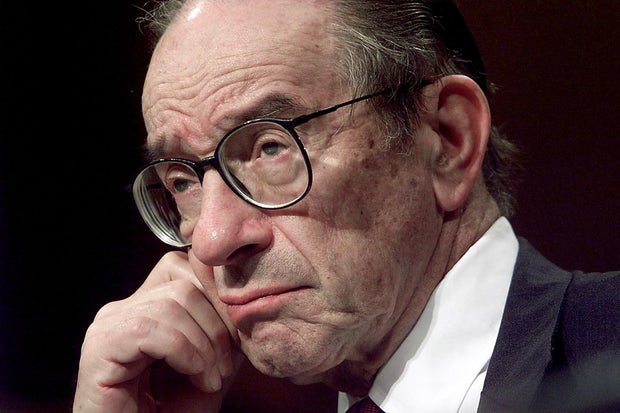
Alan Greenspan, a prominent economist and former chairman of the Federal Reserve, passed away on Monday at the age of 100. His wife, Andrea Mitchell, confirmed his death, citing complications from Parkinson’s Disease. Greenspan’s tenure as Fed chair, spanning four U.S. presidential administrations, left a significant mark on U.S. economic history.
His leadership coincided with the Great Moderation, a period noted for low inflation, stock market gains, and economic stability lasting from the mid-1980s to 2007. However, his tenure also witnessed several financial downturns, including the 1987 stock market crash and the dot-com bubble burst in the early 2000s. In 1996, Greenspan coined the term “irrational exuberance” to describe market bubbles driven by excessive investor optimism, notably during the internet stock craze.
Greenspan’s connection to the 2008 global financial crisis and subsequent Great Recession sparked controversy. Despite the downturn occurring after his retirement in 2006, some critics held his “loose money” policies partly responsible for the subprime mortgage crisis contributing to the largest U.S. economic downturn since the Great Depression.
“The main post-crisis criticism of Mr. Greenspan was that he was a naive believer in market efficiency, failing to pop bubbles in the late 1990s or mid-2000s and failing to regulate the financial sector properly,” according to a 2017 essay in The Economist.
Greenspan defended his pre-Recession policies, asserting in a 2007 interview with Fortune Magazine that he was misrepresented by “revisionist history” and maintained he had raised warnings about subprime mortgages.
Initially dismissing the impact of human behavior on economics, he later acknowledged its importance. “You can count that human beings will become euphoric on occasion, and in deep distress and fear. What you can count on is that will never change,” he told Fortune.
Known for cryptic economic comments that officials and investors often interpreted like clues, Greenspan also championed increased transparency at the Federal Reserve. In a 2009 oral history, he stated, “You don’t want to surprise the markets unless there is a purpose to it.”
Born on March 6, 1926, in New York City, Greenspan showed early mathematical aptitude. He pursued economics at New York University, earning multiple degrees. He worked at the National Industrial Conference Board and founded Townsend-Greenspan & Co., his economic consulting firm.
Greenspan was closely associated with Ayn Rand, attending her objectivist meetings during his studies. He held significant roles in government, serving as chairman of the President’s Council of Economic Advisers and on the Economic Policy Advisory Board. President Reagan appointed him Fed chair in 1987, and he retained the position under three subsequent presidents: George H.W. Bush, Bill Clinton, and George W. Bush. He retired in 2006.
Married to journalist Andrea Mitchell since 1997, Greenspan never received a direct request from a president to cut interest rates, though some hinted at it. “However, I will tell you… no politician ever called me up and asked me to raise interest rates,” he noted to Fortune wryly.
 Upcoming Congressional Elections: Key Districts to Watch
  President Trump’s Pre-Midterm Interview on Key Issues
  Trump’s 2024 Reelection and Evolving Voter Dynamics
  Defense Secretary Emerges as Key Player in the Trump Administration
  Hegseth’s Vision for the Military: Balancing Tradition and Innovation
  Significant Funding Boosts Ken Paxton’s Texas Senate Campaign Amid Tight Race