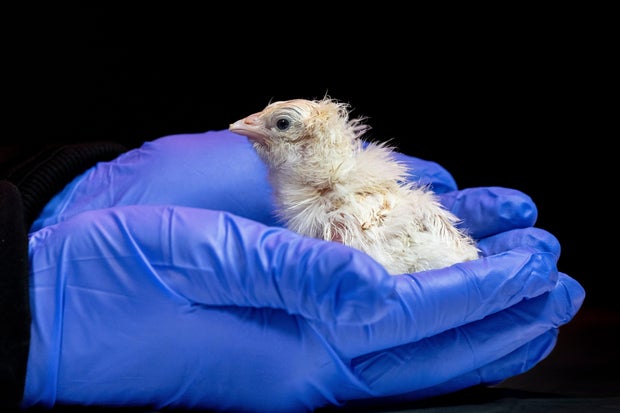
A biotech company announced it has successfully hatched live chicks using an artificial environment. This development, part of the company’s mission to bring extinct creatures back to life, has sparked mixed reactions among scientists.
Colossal Biosciences reported that 26 chicks, aged from a few days to several months, were born using a 3D-printed structure resembling an eggshell. Previously, Colossal had genetically modified animals to mimic extinct species, such as mice with woolly mammoth hair and wolf pups resembling dire wolves.
CEO Ben Lamm discussed scaling up this technology to genetically align living birds with New Zealand’s extinct South Island giant moa. Moa eggs are significantly larger than a chicken’s, which makes natural laying unfeasible. Lamm remarked, “We wanted to build something that nature has done a pretty good job of developing and make it better and scalable and even more efficient.”
“They might be able to use this technology to help them make a genetically modified bird, but that’s just a genetically modified bird. It’s not a moa,” explained evolutionary biologist Vincent Lynch at the University at Buffalo.
Colossal’s process involved introducing fertilized eggs into an artificial system with an incubator, supplemented with calcium and real-time embryo development imaging. The designed artificial shell allows oxygen ingress similar to real eggs. However, it lacks other essential components present in natural eggs, such as temporary supportive organs.
Nicola Hemmings from the University of Sheffield noted, “Producing a chick from an artificial vessel is not necessarily new.” This aligns with past research, which used simpler methods to create transparent eggshells from plastic, aiding avian developmental studies.
Colossal plans to eventually attempt moa resurrection using this technology. Prior to that, they must analyze ancient moa DNA and compare it with living birds’ genomes. Lamm emphasized starting with engineering challenges related to surrogate birthing ahead of the moa attempt.
Bioethicist Arthur Caplan from New York University raised concerns regarding the environment these resurrected creatures would inhabit, saying, “The big challenge is, what environment is this animal going to live in?”
Scientists like Hemmings argue conservation efforts are more viable for existing endangered species, through preserving reproductive cells. “My personal interests lie more in preserving what we’ve got than trying to bring back what is already gone,” Hemmings stated.
Colossal highlighted their artificial hatching platform’s importance, considering the decline in bird populations. They suggest it could aid in rescuing fragile embryos, assisting captive breeding-resistant birds, and potentially reviving species from frozen cells.
Colossal initiated plans in 2021 to revive the woolly mammoth, followed by the dodo bird. By 2024, they claimed a breakthrough with efforts to bring back the Tasmanian tiger. As stated in an interview, Jonathan Vigliotti compared the notion to science fiction, to which Lamm responded optimistically, underscoring the potential shift from fiction to reality.
 Trump’s 2024 Campaign Targets Young Men Through Cryptocurrency
  How Modern Windows Improve Home Insulation
  State Department Simplifies Passport Process with Online Applications
  Climate-Resistant Rock Glaciers: Hidden Water Resources
  California Voters to Decide on $7.5 Billion State Research Fund
  Senate Democrats Block Data Center Bill Over Efficiency Concerns