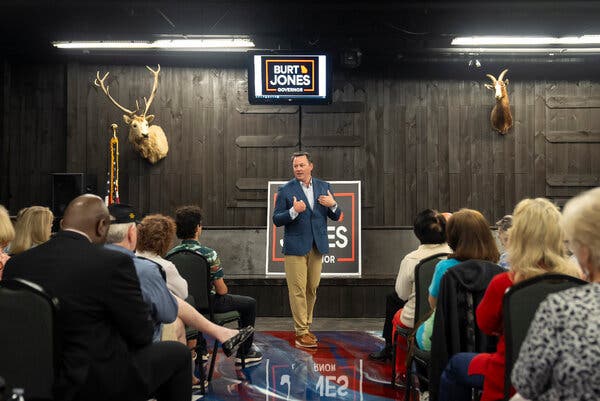
Burt Jones, a leading Republican contender in Georgia’s gubernatorial race, openly emphasizes his involvement in efforts to overturn the 2020 presidential election results. Jones, who played a key role in attempting to keep Donald J. Trump in office, proudly shares this aspect of his political history with voters.
While campaigning, Jones has highlighted his participation in the events following the 2020 election, telling a crowd at a gun store in suburban Atlanta, “You’ve got to think back to who was standing up — who was in the ditch, in the foxhole — with everybody when we were fighting in 2020.” This statement underlines his position as a staunch Trump supporter.
Recently, with backing from former President Trump, Jones emerged as the leading vote-getter in the first round of Georgia’s Republican primary for governor. His main opponent in the June 16 runoff is Rick Jackson, a pro-Trump billionaire known for his assertive demeanor.
Jones’s connection to the 2020 election dispute remains significant. Few state officials had as much influence during the efforts to maintain Trump’s presidency as Jones did. An examination by The New York Times of state and federal investigations provides insight into his activities during this period. The investigations utilized public documents and leaked discovery materials from an unsuccessful Georgia criminal case against Trump and his associates.
The documents reveal that in the weeks following the election, Jones, then a state senator, coordinated his efforts with the Trump campaign. He also had direct contact with Trump, who, during a 2020 rally, referred to Jones as “in my pocket.” These connections illustrate the depth of Jones’s involvement.
 The Trump Team’s Challenge to the Military Leadership
  Maryland First State to Restrict Electronic Pricing in Grocery Stores
  Activists Push for Nationwide Ban on Child Marriage in the U.S.
  Democratic Hopes and Historical Warnings in 2026 Senate Race
  Republicans Face Challenges Amidst Cost of Living Concerns
  A Different Kind of Fall for Congress This Year