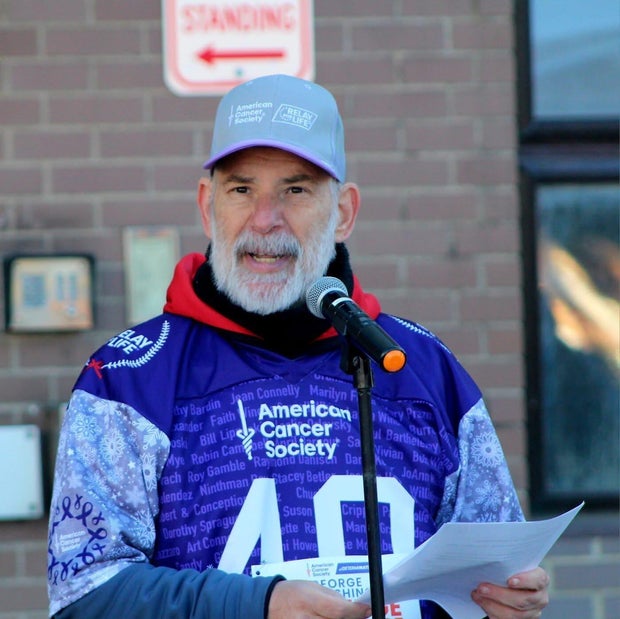
Joe Gillette, a New York resident, experienced a life-changing morning when his usual commute took an unexpected turn. The highway, now with an additional lane, brought a startling discovery. He observed double vision in one eye, suspecting it might be a residual effect of a recent COVID-19 infection. Concerned, he promptly scheduled a doctor’s appointment.
His physician recommended seeing an eye specialist and obtaining a brain scan. At the specialist’s office, Gillette learned about nerve damage in his right eye, which explained the double vision. Despite feeling he had an answer, his intuition urged him to pursue the brain scan.
On his 57th birthday, Gillette followed through on this instinct. While out with his wife, a notification appeared on his online patient portal. It revealed devastating news: Gillette had Stage IV kidney cancer with metastases in his kidney, lung, brain, and stomach.
“My wife was right next to me, and we’re reading it, it says ‘Cancer, tumor in the kidney, lung, brain and stomach,’” Gillette recounted. “It was the worst birthday present ever.”
His doctor confirmed widespread tumors, all originating from the kidney. Remarkably, he had shown no other symptoms until the onset of double vision. Gillette remarked, “If it wasn’t for COVID, I wouldn’t have caught it.”
Aggressive Treatment and Recovery
Dr. Martin Voss, his oncologist at Memorial Sloan Kettering Cancer Center, took charge of Gillette’s aggressive treatment plan. Stage IV kidney cancer has a grim prognosis, with less than 20% surviving five years according to the American Cancer Society. Gillette underwent immunotherapy, radiation, and complex brain surgery. Recovery demanded a 10-week medically induced coma.
Upon awakening, he was unaware of the time elapsed. Gillette remembers, “I woke up, tried to get out of bed to go to the men’s room, and the nurse said, ‘You can’t go to the men’s room.’” She informed him, “You’ve been here for two and a half months.”
Physical and occupational therapies aided his recovery. More radiation therapy followed, successfully shrinking the tumors. After two years of immunotherapy, which he tolerated well, Gillette underwent kidney tumor removal surgery in April 2024. Contrary to his fears of a prolonged recovery, he was discharged after three days.
Living with Gratitude
Currently, Gillette continues oral immunotherapy and has regular checkups. He visits Voss every six to eight weeks and undergoes routine MRIs and endoscopies. Although new growths appear occasionally, targeted treatments have maintained cancer control.
Dr. Alpa Patel of the American Cancer Society emphasized the importance of the evolving treatment options available to Gillette, observing, “He has responded to treatments that a decade ago didn’t exist.”
Gillette admits to scan-related anxiety but remains focused on the present. He cherishes family milestones and volunteers with the American Cancer Society. He remarks, “I’m grateful every day, not for what happened to me, but to have had that support and gotten through it.”
 Increased Funding Needed for Psychiatric Hospitals
  Trump Administration Distributes ACA Refund Checks
  Higher Consumption of Ultra-Processed Foods Linked to Increased Health Risks
  Understanding Inflammation: Myths and Facts
  Calm Parenting: Strategies to Manage Stress
  Trump’s Executive Order to Combat Mosquitoes and Ticks in D.C.